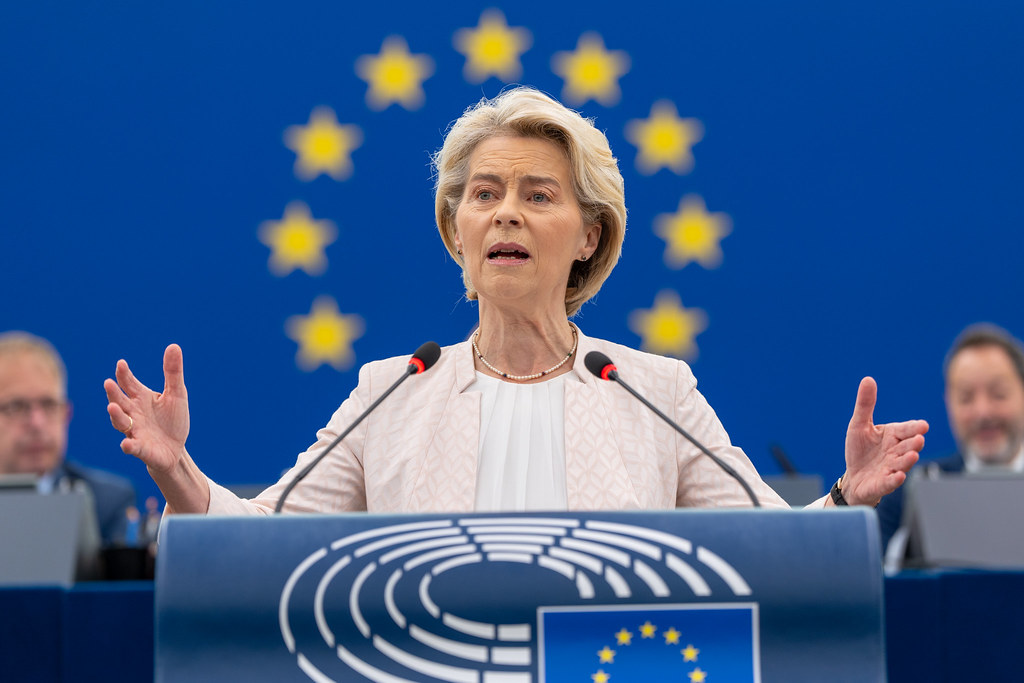
European Commission President Ursula von der Layen seemed more concerned with security and alliances than the lucrative trade deal just handed to Australia when addressing Parliament this week. Dr Lee Duffield, former ABC European Correspondent based in the "EU capital", Brussels, interprets the visit as Europe, in some strife, wanting help from allies and friends.
"Trust matters more than transactions", said President von der Layen in an address to the Australian Parliament on Tuesday 24 March. In the speech, Dr von der Leyen decried the degeneration of international relations where "great powers are using tariffs as leverage and supply chains as vulnerabilities”. Australia and the EU will be more resilient dealing with them by sticking together, she said, and will get “certainty … which people in the world are longing for”.
Europe, said the European President, which had been dependent on Russian resources, was hard hit by the Ukraine War now on its borders; also by “over-industrialisation” in China, where all EU states now had trade deficits with that country and this year the hard impacts of the Iran War. It was taking up a strategy of internal economic development and re-forging alliances, like the new set of agreements with Australia.
So the picture is of the third largest world economy as the main standard bearer for democratic rights and the rule of law, in a world increasingly dominated by geopolitical predators, determined to defend well and assert its own strengths. She issued a reminder that “distance is no longer a protection” — Australia was close to all of the centres of trouble.
Priority agreements: Allies with money
Dr von der Layen’s authority could be lost on Australians, for example the ABC type who introduced the parliamentary broadcast saying she handled “administration” for the 27-member bloc.
In truth, the European Commission is the executive body and she is chief executive. They propose policy, and implement it. They get it approved by two bodies, the European Council is made up of national ministers from member countries and the directly-elected European Parliament, which has strong powers such as approving the appointment of senior executives of the EU.
Therefore, the Commission President’s signature is a firm affirmation that the agreements being prioritised will be acted on and made to produce useful outcomes.
Those are:
- An agreement on defence co-operation, counter-terrorism and cyber security, focused on “stability, security and sovereignty.”
- Australia joining the Horizon EU Fund for research and innovation, for work on advanced computing, climate, clean energy, critical minerals and health.
- The Australia –EU Free Trade Agreement, eight years in the making, now successfully completed by Trade Minister Don Farrell and his EU counterparts.
Prime Minister Anthony Albanese told Parliament the deal would add $10 billion annually to the Australian economy, and move Europe from Australia’s third biggest trading partner to second, after China — displacing Japan and the United States in the order. EU modelling estimates an increase in Australia's GDP of up to $7.8 billion by 2030.
The gains would be mutual, flowing from the slashing of tariffs, which hamper exchanges and add costs to consumers. Under the deal, Australia will remove its 5% tariff on goods such as European cars, fashion clothing, and food and drinks, making them less expensive. Europe will let in many Australian products, including critical minerals (a point heavily emphasised by the EC President), manufactured items and certain agricultural goods, especially dairy products
Champagne and feta: What’s in a name?
A sticking point in negotiations had been regional naming and claiming of European products, such as parmesan, feta, champagne or prosecco. Several wine names were conceded by both sides long ago, such as champagne itself, and Europe forswearing any colonisation of names admittedly much less valuable on open markets, associated with varietals or regions in Australia, such as Rutherglen or McLaren Vale Shiraz. The settlement has compromises, but is very loose — a breakthrough, far away from the hard line rejection usually adopted by Europe previously against Australia.
Several named products, including parmesan and kransky will be alright to make in Australia.
Australian prosecco will now be permitted also, although not for export by Australia — the only concession ever made by Europe in regard to that name.
Australian produced feta cheese can be called feta, although it is “grandfathered”, limiting it to current producers. Consequently, it is expected to eventually go. (Feta made in Denmark, an EU member, is the only non-Greek feta recognised by Brussels, sanctioned to be made and exported.)
Trade Minister Don Farrell told the ABC that post-war European migrants had won the day on naming rights; he said he had used the argument that millions of people had brought their food cultures to Australia and made their own authentic products in their new home.
Opposition says it’s about meat
Another sticking point was Australian exports of red meat, where we saw reminders of the days of “buffalo diplomacy”, when Australian representatives would butt their heads against the tariff walls around “Fortress Europe”, when Australian representatives would butt their heads against the tariff walls around “Fortress Europe”.
In the last briefing I recall from Australian trade officials on beef, over 15 years ago, they said that even then they were no longer so worried about Europe, because they had expanding markets elsewhere. Not so much has changed in that outlook, with the Minister citing a tripling in the value of beef exports since the present Government came into office, to $18 billion a year. However, beef has stayed under a quota system, albeit restored to 35,000 tonnes per annum, after in recent years it had been reduced to 4,000 tonnes. Similarly, lamb went up significantly, from 6,000 to 25,000 tonnes.
Opposition Leader Angus Taylor and right-wing industry group the National Farmers Federation, cried out that it was not enough and set out to make the whole story about beef.
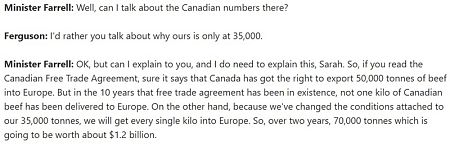
Conservative media outlets were naturally engaged and several other journalists got caught in the feeding frenzy. For example, ABC 7.30 host Sarah Ferguson, taking up the tonnages as the story, attempted an adversarial strike against Farrell, who had to insist on explaining. He pointed out that the large gains made would lead to actual sales, because of agreements he had got on “conditions” of trade and handling of the product. Where the interviewer had been given a figure of 50,000 tonnes allocated to the Canadians, he said neglect of the “conditions” meant they had not sold one kilogram.
Right wing has problems with the idea of Europe
Taylor’s intervention, apart from a few inaccuracies with the regional naming issue, had two problems commonly associated with Australian conservatives generally over the years.
The first problem was not really understanding what the European Union is, how important it is and how it works. The second related problem iconcerns them being married to England, where the British relationship is considered sufficient, or a good model for dealing with Europe. The terms of the Coalition brokered 2021 Australia – United Kingdom Free Trade Agreement, Taylor said, were far more generous towards Australia.
In the background, the British economy is different to Europe. It is more integrated with Australia in terms of enduring trade and, especially, financial relations. In agricultural production, the UK was Australia’s ally over all the years of campaigning against the protection of European farm goods with subsidies and tariffs — the now supplanted Common Agricultural Policy. UK farming had become more independent and viable, not requiring subsidies. For perspective, the UK has population of 70 million and GDP of $4.25 trillion equivalent; the EU has population of 450 million and GDP of $19 trillion. Does it make that much sense to directly compare them?
Too much beef about the beef?
So, in the present case, the Opposition are describing the deal as the “worst ever trade agreement” — because of the beef about the beef. The grazier lobby wanted Farrell to get 50,000 tonnes and 35,000 they said meant the entire arrangement covering many industries – of great interest to consumers and businesses – was no good. Very importantly, it was mentioned by this lobby that the EU, in all its dealings, wants to see sustainability; environmental policies regulating tree clearing and in relation to climate change — anathema to environmental holdouts. That was behind Angus Taylor’s contribution in the welcome to von der Layen, where he had two bob each way: he supported free trade agreements, but Australia “must not trade away its sovereignty”.
The other Opposition activity for the day was the campaign in Parliament to heat up anxiety about fuel supplies; no collaboration or co-operation with government in a crisis, that would discourage panic buying or find measured options for keeping up supply. Is it then a given, that politics this year is to be marked by adamant oppositionism — blaming and abuse of government in place of alternative policies?
An overall response to the serious and substantive business brought to Canberra by the President of the European Commission, on the part of the Australian Opposition, might have been greatly in the general public interest. Taylor did line up with Europe on such issues as formation of a group to try and reopen the Strait of Hormuz and joined in condemning the continued Russian invasion of Ukraine.
As for Europe, Australian conservative resistance to the European project is so long-standing and consistent it can make you wonder if it is not a misplaced Anglophile impulse harboured by descendants of British migrants, reliving old conflicts with France or Germany today forgotten even in England itself. It has been an undercurrent dragging on relations for a long time.
Amongst Dr Lee Duffield’s vast journalistic experience, he has served as ABC's European correspondent. He is also an esteemed academic and member of the editorial advisory board of Pacific Journalism Review, and an elected member of the University of Queensland Senate.
 This work is licensed under a Creative Commons Attribution-NonCommercial-NoDerivs 3.0 Australia License
Support independent journalism Subscribe to IA.


Related Articles