A timeline is not a delivery date, and a single shipyard carrying the weight of both a national deterrent and a trilateral alliance remains exactly what the title suggests: a single point of obsolescence, writes Professor Vince Hooper.
ANDY BURNHAM HAS BEEN PRIME MINISTER for ten days and has already discovered the one town in England that Whitehall cannot ignore.
On Thursday he travelled to Barrow-in-Furness, a Cumbrian settlement of fewer than 70,000 people that happens to be the only place in Britain capable of building a nuclear submarine. He announced £8.4 billion for the Dreadnought program.
He spoke of reindustrialisation, apprenticeships, and the dignity of skilled work. He told the shipyard workers that security is about who builds it, not only what we build. It was a sentence that could have been lifted from a mayoral stump speech in Salford, which is more or less where it came from.
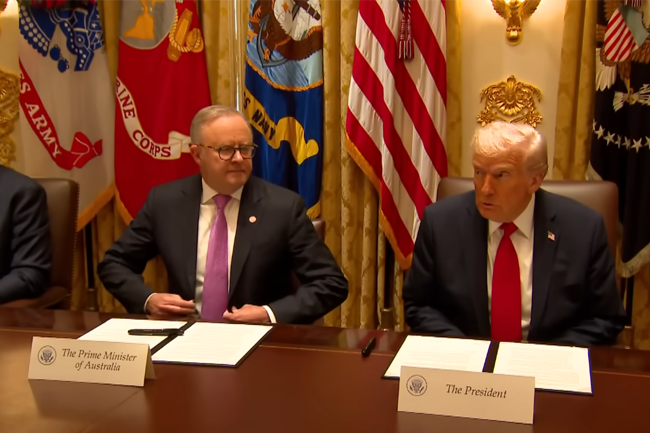
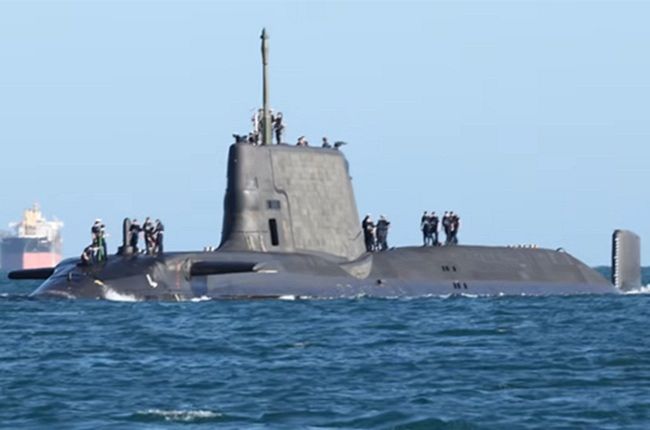
Australian readers may be forgiven for assuming this has nothing to do with them. It does. The money is for Dreadnought, Britain's nuclear deterrent, but the sheds it flows into are the same sheds that must deliver SSN-AUKUS, the attack submarines on which Australia's undersea future has been staked.
Every Dreadnought hull and every SSN-AUKUS hull must pass through the same facility, fitted by the same workforce, in a town that cannot currently house the workers it already has.
The UK Defence Committee warned in April that investment in upgrading Barrow had already slipped and that any further failure could delay SSN-AUKUS with serious consequences for credibility with AUKUS partners.
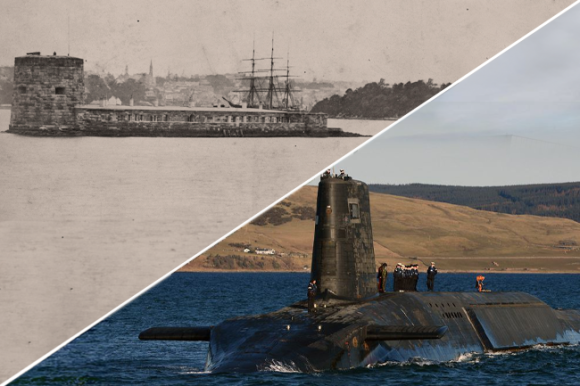
Lord Case, chairing the cross-government Team Barrow effort, conceded that the broader ecosystem, from housing and schools to transport and healthcare, was not keeping pace. The ambition is one boat every eighteen months. The most recent Astute-class boats have each taken more than a decade from keel to commissioning. One trusts the PowerPoint is more optimistic than the precedent.
The £8.4 billion covers Delivery Phase 4: sea trials for HMS Dreadnought and construction milestones for HMS Valiant. It preserves the possibility of SSN-AUKUS steel being cut in 2027 without the yard falling into the kind of gap that turned the Astute programme into a thirteen-year crawl from keel to operational status.
BAE has achieved a forty per cent productivity increase at the yard over three years, which is impressive until you remember that two submarine programmes are now competing for the same finite pool of welders, engineers and shed space.
The productivity gains occurred inside what economists would politely call a monopoly supplier. Apply a Herfindahl-Hirschman index to British submarine construction and you arrive at 10,000, the theoretical maximum. In any other sector that number would trigger an antitrust inquiry. In Barrow it triggers a prime ministerial visit. There is no second yard.
For Canberra, the risk compounds across the Atlantic. A July 2026 GAO report found that at least thirty-seven per cent of the U.S. Navy's fast-attack submarine fleet is in maintenance at any given time. American Virginia-class production runs at 1.1 to 1.2 hulls per year; the AUKUS plan requires 2.33.
The U.S. Navy has told Congress it will not reach even two hulls annually before 2032. Under the National Defence Authorisation Act, the President cannot legally sell a nuclear-powered submarine to a foreign partner unless he certifies to Congress that the transaction will not degrade domestic undersea capabilities.
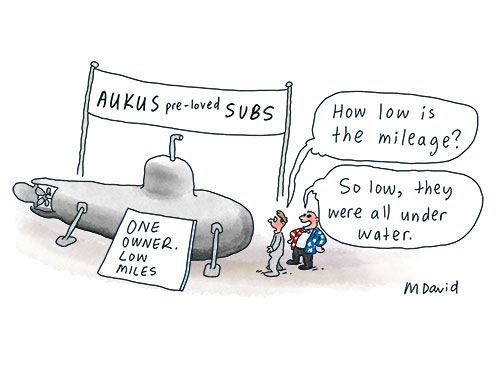
Australia is counting on three to five Virginia-class boats from the early 2030s as a bridge while it waits for SSN-AUKUS to arrive. If Washington cannot build enough hulls to satisfy its own fleet, the certification becomes politically impossible and the bridge collapses before it carries a single boat south.
On the British side, the Defence Committee heard in December that four of six commissioned Astute-class hulls were at low readiness; by late June, Navy Lookout reported that none was at sea. None.
The capability gap between Collins-class retirement and SSN-AUKUS delivery is not a scheduling inconvenience. It is a window in which Australia could find itself without a credible undersea force, which is an unusual position for a country that has just committed the largest defence expenditure in its history to acquiring one.
The political choreography is worth reading as closely as the engineering. Burnham has installed John Healey, the defence secretary who resigned in June over Starmer's failure to fund the department, as Chancellor of the Exchequer, placing the man who quit over the defence budget in charge of the national finances, which is either poetic justice or an exceptionally dry joke.
He has given Defence to Wes Streeting, a right-flank Labourite who has affirmed the inherited commitment to three per cent of GDP on defence by the next parliament, and made Ed Miliband, until last month the energy secretary, his Foreign Secretary, the post from which Britain's end of the AUKUS relationship is diplomatically managed.
Miliband's previous experience of trilateral partnerships was largely confined to climate summits. The £8.4 billion itself was already committed under the Defence Investment Plan, and sits above a £4.7 billion shortfall in the broader £298 billion spending envelope that Burnham must find in his first budget.
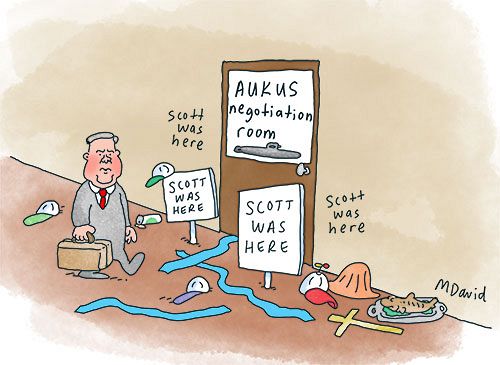
Today's announcement repackaged existing commitments inside a jobs narrative tailored for a prime minister whose political capital is northern, industrial, and built on a decade of telling Westminster it does not understand the provinces.
Burnham is Britain's sixth prime minister in a decade, as he himself acknowledged in his first speech from Downing Street. A multi-decade submarine programme passing through that many hands is its own kind of risk. It helps that Burnham voted for Trident renewal in 2016 when Jeremy Corbyn voted against. This is not a man who wandered into submarine policy for a photograph.
As signalling, the visit works. As reassurance that AUKUS remains on track, it falls rather short.
The Defence Investment Plan reconfirmed up to twelve SSN-AUKUS boats inside a £63.6 billion nuclear ring-fence, but attached no programme cost. That omission speaks volumes in a language Canberra understands fluently.
Pillar 2 of the partnership (hypersonics, AI-enabled undersea surveillance, autonomous undersea vehicles) is advancing more quietly and with less industrial risk, but it is Pillar 1's submarines that define whether AUKUS is a programme or a slogan. There is an uncomfortable irony in that division. Australia's first SSN-AUKUS boat is not expected until the early 2040s, a platform being designed today for a battlespace nearly two decades away.
The very Pillar 2 technologies the partnership is developing (autonomous detection, seabed sensor networks, AI-enabled surveillance) could reshape undersea warfare before the first hull enters service, making crewed submarines less decisive than the programme assumes.
The UK Government plans to cut steel on its first SSN-AUKUS boat at Barrow next year, a timeline that will reassure some in Canberra if it holds.
But a timeline is not a delivery date, and a single shipyard carrying the weight of both a national deterrent and a trilateral alliance, while the ocean it is building for changes around it, remains exactly what the title suggests: a single point of obsolescence.
Professor Vince Hooper is a proud Australian-British citizen and professor of finance and discipline head at SP Jain School of Global Management with campuses in London, Dubai, Mumbai, Singapore and Sydney.
 This work is licensed under a Creative Commons Attribution-NonCommercial-NoDerivs 3.0 Australia License
Support independent journalism Subscribe to IA.


Related Articles
- Independent AUKUS Inquiry ramps up pressure on Labor
- Labor's progressive patriotism collides with AUKUS
- From Crimea to AUKUS: How distant wars reshape Australia
- AUKUS Public Inquiry lays bare a pact built on false promises
- AUKUS Inquiry must welcome every side of the debate