To shape the national conversation, the AUKUS Inquiry must be seen as open, balanced and willing to test every argument, writes Dr James Beattie.
AS SOMEONE who is strongly opposed to AUKUS, I welcome the public Inquiry into the pact.
Two public hearings have already been held – in Melbourne and in Fremantle – and the next is scheduled for Adelaide on 16 July 2026, with a dedicated hearing for Indigenous Australians on 17 July, also in Adelaide.
However, I would like to sound a note of caution about how the Inquiry proceeds and how it is framed publicly, to maximise any impact it might have on the Government, the Opposition and the Australian public at large.
Under the Royal Commissions Act 1902, the Prime Minister and Federal Cabinet have the power to initiate all federal royal commissions, and the Governor General then formally establishes such inquiries on their advice. The terms of reference of royal commissions are also decided by the PM and Cabinet, and can thus be biased by including or excluding particular issues from the terms of reference.
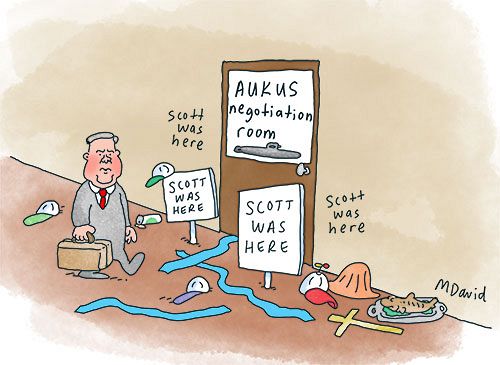
The Government also decides who will conduct the commission, and how much time the commissioners will have to collect, read, listen to, reflect on, synthesise and report on the matter at hand. If they are sufficiently Machiavellian or politically naïve, they can almost determine the outcome of the commission from the start, even while trying to project an image of fair-minded “objectivity”.
This is why the announcement of many royal commissions is greeted with cynicism and their findings regarded with scepticism.
But anyone can hold a public inquiry into any topic. They can raise funds, call for submissions, appoint commissioners, hold hearings and produce reports. Such inquiries may try to transcend the often politically motivated royal commissions that are routinely called for in Australian politics, or they may just aim to provide a public space where participants can let off steam because their voices are not being heard against the roar of consensus among the dominant political parties of the day.
These are not the only options. But I think the AUKUS Inquiry risks falling between the parallel stools of the politically motivated royal commission model – which amounts to the performance of listening – and the well-meaning but hermetically sealed grievance-fest, the performance of being heard.
Given this, the Inquiry’s commissioners and their media advisors will need to work extremely hard to gain any credibility with or participation from members of the public or interest groups who have more complex or ambivalent views about the pact, or who frankly support it.
For me, this would not be a bad thing. The AUKUS songsheet has been passed around from the Coalition to Labor to One Nation and back again, and it’s now so tattered and worn from overuse that I’d be very happy never to hear another note from it again. But if the only members of the public who make a submission are just dog-earing a different, dissenting hymnal, the Inquiry’s final report may fall on deaf journalistic and political ears, and will lend itself to easy dismissal and derision.
All five of the Inquiry’s commissioners have expressed either frank opposition to AUKUS or serious concerns about it. They are not sitting on the fence. Perhaps their choice was deliberate: if the panel had included one or two commissioners who were genuinely undecided about the deal's pros and cons or actively supportive of it, this might have discouraged some anti-AUKUS members of the public from participating, for fear that their views would not be taken seriously.
But given that the Inquiry is already underway, this is idle speculation. More important is how the commissioners now conduct the remainder of the Inquiry as it unfolds.
The Inquiry’s terms of reference give us modest reason for hope. They frame the issues in a way that doesn’t give the appearance of a pre-determined outcome. However, unlike a royal commission, this Inquiry does not have the authority to compel anyone to appear before it. I understand that the Inquiry’s organisers have made strenuous attempts to bring a diversity of voices into the room.
Still, so far, it seems former Defence Minister Linda Reynolds is the only serious AUKUS supporter who has fronted the Inquiry. I trust the organisers will continue to work hard at bringing a diverse range of voices into the mix.
In particular, it is essential that figures such as Prime Minister Anthony Albanese, Defence Minister Richard Marles, Foreign Affairs Minister Penny Wong and Opposition leader Angus Taylor be pursued repeatedly to front a public hearing.
So far, most of the questioning of AUKUS has come either from the Greens, or from international relations and defence experts, or from seasoned journalists who have a largely ritualised approach to interviewing politicians, shuttling between Dorothy Dixers and gotchas, and sometimes not being sure which strategy they should be pursuing at any given moment.
I think it would enhance the credibility of the Inquiry considerably if it were to publicly invite such politicians and other opinion leaders to attend and respond to some of the concerns and questions raised by members of the public and by the commissioners.
There can be no harm in formally and openly pressing some of the key architects and advocates of the pact to appear — they are clearly affected by AUKUS, and some have staked their political careers and reputations on it. If they choose not to show up, then this itself would be important to include in the Inquiry’s report and press releases.
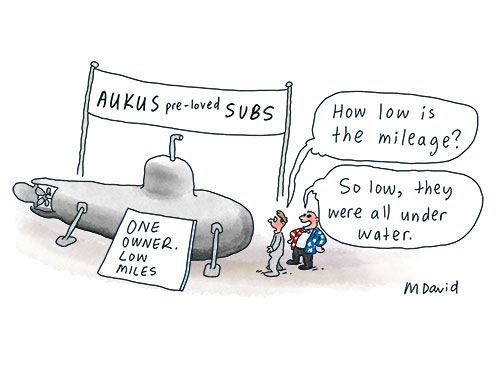
Similarly, inviting experts with extensive security and international relations knowledge and experience to explain or respond to questions could enhance the standing of the Inquiry. I understand that at least one such expert, Hugh White, is expected to appear in the Canberra hearing. I hope the inquiry secretariat also tries to ensure that Sam Roggeveen appears in the Sydney hearing.
These experts are certainly not card-carrying doves on defence and national security. But they have very sophisticated and well-reasoned ways of considering the merits and pitfalls of the submarine deal. The public airing and interrogation of their views will enhance the Inquiry’s credibility and ultimate recommendations considerably, and bring a valuable counterweight to the opinions of AUKUS enthusiasts such as Jennifer Parker, whose views tend to dominate mainstream media coverage of AUKUS.
Ever since Scott Morrison sprang the AUKUS pact on an unsuspecting Coalition Government, Labor Party and general public, I’ve been listening carefully for convincing pro-AUKUS arguments in the assertions of politicians, defence experts and security boffins, but have so far come away empty-eared. As an old-school philosopher, there are few intellectual pleasures greater than learning you’ve been wrong about an important issue — discovering you’ve missed a vital piece of information, or made a fundamental reasoning error.
Of course, I have other values that sit alongside the truth, and AUKUS doesn’t rest easily with any of them.
But are there any AUKUS advocates who think they have that secret missing piece of information, or who can decisively debunk the security and defence experts who have argued extensively and persuasively against the pact? And can they also make a convincing case for the moral, political and economic value of AUKUS? If so, I urge them to make a submission. Please explain why I should change my mind.
Dr James Beattie is a philosopher and writer with a long career as a broadcast journalist-producer with the ABC (1970s to 1990s).
 This work is licensed under a Creative Commons Attribution-NonCommercial-NoDerivs 3.0 Australia License
Support independent journalism Subscribe to IA.


Related Articles
- AUKUS: Australia's $368 billion boondoggle
- Investigating the foolish: The AUKUS Public Inquiry is announced
- AUKUS: Australia gets what America can spare
- Australia didn't vote for this war, but it's fighting it anyway
- AUKUS ties nuclear anchor around Australia's neck