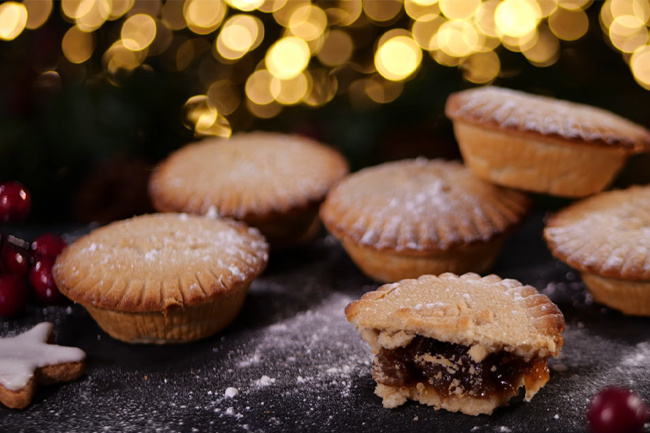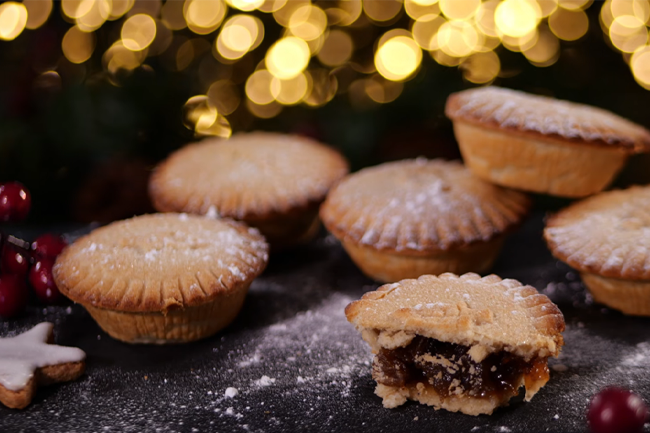
From medieval feasts and religious outrage to murder accusations and American nightmares, the humble Christmas mince pie has a surprisingly colourful and controversial past, writes Wayne Hawkins.
A tray at a time
At this time of year, our bakery in Claremont turns out all sorts of Christmas treats and fruit mince pies are one of them. Tray after tray, every day, until the last customer walks out on Christmas Eve.
After more than 25 years of making them, I realised I'd never asked the obvious question: Why are we eating little pastry cases of dried fruit, spice and often a splash of brandy every December? And why is it called “mince” when there's no meat in it?
The answer, it turns out, involves crusading knights, furious Puritans, a dead sailor and a U.S. president with a 50-pound pie. Grab a cuppa. This is the story of what you're about to eat.
It really was meat
The mince pie started life as exactly what its name says: minced meat in a pie. Food historians trace it to medieval England, where knights returning from the Crusades brought home Eastern spices and a taste for mixing sweet with savoury.
A recipe written on a scroll around 1390 calls them “tartes of flesh”. Not quite the label we'd put on the counter. Early versions were huge, shared pies stuffed with game birds, hare, offal, dried fruit, saffron and spice. The pastry was a thick case, a “coffin”, built to protect the filling in the oven. It may not have been meant for eating at all.
Over the centuries, the meat shrank and the fruit took over. By the 1800s, most recipes had dropped the meat but kept the beef suet. Alcohol joined in, too. By the 18th Century, brandy and other spirits had largely replaced wine and vinegar as the preservative, so mince meat could be made weeks ahead and kept in the larder. A splash of brandy, rum or sherry is still a common addition today.
The suet has mostly gone the way of the meat. Modern mince meat usually swaps beef fat for vegetable fat or leaves it out entirely, which means most mince pies on the shelf are now vegetarian. The medieval meat pie has well and truly left the building.
Idolatry in a crust
By the 1600s, the mince pie was tied to Christmas and that put it in the crosshairs. To the Puritans, Christmas was a Catholic invention dressed up in pagan clothes, an excuse for drinking, gambling and general misrule. The pie was guilty by association.
Some versions were baked oblong, said to represent the manger, sometimes with a pastry baby Jesus on top. Its spices were linked to the three gifts of the Magi. A 1656 poem by Robert Fletcher mocked the Puritan view of the pie as ‘idolatrie in crust’. Across the Atlantic, Plymouth governor William Bradford stamped out Christmas revelry. In 1659, Massachusetts fined anyone caught celebrating Christmas five shillings and the law stayed until 1681.
Then there's the story every baker has heard: that Oliver Cromwell banned mince pies and the law is technically still on the books. It's a myth. Cromwell's Parliament cracked down on Christmas feasting, but historians find no law naming the mince pie. So you can enjoy one on Christmas Day without fear of arrest.
The pie that gave America nightmares
Here's the part that surprised me most. Long before “as American as apple pie”, the mince pie was America's pie. It was eaten year-round across the country and hailed in newspapers as a national institution.
It was also blamed for almost everything. In 1886 the Topeka Citizen called it ‘the most reliable nightmare-hatcher ever invented’. Papers of the era blamed it for indigestion, hallucinations, disordered thinking and even death.
In 1888, the Pittsburgh Press reported a sailor killed by mince pie, apparently from eating too much of it. One man's lawyer used the pie to explain why he had murdered his wife. A 1908 headline claimed mince pie caused as much crime as drink.
Not everyone wanted the nightmares cured. When someone promoted a “sanitary” nightmare-free pie, The Chamberist scoffed that the weird dreams were half the attraction. Meanwhile, the pie stayed on the presidential table. In 1909, President Taft's holiday feast included a 50-pound mince pie.
Then there was the booze. Commercial mince meat was heavily laced with brandy. In 1919, the Chicago Tribune tested an average commercial mince pie and found it was over 14 per cent alcohol, roughly the strength of a fortified wine. Temperance campaigners preached against it and once Prohibition arrived, canned mincemeat became a handy way to sneak a drink past the law.
Then, after the 1940s, it largely vanished from American tables. Apple pie took its crown and few Americans today have ever tasted mincemeat.
Back to the oven
So the next time you bite into a mince pie, you're eating 600 years of history. It has been a medieval meat feast, a Puritan scandal, an American national dish and an alleged cause of murder. Now it's a sweet, fruity two-bite treat.
What strikes me is how much our food carries without us noticing. The things we eat at Christmas aren't random. Each one is shaped by war, trade, religion, politics and moral panic, and each has outlived the people who tried to ban it or blame it.
There's an old English custom: eat a mince pie on each of the 12 days of Christmas and you'll have 12 happy months ahead. I can't promise it works. But I can promise there'll be a fresh tray on the counter every morning until Christmas Eve. Nightmares not included.
-Wayne Hawkins is a product of public schools who dropped out before earning any significant degree. His real political education came later, from more than 25 years of running businesses locally and overseas, seeing inequality up close and turning to history to understand how it got that way.
 This work is licensed under a Creative Commons Attribution-NonCommercial-NoDerivs 3.0 Australia License
Support independent journalism Subscribe to IA.