Trump’s unpredictable trade policies expose Australia’s dependence on the U.S. and the need for greater economic independence and stronger climate leadership. Professor Vince Hooper writes.
DONALD TRUMP’S decision to post footage of a man’s death at an English wildlife park is grotesque.
It is also, inadvertently, a lesson in negotiation that Canberra should take seriously.
There is a line everyone believes Winston Churchill said in May 1940: “You cannot reason with a tiger when your head is in its mouth.” Gary Oldman roars it at Lord Halifax in Darkest Hour, and it has since migrated to mugs, memes and management seminars.
There is no reliable record of Churchill saying it. The line appears to belong to screenwriter Anthony McCarten, whose script scatters Churchillian references, not always in the right context.
What Churchill did say, on 28 May 1940, as Halifax pressed the War Cabinet to explore terms through Mussolini, was recorded by the Labour Minister Hugh Dalton:
‘If this long island story of ours is to end at last, let it end only when each of us lies choking in his own blood upon the ground.’
The film’s tiger is apocryphal. Its logic is not. And this week it acquired an unwelcome topicality.
Saturday in Doncaster
On Saturday 10 October, a man died after entering the Amur tiger enclosure at Yorkshire Wildlife Park, near Doncaster. Footage spread within hours, and South Yorkshire Police asked the public not to share it.
On Tuesday, the family of William Chapman described a ‘bright, warm and engaging young man’ who had suffered significant mental illness over several years, urging people to stop sharing the footage.
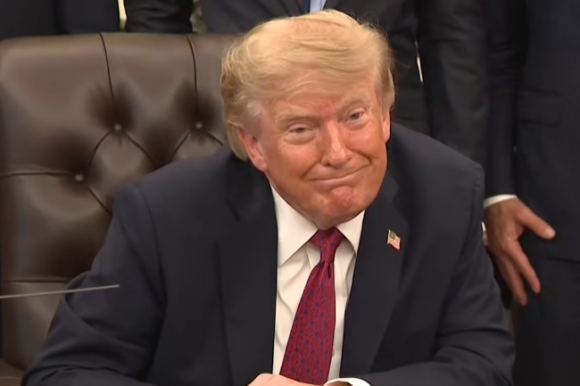
The same day, the President of the United States posted the video to Truth Social with the caption ‘Don’t ever mess with nature! President DJT’. He followed it with a compilation of big cats attacking people, some of which appeared to be AI-generated.
I want to be careful here. A vulnerable young man is dead and a family is grieving. He is not a metaphor and nothing that follows is about him. The tiger did what tigers do. The person who chose to turn a stranger’s final moments into a moral fable for millions of followers, after police had asked the public not to share it, did so deliberately. He is the most powerful negotiator on Earth and the post tells us something about how he negotiates.
The tiger as a negotiating posture
Trump’s method, across tariffs, alliances and wars, is to put the counterparty’s head in the mouth first and open talks second.
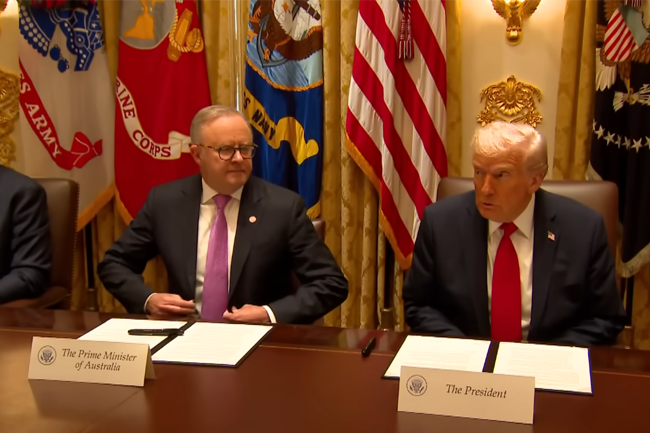
Australia knows the drill. In July, the Administration raised the tariff on Australian goods from ten to 12.5 per cent, citing forced labour concerns, placing us alongside dozens of other economies. In August, Prime Minister Anthony Albanese used a “warm and productive” call to ask the President to consider a full exemption, or at the very least no increase. Trump agreed to consider it.
That is what reasoning with the tiger looks like, and Churchill’s real argument in May 1940 explains why it so rarely works.
Halifax believed that asking Mussolini what terms might be available would do little harm. Churchill saw that the asking was itself the concession. Once a cabinet is seen seeking terms, it cannot easily return to defiance. The other side has learned how much pressure it takes to make you blink and it sets every future demand accordingly.
The same applies to a trading nation that answers each new tariff with a polite request for relief. Every request teaches Washington that the tariff works.
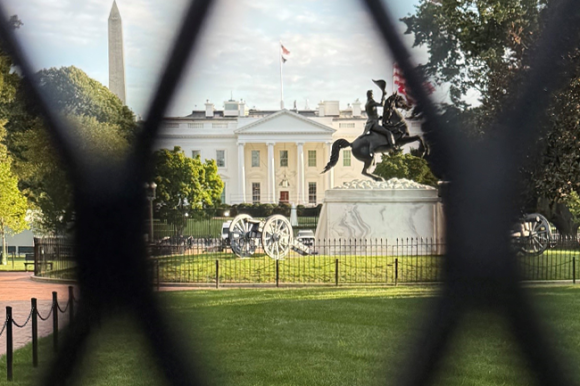
There is a second trap. When the same government imposes the penalty and offers the relief, the relief is not protection. It is the penalty with a different label, revocable on a whim.
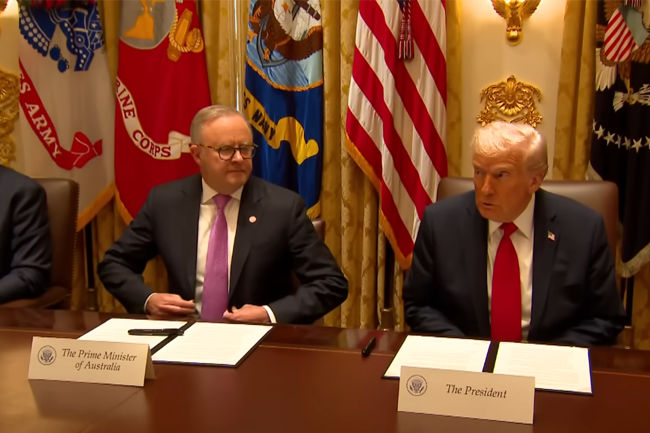
Australia has already tested this. At the White House in October 2025, Albanese signed a critical minerals framework built around a US$8.5 billion (AU$12.2 billion) project pipeline, and Washington announced Australian purchases of Anduril underwater drones and Apache helicopters alongside it. Nine months later, the tariff on Australian goods went up anyway.
Whatever Canberra offers next, whether more minerals, more AUKUS money or more hardware, it is paying for relief from a risk the other side can recreate the following week.
The third problem is dependence. Australia’s ultimate security guarantee has one supplier and a counterparty that knows you have nowhere else to go has little reason to bargain. The sensible answer is not a warmer phone call, but a patient widening of options. And Canberra has already shown it can be done.
In March, after eight years of talks, Australia concluded a free trade agreement with the European Union under which 98 per cent of current Australian exports by value will enter the EU duty-free, alongside a new security and defence partnership. The deal still has to be ratified on both sides. Finishing that job, rather than polishing the next appeal to Washington, is where the effort belongs.
None of this is anti-American. It is simply what any prudent nation does when it leans too heavily on a single, unpredictable friend.
And unpredictability is the point. The danger of a tiger is not its ordinary behaviour. Most days, a well-kept tiger sleeps. The danger lies in the rare day it does not and the only useful question is how bad that day could be. A warm call one week; a caption over a dead man’s final moments the next. Planning for the ordinary day is how you end up on the wrong side of the fence.
The second negotiation: Antalya
Next month, Australia leads a very different negotiation. Under the compromise struck at COP30, Türkiye hosts COP31 in Antalya while Australia, through Minister for Energy and Climate Change Chris Bowen, serves as president of negotiations with ‘exclusive authority in relation to the negotiations’.
Ankara has since reminded everyone that it retains the final decision on the summit’s outcome, though under the agreement the drafting and deal-making are meant to be Canberra’s.
The United States will not be at the table. Its withdrawal from the Paris Agreement took effect on 27 January, and it is also leaving the UN climate convention itself, making Antalya the second summit without American representation.
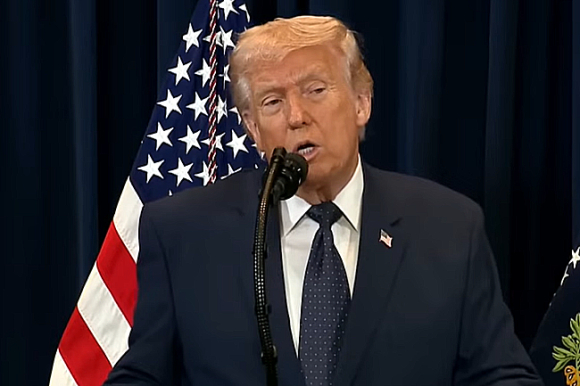
Here the irony of Tuesday’s caption becomes almost too neat. ‘Don’t ever mess with nature’ is sound advice. It comes from a leader who walked out of the central agreement in which the world tries, imperfectly, not to mess with nature.
In Antalya, the tiger is real and it does not negotiate. The atmosphere does not read Truth Social or grant tariff exemptions. Climate is the purest case of Churchill’s logic: once your head is in the mouth, reasoning is over. The only negotiation that works is the one that happens before anyone climbs the fence and it should be shaped by the worst plausible outcome rather than the comfortable central forecast.
Bowen’s task is to get nations to bargain with each other about staying out of the enclosure, without the largest historical emitter in the room.
The test will be fossil fuels. Last year’s summit in Belém ended without an explicit commitment to move away from them, leaving only a voluntary roadmap offered by Brazil. Türkiye’s Environment Minister Murat Kurum has said that simply telling nations to phase out fossil fuels is not realistic.
Bowen has promised to press producing countries for a meaningful step forward, but has said little about the roadmap itself and both co-hosts are pursuing fossil fuel expansion at home. If Australia wants to lead the room in Antalya, it will first need to show it has taken its own head out of the mouth.
The fence, not the tiger
Back in Doncaster, the park was evacuated, the police asked for restraint and a family began to grieve. Most people obliged. The tiger had no say in any of it. Every meaningful choice was human: how we keep people and dangerous animals apart, which the investigation will examine, how we care for unwell people, what we choose to film and to share.
The line McCarten gave Churchill survives because it is half true. You cannot reason with a tiger once your head is in its mouth. The other half is the part that matters for policy: you can decide where to put your head.
Australia has two negotiations in the coming months. In one, it is asking a tiger for clemency. In the other, it is trying to keep the world on the right side of the fence. Canberra should be clear-eyed about which is which and should spend far less effort on the first than on the second.
Professor Vince Hooper is a proud Australian-British citizen and professor of finance and discipline head at SP Jain School of Global Management with campuses in London, Dubai, Mumbai, Singapore and Sydney.
 This work is licensed under a Creative Commons Attribution-NonCommercial-NoDerivs 3.0 Australia License
Support independent journalism Subscribe to IA.


Related Articles
- JEFF MCMULLEN: American angst
- Trump’s lies should be the headline
- Trump accelerates AI race as industry leaders urge caution
- Trump-Xi talks unlikely to meet a world in crisis
- CHRIS HEDGES: Trump’s assault on the midterms threatens American democracy