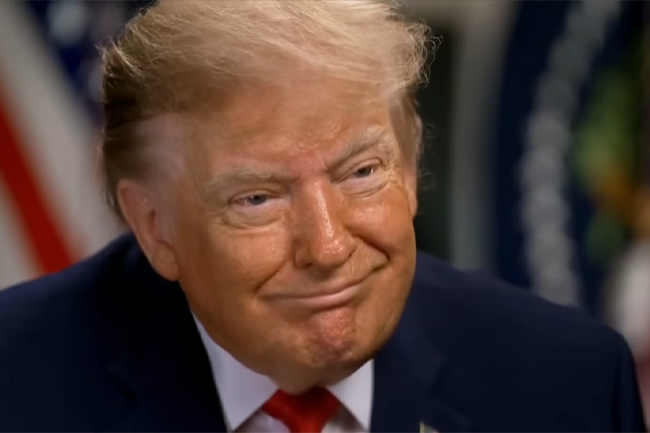
Trump's midterm defeat may have shifted the balance of power in Washington, but Australia remains exposed to the economic fallout of America's political turmoil, writes Professor Vince Hooper.
ON MELBOURNE CUP DAY, the Reserve Bank (RBA) lifted rates and American voters clipped Donald Trump's wings.
Both results land in Australia, but Canberra has not yet worked out what has changed and what has not.
On Tuesday 3 November, two contests were settled within hours of each other. At Flemington, the race that stops the nation was run. In Martin Place, the Reserve Bank board voted six to three to lift the cash rate to 4.85%, its highest level since November 2008 and the fifth rise of the year.
By the time Australians woke on Wednesday, American voters had handed the Democrats both chambers of Congress, flipping Senate seats in North Carolina, South Carolina, Ohio, Texas, Kansas, Iowa and Maine.
The two results share a common denominator: the price of fuel. The swing against Republicans was driven by a cost of living crisis blamed on fuel prices from Trump's war against Iran. Australians are paying for the same war at the bowser. Across the five largest cities, unleaded averaged about 233 cents a litre in early November, against about 164 cents in mid-February, before the first strikes. That is roughly 70 cents more on every litre, or around $35 more for a 50-litre tank.
That is awkward for a government that lent its voice to the war at the start. When the United States and Israel struck Iran in February, PM Anthony Albanese, Foreign Minister Penny Wong and Defence Minister Richard Marles issued a joint statement saying Australia ‘stood with the brave people of Iran’ and backed efforts to stop an Iranian bomb. Eight months on, Education Minister Jason Clare says Australians “didn't start the war but are copping it”.
Both statements are true. The second is the bill for the first.
Canberra's reaction to the midterms has been a study in managed calm. Marles insists nothing changes and that Australia must be the custodian of the alliance, whoever governs. Trade Minister Don Farrell called the result a vindication of the government's stand against tariffs and plans to tell U.S. Trade Representative Jamieson Greer that Americans have rejected them.
Nationals Senator Bridget McKenzie said that if Australia held midterms today, Albanese would suffer the same fate. Greens Senator David Shoebridge accused the Prime Minister of giving Trump a “bear hug” just as Americans were reaching for the barge pole.
All of them are partly right. None of them has quite grasped what has changed. The midterms alter the balance of power in Washington. They do not alter Australia's exposure to it.
What Congress can and cannot do
Start with what the new Congress can actually do. Democrats have won at least 254 House seats and 54 in the Senate, with a handful of races still being counted. That is well short of the two-thirds needed to override a veto and Trump has already said he will veto Democratic bills. The new Congress does not sit until January. The current funding bill expires on 11 December.
What Democrats have won is leverage over the war's funding, not control of the war itself. They can refuse to pay for it. Whether they will is another matter. Cutting money while American forces are deployed is the kind of threat oppositions make and rarely carry out. The 2006 precedent is instructive: Democrats swept Congress after an unpopular Middle Eastern war and then pulled their punches.
For Australia, the war's end is now more likely, not certain. A policy built on peace by Christmas is a policy built on hope.
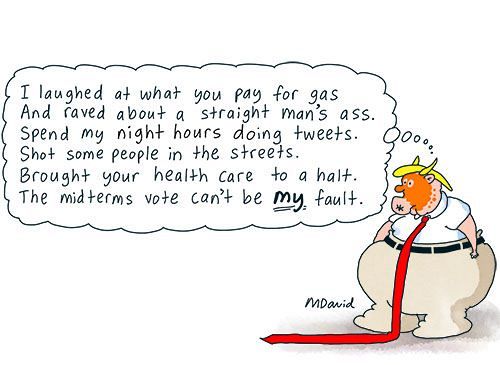
Blocked at home, busier abroad
Trump's presidency has a habit: block it in one place and it reappears in another. When the Supreme Court struck down his tariffs six to three in February, he signed a new executive order on different legal footing within days.
Expect the same now. Stalled in Congress, the Administration will lean harder on executive orders, emergency powers and foreign policy, the areas where a president needs no one's permission.
Australia's 12.5% tariff, imposed in July on the claim that Australia is lax on forced labour and in defiance of a free trade agreement that has run since 2005 and an American trade surplus with Australia, does not disappear because Hakeem Jeffries takes the Speaker's gavel. Farrell is right that tariffs hurt American consumers. But a message delivered to the President's own trade representative is a message delivered to the wrong address.
Cheaper oil, same war
Traders moved first. Brent crude fell almost 9% on Wednesday 4 November to around US$94 (AU$138) a barrel, its lowest since early September. The Australian dollar firmed as the greenback slid. Talk of petrol relief followed within hours.
Yet traders were betting on what Congress might do, not on anything that had happened in the Gulf. Washington confirmed limited strikes on Iran's Qeshm Island the day before the vote. Shipments through the Strait of Hormuz have recovered towards pre-war levels, but at a higher cost, and Qatar-mediated talks have yet to produce a deal.
A negotiated end has become more likely. The worst outcomes have not gone away. A President with two years left, no path through Congress and a Vice President who has publicly tied the defeat to the war has every reason to seek a decisive result abroad. RBA governor Michele Bullock has already warned that inflation is ‘pretty much baked in’ for the next year. Australian households should not bank a petrol windfall the Gulf has not yet delivered.
The AUKUS irony
The Greens have seized on the result to renew calls to scrap AUKUS and Dr Mark Beeson has argued that the money would be better spent at home. Whatever the merits of that case, the midterms do not strengthen it.
AUKUS's most reliable friends in Washington are Democrats. Joe Courtney co-chairs the Congressional Friends of Australia Caucus and is the senior Democrat on the House Seapower subcommittee, the panel that oversees submarine building. Tim Kaine has described support as strong and bipartisan and co-introduced the AUKUS Improvement Act.
Congress has put a record US$10 billion (AU$14.7 billion) into the submarine industrial base since 2018 and Australia has added US$3 billion (AU$4.4 billion) of its own. A Democratic Congress is more likely to protect that money than to cut it.
The real risk is not cancellation but neglect. American yards are building Virginia-class boats at about 1.1 to 1.2 a year against the 2.33 needed. If the next two years become a trench war between Congress and the White House over Iran funding, defence budgets become hostages to that fight.
The midterms do not change what Australia has paid for. They make it less certain that Washington can deliver it on time.
Three doors, not one
Australia sells 37% of its goods to China and 5% to the United States, while relying on Washington for its security. It is leaning heavily on two powers that are rivals with each other.
Beef shows what that means on the ground. The U.S.-China trade war opened China's market to Australian cattle producers, until Beijing's safeguard quota filled and a 55% over-quota tariff began forcing shipments elsewhere. Washington, meanwhile, left beef out of its July tariff, with American beef prices at record highs.
One of Australia's great export industries now rises and falls on two governments' quarrels with each other and Canberra has a vote in neither.
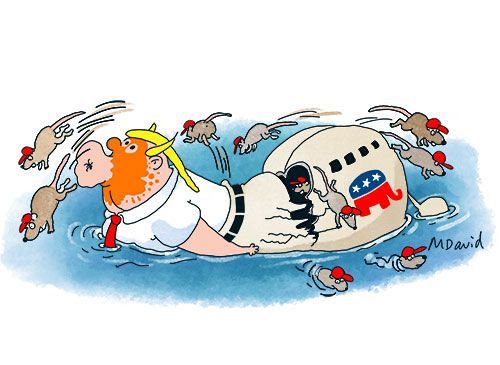
The midterms spread power in Washington across more hands. For Australia, this cuts both ways: more people to persuade, but no single figure who can deliver. Marles' custodian model assumes one door to knock on. From January, there will be three: the White House, Jeffries' House and Chuck Schumer's Senate.
That suggests four practical moves.
First, stop treating the alliance as a relationship with one man. The incoming chairs of the armed services, foreign affairs and trade committees matter as much as the selfie with the President.
Second, take the tariff case to Congress, which holds the constitutional power over trade.
Third, treat fuel security as national security. The lesson of 2026 is that Australia imports its petrol price from decisions made in Washington and Tehran.
Fourth – and this is the uncomfortable one – McKenzie's jibe lands. The anger that just cost Republicans both chambers is waiting here, with a cash rate at an 18-year high.
Copping it
At Flemington, the Cup was run and the crowd went home. In Washington, the contest has only just begun, and it will run for two years between a President who cannot legislate and a Congress that cannot override him.
Australia did not start the war, though its government applauded the first strikes. It did not vote on 3 November. On current settings, it will be copping the consequences of both.
Professor Vince Hooper is a proud Australian-British citizen and professor of finance and discipline head at SP Jain School of Global Management with campuses in London, Dubai, Mumbai, Singapore and Sydney.
 This work is licensed under a Creative Commons Attribution-NonCommercial-NoDerivs 3.0 Australia License
Support independent journalism Subscribe to IA.


Related Articles
- Trump's assault on International Criminal Court sparks global backlash
- U.S. election result is not normal because Trump’s MAGA is not normal
- JEFF MCMULLEN: Trump's midterm humiliation signals democratic correction
- CARTOONS: Trump feeling 'blue' after midterm mauling
- Trump's defeat won't end America's authoritarian threat