Labor's attempt to frame AUKUS as an expression of progressive patriotism raises difficult questions about ideology, consistency and Australia's defence priorities, writes Dr James Beattie.
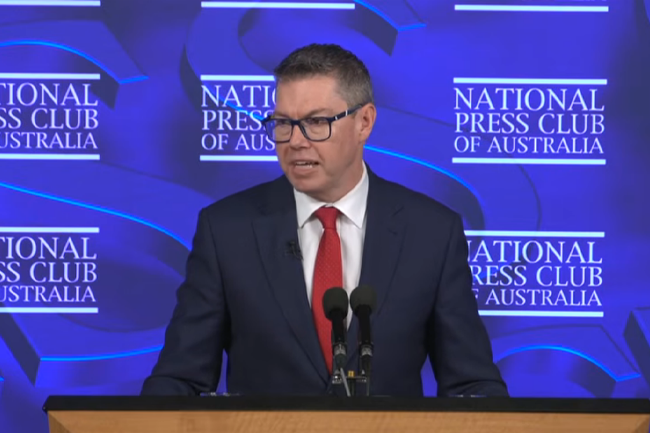
DEFENCE INDUSTRY Minister Pat Conroy sought to gain traction for the idea that AUKUS embodies “progressive patriotism” in his most recent National Press Club address.
Perhaps Conroy was trying to pour cold water on internal Party dissent and continuing public concern about the pact. Or perhaps, as I’ll discuss shortly, it was more about trying to distance Labor from Senator Pauline Hanson’s particular flavour of patriotism, but without sacrificing the rhetorical and emotional pull of the flag.
Even in his 2024 Press Club address, Minister Conroy had made a passing reference to defence as “a progressive thing”. But he – and Labor more generally – don’t seem to have been quizzed thoroughly about how Australia’s continuing marriage to AUKUS could accommodate a ménage à trois with progressivism. Let’s try to pick it apart here.
First, is the concept of progressive patriotism even coherent as a stable political position and do we need to bend progressivism beyond recognition to make the case that AUKUS is an instance of it?
Political progressivism, as most commonly understood, focuses on things like expanding the state’s provision of funding for health, education and welfare, redistributing wealth, advancing social equality, recognising the prior sovereignty of Indigenous peoples in both material and symbolic ways, and preferring multilateralism, internationalism, disarmament and international law.
While progressive governments may often be suspicious of militarism, arms build-ups and entanglements in great-power politics, they do not automatically opt for pacifism, pure political neutrality, or outright internationalism. Progressive forms of patriotism have a history that goes back at least as far as the 1940s, when George Orwell, a democratic socialist, and even Virginia Wolff, an avowed internationalist, had developed ideas that clearly shaped the idea that progressivism could be compatible with a form of patriotism.
A notable forerunner of Orwell in this respect was RH Tawney. Along the way to the ALP’s discovery of the concept, figures as diverse as British musician and left-wing activist Billy Bragg and former British Labour Prime Minister Gordon Brown have tried to thread the delicate needle of an ‘outward-looking and internationalist patriotism’, as Brown put it.
Some progressives insist that nations can and must both build strong military and defence capabilities and invest robustly in welfare initiatives, particularly in the current global context. But other progressives, such as the members of the International Union of Scientists, have pleaded against build-ups in military expenditure, turning the traditional Latin adage “If you want peace, prepare for war” upside down, saying, “Si vis pacem, para pacem”: “If you want peace, prepare for peace.”
Those with long memories will recall that the Labor Party has often been explicitly anti-war and arms-control-oriented. It was Labor that finalised the withdrawal of Australian troops from Vietnam in 1973 and shifted Australia away from a policy of “forward defence” to a policy of “continental defence”.
This shift was never fully realised. For example, Australia remained – and remains – firmly entrenched in the ANZUS Treaty. And the decades since that treaty was signed in 1951 have not thrown up a government of any persuasion that has been seriously committed to a strongly progressive stance on militarism, non-participation in U.S.-led wars and foreign invasions and genuine Australian autonomy in defence and military matters.
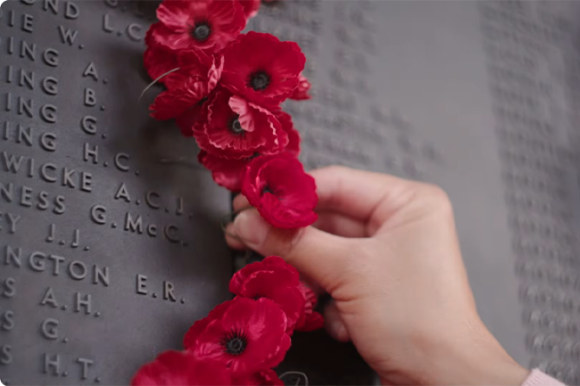
Moreover, although Australia is still a signatory to and staunch supporter of the 1970 Treaty on the Non-Proliferation of Nuclear Weapons, unlike New Zealand, we have never had the distinction of being suspended from ANZUS for taking a principled stance against the presence of nuclear weapons and nuclear-powered vessels in our sovereign territory. To this day, New Zealand remains partially suspended from ANZUS and shows no signs of changing its nuclear-free stance, even under the current conservative government.
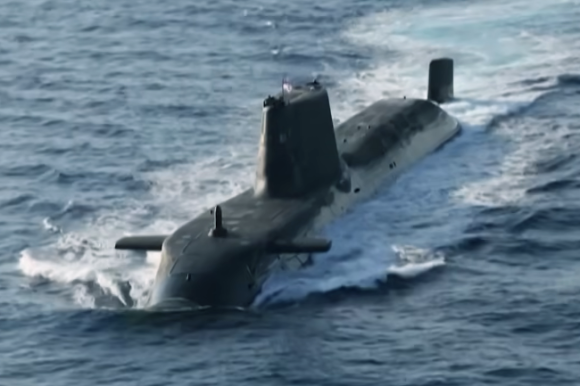
That sounds more like progressivism to me, as opposed to the ALP’s “full steam ahead” commitment to a nearly half-trillion-dollar nuclear submarine program that’s tied tightly to the U.S.’s strategic posture towards China. AUKUS explicitly involves Australian-owned nuclear-powered submarines being based in Australian territorial waters, with American nuclear-powered vessels also routinely using our military bases as part of our “sovereign” military capability.
Moreover, AUKUS does not require the Government to either confirm or deny that these vessels are carrying nuclear weapons.
Despite these challenges, Labor has made an apparently unshakeable commitment to AUKUS and is now making it the flagbearer for its form of progressive patriotism. But is this a tenable position?
First, exactly what particular conception of patriotism does Minister Conroy have in mind? Apart from branding it “progressive”, he doesn’t give any clear answer to this question. But he does try to distance Labor from One Nation, calling Pauline Hanson’s brand of patriotism “populist” as opposed to “progressive”.
However, this raises an apparently insurmountable problem for the party. If AUKUS exemplifies progressive patriotism, why do we find the Liberal Party and the National Party queuing up behind Labor to support the pact? One Nation, whose policy page doesn’t even have a policy on defence, has also openly joined the pro-AUKUS dance.
If we follow the logic of this conga line, it seems the Coalition and One Nation have now been outed as progressives. So, if Labor insists on sticking with AUKUS through thick and thin, and parading it as a centrepiece of its progressive patriotism, then it must also accept that Australia’s three most successful conservative parties are along for the ride as fellow progressive patriots.
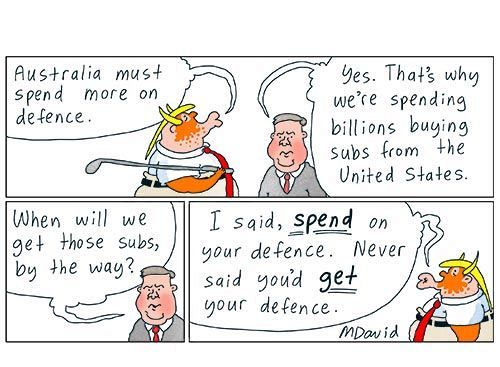
Either they all get the “progressive” jersey, or Labor has to pull back from the idea that AUKUS is somehow part of a progressive agenda – patriotic or otherwise. Or, in a burst of economic, moral and military sanity, the Government could always abandon AUKUS.
Minister Conroy could have swept this problem under the carpet by framing the Government’s commitment to progressive patriotism in terms of its more socially oriented, nation-building policies and commitments, leaving AUKUS quietly in the background in the hope that no one remembered it.
This would not have solved the logical tension that the conservatives’ support for AUKUS poses for Labor in its struggle to sound progressive. But it might have persuaded some into thinking there was a substantial distance between Labor’s progressively flavoured patriotism and Pauline Hanson’s self-description as “a patriot, and an unashamed nationalist”.
But if this had been their strategy, then a discussion of progressive patriotism would have been completely out of place in this press conference, and the Minister for Defence Industry would not have been its natural advocate. The Government is therefore making a strategic error in invoking progressive patriotism to underwrite AUKUS.
Tying the pact to progressivism of any kind is not likely to widen public support for it and, in striving for political “product differentiation”, Labor may simply be scoring an own goal.
If the Government’s promotion of the submarine deal as a form of progressive patriotism is allowed to slip smoothly into the already disorderly AUKUS discourse, what next? Perhaps the Prime Minister will take a leaf out of U.S. Secretary of War Pete Hegseth’s “Department of War” playbook and rename Australia’s Department of Defence the “Department of Peace”?
This may risk attracting a belated plagiarism lawsuit from George Orwell’s 1984 estate. But at least any companies purveying porcine lipstick will be in for a bonanza.
Dr James Beattie is a philosopher and writer with a long career as a broadcast journalist-producer with the ABC (1970s to 1990s).
 This work is licensed under a Creative Commons Attribution-NonCommercial-NoDerivs 3.0 Australia License
Support independent journalism Subscribe to IA.


Related Articles
- From Crimea to AUKUS: How distant wars reshape Australia
- AUKUS Public Inquiry lays bare a pact built on false promises
- AUKUS Inquiry must welcome every side of the debate
- AUKUS: Australia's $368 billion boondoggle
- Investigating the foolish: The AUKUS Public Inquiry is announced