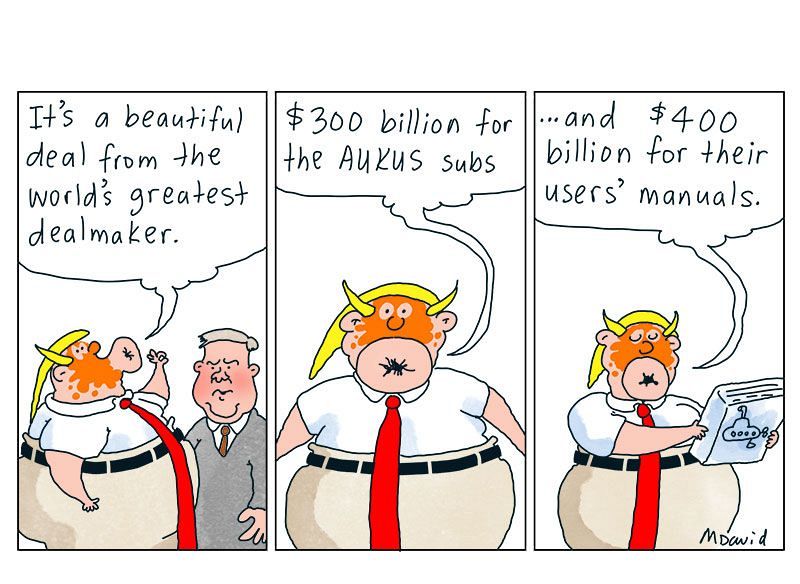
An independent AUKUS inquiry is raising fresh questions over the project's cost, purpose and Labor's reluctance to debate it, writes Dr John Jiggens.
THE AUKUS NUCLEAR submarine project is the most expensive government project ever undertaken by an Australian government, an enormously costly project that will seriously impact the Australian economy for decades.
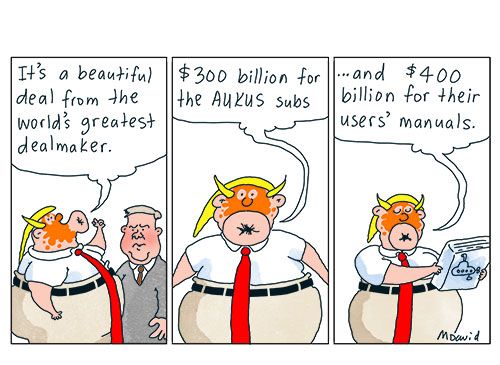
AUKUS is “estimated” to cost around $370 billion, but this mind-boggling guesstimate is itself illusory: AUKUS is a boondoggle, a wasteful, wildly expensive project that will keep increasing in cost as it feeds royally on Australian government funds over the next decades.
AUKUS is highly controversial: it was described by former Prime Minister Paul Keating as “the worst deal ever”. Former submariner and Senator Rex Patrick predicted that, “The AUKUS nuclear submarine project will bleed the Australian Defence Force white”.
Despite the astronomical debt the AUKUS nuclear submarine project will burden Australia with and the deep public unease about the desirability of nuclear submarines, there has never been a parliamentary Inquiry into AUKUS.
Our Parliament’s abject abdication of its financial responsibility for this potentially ginormous boondoggle motivated a coalition of former MPs, retired military and naval officers, strategists, academics, human rights lawyers and union leaders to organise an independent AUKUS Public Inquiry, under the auspices of the Australian Peace and Security Forum (APSF).
The inquiry secretariat is headed by retired Major General Michael Smith and retired Labor politician Doug Cameron.
Five commissioners for the Inquiry were appointed: lead commissioner is Peter Garrett, former Labor Minister and frontman for Midnight Oil; retired Admiral Chris Barrie, former chief of the Australian Defence Force; Carmen Lawrence, former Premier of Western Australia; Leanne Minshull, co-CEO of The Australia Institute; and Karina Lester, Indigenous leader and International Campaign to Abolish Nuclear Weapons (ICAN) ambassador, whose family were impacted by the 1950s British Nuclear tests in outback South Australia.
The AUKUS Public Inquiry launched on 2 June. The Inquiry has invited submissions on alternative defence strategies, and it has held public hearings about AUKUS in Melbourne and Fremantle. The next public hearing will be held in Adelaide on 16 July.
Annette Brownlie, the convener of the Independent and Peaceful Australia Network (IPAN), has been assisting the Inquiry.
She explained the reasoning behind the Public Inquiry:
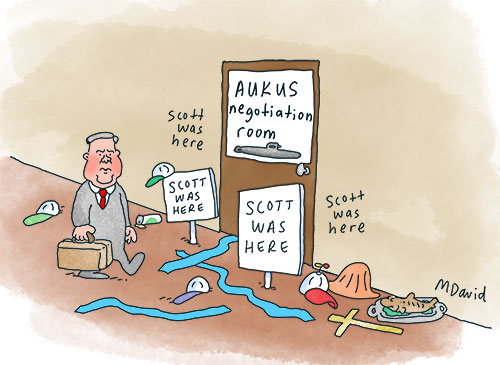
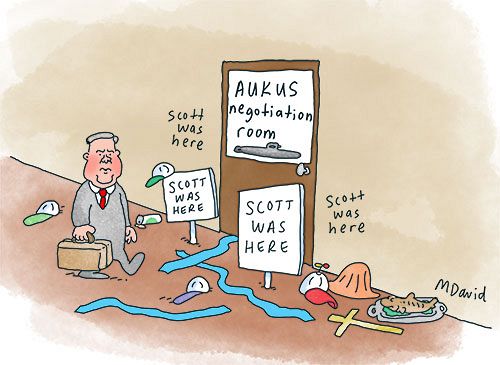
“AUKUS is a result of a secret deal that was made by the Scott Morrison Government and shrouded in secrecy. So, we need to have transparency and this Inquiry. The idea of the Inquiry is to ask questions: questions that have never been put to the Government or the people, never mind never been answered. So, we're looking for transparency.”
As the U.S.-Iran war has demonstrated, hosting U.S. bases could cause Australia to come under attack. At the Fremantle hearing of the Inquiry, former Liberal Defence Minister Linda Reynolds conceded that the Stirling Naval Base on Garden Island, just south of Fremantle, was a target in the event of a conflict with China.
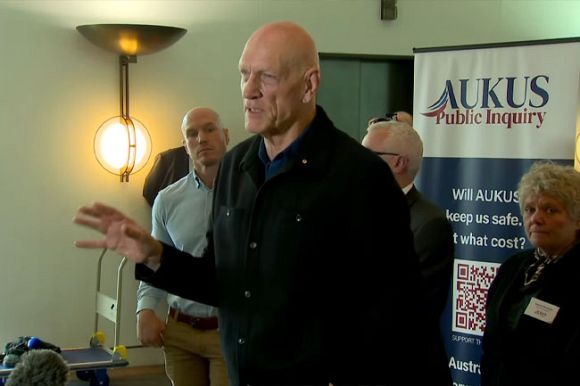
Brownlie said:
“Look at what's happened in the Middle East where United States bases in countries surrounding Iran have been the victims of targeting in response to the American and Israeli bombing of Iran. So, the bases here in Australia, the facilities that we're providing to them are in fact making us more at risk, more vulnerable and less secure.”
A flood of submissions has flowed into the Public Inquiry from across the country, around 450 in the first month.
According to Annette Brownlie, a theme that comes through many of the submissions is that AUKUS is about offence, not defence. AUKUS was seen as about signing Australia up for a U.S. war against China, providing a forward base for the United States to wage war.
In contrast, the Future Submarine project that AUKUS replaced had been based on a policy of Australian self-reliance in defence, of defending the Australian continent from invasion. It called for 12 conventional submarines to be built for $20 billion.
The deal Scott Morrison signed was for eight nuclear submarines for nearly $370 billion; a major change from the goal of an affordable and self-reliant force defending Australia, to the role of an auxiliary for the U.S. navy in an offensive war against China, Australia’s major trading partner.
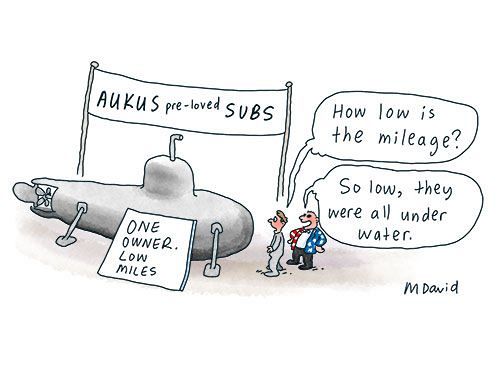
As Dr Michael Gilligan, the former Head of Force Development and Analysis Division for Australia’s Defence, told the Inquiry in Fremantle, the hideously expensive Virginia class submarines Scott Morrison signed up to purchase were specifically designed for a U.S. war with China, not for the defence of Australia.
Dr Gilligan said:
“The Virginia Class submarine is not a general-purpose submarine like our Collins class. It is designed for supreme acoustic invisibility for a specific purpose — to find and doggedly track underwater for months and be able to destroy submarines that pose a nuclear threat to the U.S. mainland.”
IPAN’s Annette Brownlie commented that many Inquiry submissions were concerned with building a self-reliant defence force for Australia:
“This question will be at the heart of the next IPAN conference, titled, ‘It's Time to Break Free from the United States’, which will be held between July 24-26 in Adelaide.”
The IPAN conference in Adelaide will be held at the same time as the triennial Labor Party conference.
Said Brownlie:
The Inquiry is meant to put pressure on the government of the day. There will be a fringe event at the Labor Party conference where AUKUS will be a featured issue.
We hope that it would put pressure on the current Labor Government, given that they have been so intransigent about questioning the AUKUS agreement to the point where they've really restricted debate within their own party.
IPAN’s hope is to stimulate a debate at the ALP conference about AUKUS to apply pressure on the leadership to not stymie debate and to tolerate free debate within their membership over this vital issue.
Dr John Jiggens is a writer and journalist currently working in the community newsroom at Bay-FM in Byron Bay.
 This work is licensed under a Creative Commons Attribution-NonCommercial-NoDerivs 3.0 Australia License
Support independent journalism Subscribe to IA.


Related Articles
- Labor's progressive patriotism collides with AUKUS
- From Crimea to AUKUS: How distant wars reshape Australia
- AUKUS Public Inquiry lays bare a pact built on false promises
- AUKUS Inquiry must welcome every side of the debate
- AUKUS: Australia's $368 billion boondoggle