As federal force meets organised resistance, Minneapolis becomes a defining moment in Trump’s presidency, writes Dr Norm Sanders.
IN EARLY DECEMBER 1941, Hitler’s army came within 20 kilometres of the Moscow city limits after rolling across much of Europe. German troops in Operation Barbarossa could see the spires of the Kremlin.
But the German army was unprepared for the extreme Russian winter and faced stiffening Soviet resistance. The Germans were forced to begin a bloody retreat, which marked the beginning of the end of the Nazi regime.
In early December 2025, U.S. President Donald Trump’s army rolled into snowy Minneapolis. Like Hitler, Trump thought his forces would soon take over the city. He didn’t count on the Minnesotan citizenry fighting back.
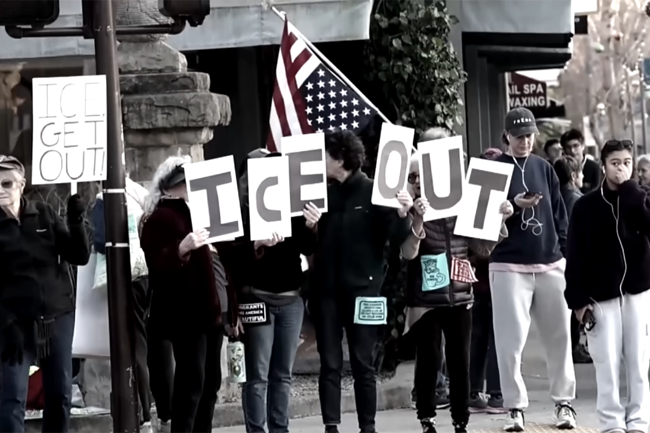
There were massive protests in the streets. Neighbourhoods organised into units to warn of Immigration and Customs Enforcement (I.C.E.) patrols in their areas. Citizens roamed the streets with whistles to raise the alarm when I.C.E. appeared anywhere in the city.
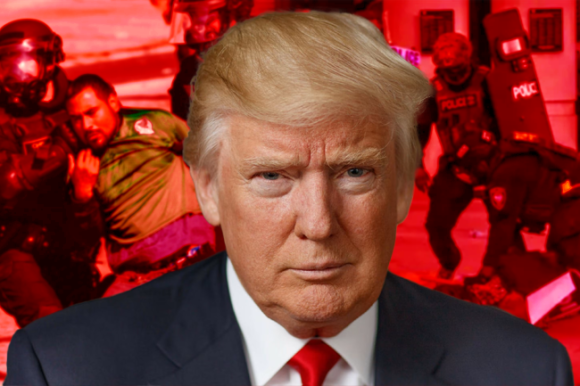
Renée Good was one of the concerned Minneapolis citizens. She was a mother of three who loved to sing and write poetry. Good had just dropped off her child at school and was stopped by I.C.E. officers. She tried to drive off but was murdered, shot in the face, by I.C.E. officer Johnathon Ross.
Trump’s minions jumped into the media. Homeland Security Secretary Kristi Noem said that Good was at fault for her own death, claiming she was engaged in “domestic terrorism”.
Widespread protests took place immediately. Several days later, Minneapolis Police Chief Brian O’Hara reported that at 9:03 A.M. local time Saturday, police received a call about a shooting involving federal enforcement officers.
PBS News reported:
The man, later identified as Alex Jeffrey Pretti, was believed to be a “lawful gun owner” with a firearm permit, O'Hara said. He added that Pretti's only known interactions with law enforcement had been for traffic tickets.
Videos taken by other civilians show the events leading up to Pretti's deadly encounter with federal agents. He's first seen filming the scene in the street. Whistles blare from nearby protesters. An agent shoves a demonstrator with a red backpack to the ground and is seen spraying a chemical agent in people's faces. Pretti, who uses one hand to protect himself from the spray and holds his phone in the other, moves to help a woman who was also affected.
More agents approach and pull Pretti back. There's a scuffle as Pretti appears to resist agents who pin him down and hit him repeatedly. At one point, at least one agent is heard saying Pretti has a gun. Soon after, an officer appears to remove a gun from a holster on Pretti. One agent fires a single shot before several more ring out.
Another agent soon began firing to join the original shooter. They pumped a total of ten bullets into the back of Pretti, who was lying motionless face down in the street.
Susan and Michael Pretti, Alex's parents, first learned of their son's death from an Associated Press reporter. The couple, who live in Colorado, released a statement saying their son was a “kindhearted soul who cared deeply for his family and friends”. The 37-year-old Minneapolis resident had worked as an ICU nurse at a Veterans Administration hospital in the city.

“Alex wanted to make a difference in this world. Unfortunately, he will not be with us to see his impact,” the statement read.
Pretti was born in Illinois and grew up in Green Bay, Wisconsin, where he was a Boy Scout, played high school football and baseball, and sang in a boys' choir. He was also an outdoorsman who took his dog, Joule, who recently died, everywhere he went, his mother told AP.
Trump World, predictably, tried to spin the sordid affair to their advantage. But Pretti was a problem for them. How could they paint a high school athlete, a choir boy and a dog lover as a terrorist? Undaunted, they rose to the challenge.
In the Department of Homeland Security’s first account of the incident, Assistant Secretary for Public Affairs Tricia McLaughlin said federal officers attempted to disarm the man. An agent, fearing for his life and the lives of the other officers, “fired defensive shots”.
The man had two magazines and no ID, McLaughlin said, suggesting “this looks like a situation where an individual wanted to do maximum damage and massacre law enforcement”.
Not to be outdone by a subordinate, DHS boss Noem called Pretti a “domestic terrorist”, adding:
“[Pretti] had a weapon on him, and multiple dozens of rounds of ammunition, wishing to inflict harm on these officers, coming, brandishing like that.”
Trump himself was more restrained. He stated that it was a “very unfortunate incident” and “terrible”, while simultaneously criticising Pretti for being armed. This turned out to be a very unfortunate statement for Trump. It prompted the ultra-right-wing National Rifle Association (NRA) to publicly criticise the President for the first time in history.
The NRA had spent millions in campaign donations, including to Trump, to preserve the unfettered right to carry firearms in America. Here was the President of the United States implying that Pretti was a terrorist because he carried a pistol. The MAGA base was splintering.
Meanwhile, a severe storm was battering the Eastern U.S. Snow was piling up and blocking roads. Millions of snowed-in Americans were watching TV for a diversion. What they saw was video after video of federal agents murdering Alex Pretti. There was no way for the Trump regime to spin its way out of this.

Tricia McLaughlin announced that the two federal agents who fired their guns during the fatal shooting of Alex Pretti had been placed on administrative leave, but not put under arrest for homicide.
The officers’ actions received widespread criticism from the law enforcement community. The people were more than critical; they were angry. Libertarians and staunch conservatives, Trump’s base, were speaking out. Sporting stars and cat lovers posted their disgust online.
Trump world was colliding with American core beliefs. For one thing, in a country where there are more guns than people, there are laws and then there are rules. It is illegal to shoot a person anywhere on the body. However, in the public mind, shooting someone in the back is looked upon as cowardly. Shooting someone like Renée Good in the face is not only considered cowardly, but also extremely brutal.
The response to the shootings was immediate and nationwide. One of the most significant of the reactions was in California. The state of California and its largest county, Los Angeles, banned law enforcement officers from covering their faces, putting local and state police at odds with masked immigration agents.
The state law gives law enforcement officers a choice: If they cover their faces, they lose the ability to assert “qualified immunity”, the doctrine that protects officers from individual liability for their actions. That means they can be sued for assault, battery, false imprisonment, false arrest or malicious prosecution. The law adds a clause that says the minimum penalty for committing those offences while wearing a mask is $10,000.
Protests are continuing and growing bigger all the time. The third “No Kings” nationwide protest is scheduled for 28 March. Ezra Levin, co-founder of Indivisible, one of the groups coordinating No Kings, said that he expected it to be “the biggest protest in American history”. He noted that the first line of the preamble to the U.S. Constitution is ‘We the People’.
The people of Minneapolis are not only protesting in the streets, but they are taking action by going on strike. Citywide strikes are not an everyday occurrence in the United States; to find a precedent for the Minneapolis strike, you have to go back almost a century, to the 1940s. But it happened on 23 January. School teachers and airport workers walked out. Government offices and call centres were effectively shut down. Businesses and public institutions closed across the city as their employees rallied in the streets.

The murders of Renee Good and Alex Pretti so moved musician Bruce Springsteen that he composed ‘Streets of Minneapolis’ within days of the killings. Springsteen is frequently described as one of the greatest American singers, songwriters and rock performers of all time.
Some of the lines in the song are:
A city aflame fought fire and ice
‘Neath an occupiers’s boots,
King Trump’s private army from the DHS,
Guns belted to their coats.
Also:
And there were bloody footprints
Where mercy should have stood,
and two left to die on the snow-filled streets,
Alex Pretti and Renee Good.
‘Streets of Minneapolis’ had 5 million hits on YouTube in the first 48 hours of its release.
Trump is wounded. His ego has taken a beating and his grip on Republican politicians is weakening. He has lost control of the narrative, but he still has cards to play — big ones. In his never-ending effort to keep the lid on his Epstein involvement, he is now massing what he calls his “Armada” in the Mediterranean to attack Iran.
In spite of his frantic and increasingly unhinged actions, Trump will never escape what he fears most: a place in history where he is rated as the worst president the U.S. has ever had.
Hitler had Moscow. Trump had Minneapolis.
Dr Norm Sanders is a former commercial pilot, flight instructor, university professor, Tasmanian State MP and Federal Senator.
 This work is licensed under a Creative Commons Attribution-NonCommercial-NoDerivs 3.0 Australia License
Support independent journalism Subscribe to IA.


Related Articles
- The braggart soldier returns: Trump on the grand stage of ego
- CARTOONS: Donald Trump is on thin I.C.E. with immigrants
- Mayhem is the point: Trump's politics of terror
- Trump's Art of the Greenland Deal
- Trump’s dementia destroys time-honoured global alliances