An unsettling new economic allegory argues modern workers have become the “Eloi” of a technofeudal system designed to extract wealth, time and security from the many, writes David Higginbottom.
IN 1895, HG Wells published The Time Machine, a speculative fable about a distant future where humanity had split into two distinct species.
On the surface lived the Eloi: beautiful, delicate and entirely passive creatures who spent their days eating fruit and playing in the sun. Below ground lived the Morlocks: brutish, subterranean mechanics who maintained the machinery that kept the surface world functioning, tending, with quiet efficiency, what amounted to the largest farm in human history. The crop was human.
For over a century, the story has been read as a straightforward Victorian warning about class division. The idle rich devolve into the Eloi; the toiling poor devolve into the Morlocks. But if we update the allegory for the 21st Century, a far more chilling interpretation emerges.
What if the Eloi are not the idle rich? What if they are us — the modern, exhausted, gig economy workforce? And what if the Morlocks are not the downtrodden workers, but the elite masters of a system of economic extraction?
The stolen promise of leisure
In 1930, the economist John Maynard Keynes famously predicted that within a century, technological advancement and productivity gains would be so immense that the primary challenge for humanity would be figuring out what to do with all our free time. He forecast a 15-hour work week.
Keynes was half right. The productivity gains he predicted were achieved and then some. We built the machines. We automated the factories. We digitised the world. Yet the 15-hour work week never arrived. Instead, we are working longer, harder and with less security than we have in decades.
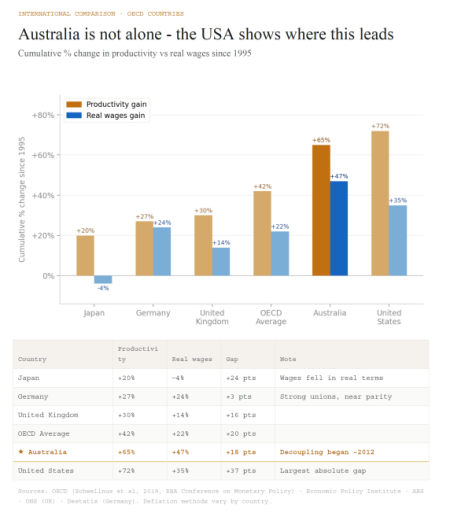
Why? Because starting in the 1970s, led by the U.S., a profound shift occurred in the global economy. For the first time since the Industrial Revolution, productivity and wages decoupled. The economy kept growing, workers kept producing more per hour, but their pay flatlined. The gains of that massive technological leap were captured almost entirely by capital.
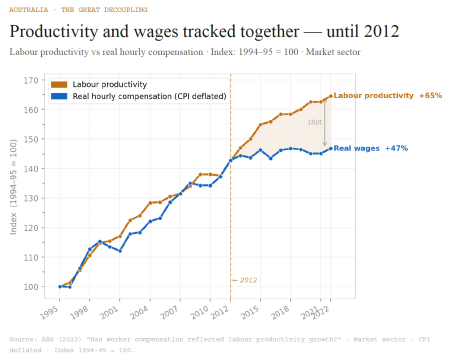
Australia managed to delay this reckoning. The Prices and Incomes Accord, centralised wage-setting and a strong union movement kept the productivity-wage link largely intact through the 1980s. But when Australia dismantled those institutions – deregulating the labour market, privatising public assets and embracing the Washington Consensus through the 1990s and 2000s – it joined the rest of the world on the same downward trajectory. The decoupling, when it came, was swift.
We became the Eloi. But unlike Wells' creatures, our passivity is not born of idle luxury. It is born of frantic, endless busyness that produces nothing we actually own.
We subsist on a diet of digital distraction and synthetic comforts, consumed between bouts of invisible labour. We are producers of vast amounts of data and attention, yet the platforms we power belong to someone else. We have not chosen this frantic existence; it has been engineered for us. We have lost the genuine leisure that allows humanity to flourish – the time to think, to organise, to live – because the productivity that should have bought that time was stolen.
The architects of extraction
If we are the Eloi, who are the Morlocks?
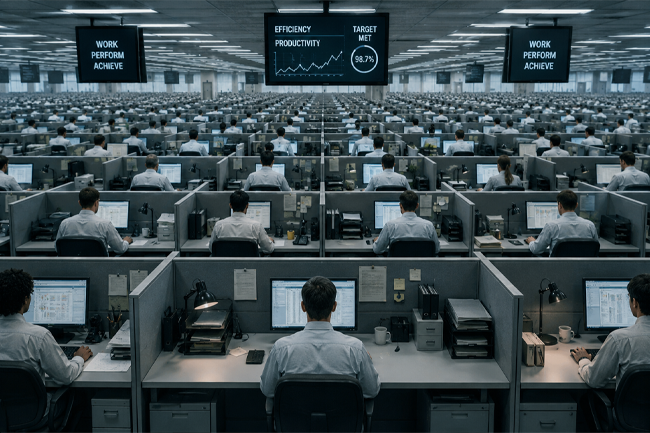
They are not brutish troglodytes. They are the architects of extraction. They operate in pristine, temperature-controlled server farms, in the boardrooms of the Big Four consulting firms and in the opaque networks of global tax havens. They are what the economist Yanis Varoufakis calls the masters of “technofeudalism”, platform owners who no longer rely on capitalist profit, but on “cloud rent”.
When you use Amazon, Google, or Facebook, you are performing unpaid labour. You are generating the data that trains their algorithms and targets their advertising. As Varoufakis notes, we have returned to the status of serfs, contributing to the wealth of a new ruling class with our unpaid digital labour, in addition to the waged labour we perform just to survive.
In Australia, this extraction takes the form of the “Game of Mates”, as detailed by economists Cameron Murray and Paul Frijters. It is the $11.6 billion in annual fossil fuel subsidies. It is the Transurban toll roads that lock taxpayers into decades of corporate rent-paying. It is the privatisation of public assets, in which profits are kept by the few and risks are socialised to the many.
The Morlocks do not produce value; they extract it. They are rent-seekers who have perfected the art of siphoning wealth from the public purse and the private citizen alike.
The machine is working exactly as designed
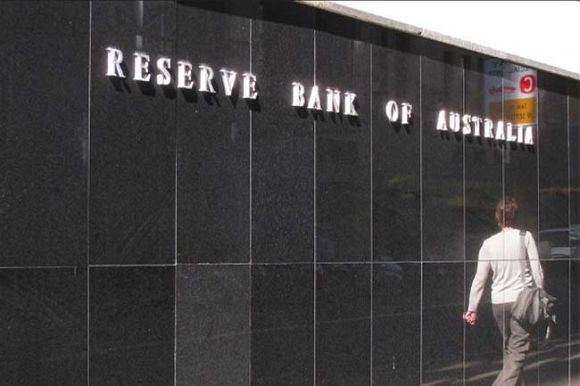
When the Reserve Bank of Australia raises interest rates to combat inflation caused by global supply shocks, it is not making a mistake. It is operating a macroeconomic machine – the neoclassical model – that is designed to protect the Morlocks at the expense of the Eloi.
As Thomas Piketty demonstrated in his landmark empirical work, the rate of return on capital historically exceeds the rate of economic growth (r > g). When central banks pump money into the financial system via quantitative easing, that money flows into assets — housing, shares, corporate bonds. The asset-owning class captures the gains, while wage-earners are left to deal with the resulting inflation.
And when that inflation hits, the neoclassical machine demands that the Eloi pay the price through higher interest rates and engineered unemployment.
We are paralysed by a system we are told is a hard science, a collective blindness to the slow erosion of our own economic security. Like the Eloi ignoring the nocturnal disappearances of their peers, we watch the hollowing out of the middle class, the casualisation of work, and the upward siphoning of our wealth, and we are told by the economists that this is simply how the machine works.
Reclaiming the future
The tragic fate of Wells' Eloi was that they had devolved beyond the point of return. Their intelligence and will to act had atrophied from disuse.
We are not there yet. But the warning stands. A society that allows the gains from its collective productivity to be monopolised by a few is a society on the path to ruin.
To change course, we must reject the neoclassical machine that justifies this extraction. We must look to alternative frameworks like Functional Finance and Modern Monetary Theory, which recognise that a sovereign government has the capacity to fund full employment, build public infrastructure and tax the rent-seekers out of existence.
As Dr Bronwyn Kelly has argued in these pages, the tools to build a genuinely public interest economy already exist. We must demand the leisure time that our productivity has already paid for.
The machines have arrived. The wealth has been generated. The only question remaining is whether we will continue to let the Morlocks harvest it, or whether we will finally claim it for ourselves.
David Higginbottom is a member of the coordinating committee of the Independent and Peaceful Australia Network (IPAN) and coordinator of the Make Peace A Priority campaign (mpap.au).
 This work is licensed under a Creative Commons Attribution-NonCommercial-NoDerivs 3.0 Australia License
Support independent journalism Subscribe to IA.


Related Articles
- Mateship for sale: The economic betrayal of working Australia
- Hastie’s break with neoliberalism puts business on notice
- Australian CEO pay scandal averted by PR spin and media churnalism
- Australia's economic future: The neoliberal lie
- Putting an end to neoliberalism