Trump’s fixation on Greenland reveals how ego, deal-making bravado and hard-power geopolitics are reshaping U.S. foreign policy, writes Dr Norm Sanders.
U.S. PRESIDENT Donald J Trump’s frantic efforts to keep Jeffrey Epstein off the front pages have hit new highs. First, he became the self-crowned King of Venezuela. Now he wants to take over Greenland “to protect it from China and Russia”.
But what if any media diversion from Epstein is merely a bonus, a side show to the main event?
Trump’s actions are always unpredictable and seem haphazard. However, there is one constant: his massive ego.
Like all ageing dictators, Trump fears losing his fame and power when he dies. It has been ever thus, from the Pharaohs with their mummies and tombs to the White House ballroom. A ballroom is nice, but a massive ego requires an equally massive place in history.
U.S. Secretary of State William Seward paid US$7.2 million (AU$10.4 million) to the Russians in 1867 for Alaska. Trump’s ego is driving him to go into the history books as the man who bought (or captured) Greenland for the USA.
Looking through this lens, Trump’s actions become understandable and predictable. He is following the tactics laid out in his 1987 book, The Art of the Deal.
The book was actually written by journalist Tony Schwartz and reached number one on The New York Times bestseller list. (Schwartz called ghost writing the book his “greatest regret in life, without question”.) Trump’s book struck a chord in the late 1980s “greed is good” era in America.
The following is from various sources, including The New Statesman.
The Art of the Deal provides significant insight into Donald Trump's approach to the Greenland situation, with analysts seeing parallels in his tactics like thinking big, creating leverage, unsettling allies for advantage, focusing on personal gain and using high-pressure tactics (aiming high, denigrating others) to force concessions, rather than traditional diplomacy. This suggests a continuation of his established “deal-making” persona in geopolitics.
Key principles from the book applied to Greenland
“Think big” and “Leverage”: Trump's idea of acquiring Greenland, a massive territory, fits the “think big” concept, leveraging its resources (rare earths, strategic location) and potential for a missile defence system (Golden Dome).
“Unsettle allies”: Trump's approach often involves disrupting existing relationships (like with Denmark and NATO) to force new terms, prioritising advantage over stability.
“Walk away/Bad deals”: The ability to appear willing to abandon deals, or even threaten military action, creates pressure to force the other side to meet Trump's demands.
“Never reveal your bottom line”: Keeping options open, even refusing to rule out force, is a tactic to maintain leverage and prevent opponents from knowing Trump's true limits.
“Self-Interest”: Trump's stated reason for needing Greenland, “psychologically needed for success”, reflects a transactional, self-focused approach seen in the book.
How it manifests in the Greenland situation
Transactional diplomacy: Viewing nations as business partners or obstacles, seeking direct deals rather than multilateral agreements.
Exploiting strategic assets: Recognising Greenland's mineral wealth and strategic Arctic location as valuable assets.
High-stakes pressure: Trump's public pronouncements and refusal to rule out force echo the aggressive negotiation tactics described in his book, aiming to shock and gain concessions.
In essence, analysts suggest Trump's actions regarding Greenland are a direct extension of the business principles outlined in The Art of the Deal, applying them to international relations to achieve what he perceives as national and personal gain, even if it strains traditional alliances.
The North American and Arctic Defence and Security Network (NAADSN) puts it this way in its publication Quick Impact. Project 25 gets a mention.
Trump’s expansionist designs on Greenland seem to fit with a larger strategy articulated in the recent U.S. National Security Strategy, as well as the Heritage Foundation’s Project 2025 that many experts hold as the wellspring of the Trump Administration’s worldview to use hard power (military and economic force) to establish an American sphere of influence across the Western Hemisphere, where all interests are subservient to U.S. national security.
Soft power (the ability to influence others through persuasion rooted in appealing values), long-term alliances such as NATO and international institutions designed to promote cooperation are to be eschewed in favour of the primacy of the state. This has led some commentators to explain Trump’s fixation on owning Greenland using the realist school of international relations theory.
According to experts and observers, while the text of the Heritage Foundation's ‘Project 2025’ does not explicitly include a blueprint for a “Greenland takeover”, it is considered a primary source for the national security strategy influencing the Trump Administration's interest in the island in 2026.
Donald Trump has recently returned to the notion that the United States “need[s] Greenland from the standpoint of national security.”
“It is vital for the Golden Dome that we are building,” the U.S. President insists, and “if we don’t do it, Russia or China will take over Greenland, and we’re not going to have Russia or China as a neighbour.”
While the U.S. already neighbours Russia across the Bering Strait, the Americans also have controlled the Pituffik Space Base (formerly Thule Force Air Base) in Greenland since its construction began in 1951. This strategic installation enables missile defence of the U.S. homeland and provides domain awareness that will help enable the “Golden Dome” system.
The Kingdom of Denmark – of which Greenland is a part – is a longstanding and reliable ally to the United States, being a founding member of NATO in 1949, with an extensive defence agreement giving the United States the right to operate their military in Greenland since 1951. Nonetheless, Trump and his inner circle now intend to acquire Greenland, whether Greenlanders and Danes “like it or not,” refusing to rule out using military force to do so.
The European response to Trump is picking up speed after a slow start. It was as if your best friend suddenly hauled off and slapped you in the face.

The European Parliament is stopping work on a trade deal that Europe and the U.S. agreed on last year. EU representatives and European Union leaders are taking action after emergency meetings. Speaking in Davos, French President Emmanuel Macron described Trump's tariff threat as fundamentally unacceptable. He said the EU must now consider using its anti-coercion mechanism, known as the “trade bazooka”, which would restrict U.S. access to European markets.
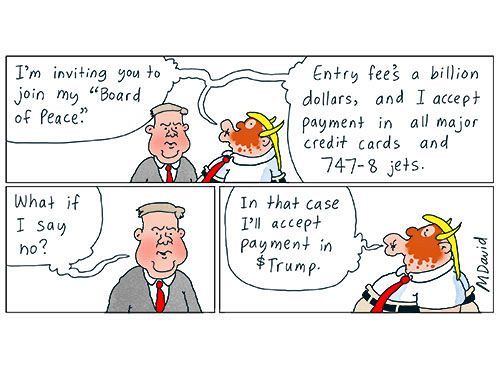
Meanwhile, in the span of a single day, the U.S. President offered ideas so outlandish they surpassed even his own record. He invited Russian President Vladimir Putin and President Aleksandr Lukashenko of Belarus to his “Board of Peace” and offered a permanent seat on this board for a fee of US$1 billion (AU$1.4 billion).
He also tied his push to seize Greenland to not winning the Nobel Peace Prize. In a text message to Norway’s Prime Minister, Trump complained that since ‘Norway decided not to give me the Nobel Peace Prize’, he no longer feels bound to think only about peace — and can now focus on what’s ‘good and proper for the United States’.
President Macron of France has already turned down the $1 billion and has declined the invitation to join Trump’s cozy little dictators club.
It seems like the Trump rampage is unstoppable. However, there is one glimmer of hope. The U.S. stock market is getting the jitters. Wall Street has posted the biggest daily drop in three months, with Trump’s Greenland tariff threat triggering a wide selloff. If Trump’s moral compass remains broken and he won’t listen to reason, his multibillionaire oligarchs may get tired of losing money and reel him in.
Whether Trump’s Greenland campaign is about present world power or future recognition (or both) is irrelevant. The Greenland purchase isn’t just another Trump real estate deal where he can send a bunch of goons around to make the owner an offer they can't refuse.
This time, Trump is dismantling a world order that has kept nuclear war at bay for 77 years. He wants to buy Greenland for a place in history. Trouble is, there may not be any history.
Dr Norm Sanders is a former commercial pilot, flight instructor, university professor, Tasmanian State MP and Federal Senator.
 This work is licensed under a Creative Commons Attribution-NonCommercial-NoDerivs 3.0 Australia License
Support independent journalism Subscribe to IA.


Related Articles
- Trump’s dementia destroys time-honoured global alliances
- Trump’s MAGA militia strategy and the erosion of restraint
- Trump threats against Fed chief trigger rare global response
- Trump unbound: An assault on democracy at home and abroad
- Western Sahara, Trump and the exposure of international law