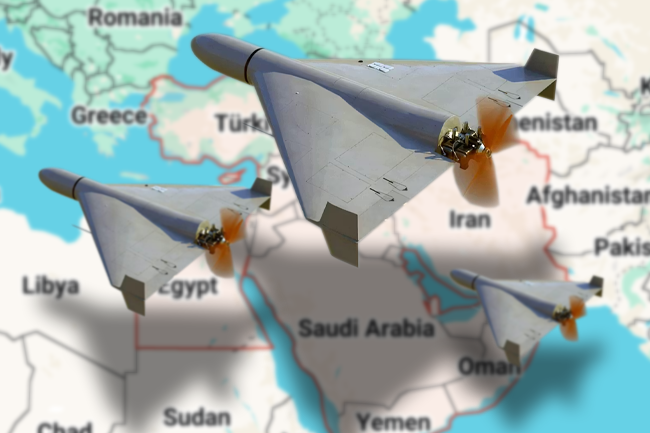
Iranian drone strikes on Gulf data centres show the cloud’s physical infrastructure is becoming a new target in modern conflict, writes Paul Budde.
RECENT IRANIAN drone strikes on Amazon Web Services (AWS) data centres in the Gulf mark a troubling development in modern conflict. While the operational impact on cloud services appears limited – thanks to the redundancy built into hyperscale networks – the strategic significance is far greater.
For the first time, hyperscale digital infrastructure, a core pillar of the global digital economy, has become a direct military target.
For decades, the technology sector has portrayed “the cloud” as something abstract and borderless. In reality, it is deeply physical. The cloud consists of vast data centres, fibre networks and energy-hungry computing facilities located in specific jurisdictions and dependent on local stability, power supply and physical security.

The Gulf has rapidly become one of the world’s most important locations for this infrastructure. Over the past five years, hyperscale companies such as Amazon, Microsoft, Google and Oracle have invested billions of dollars establishing cloud regions across the United Arab Emirates, Saudi Arabia and Qatar. These investments support not only commercial cloud services but also the rapidly expanding artificial intelligence industry.
The strikes on AWS facilities, therefore, represent more than a tactical incident. They challenge a fundamental assumption underlying the Gulf’s economic strategy: that the region provides a stable and secure environment for long-term digital infrastructure.
The Gulf states have spent decades building a reputation as modern, safe and well-organised global hubs for aviation, tourism, finance and communications. Cities such as Dubai, Abu Dhabi and Doha have positioned themselves as key gateways connecting Europe, Asia and Africa. Large-scale digital infrastructure – data centres, AI platforms and cloud networks – was meant to reinforce that role.
But confidence is crucial for such investments. Data centres are billion-dollar facilities designed to operate for decades. If investors begin to question their physical security, the economic calculus shifts.
Iran appears to understand this dynamic. Its strategy in the current confrontation seems less focused on achieving outright military victory than on undermining the economic confidence underpinning the Gulf’s development model.
Earlier attacks targeted oil facilities and shipping routes around the Strait of Hormuz, affecting energy markets and insurance costs. Now the pressure appears to be moving further into the infrastructure stack: logistics networks, corporate presence and digital systems.

The widespread use of relatively inexpensive drones plays a central role in this strategy. Iran and its proxies have demonstrated the ability to deploy large numbers of low-cost unmanned systems that are difficult and expensive to intercept. Even if most are shot down, a few reaching their targets can still cause disruption.
For Gulf states hosting concentrated clusters of critical infrastructure – oil refineries, ports, airports and now hyperscale data centres – this creates a serious asymmetry. Protecting every facility against swarms of drones is technically complex and extremely costly.
The implications extend well beyond the region. AWS is one of the largest cloud providers in the world, supporting governments, corporations and financial institutions across multiple continents. While hyperscale cloud architecture is designed with geographic redundancy, attacks on physical facilities highlight how dependent the digital economy remains on specific locations.
This situation also raises uncomfortable questions about strategic planning in Washington. The Trump Administration has taken an increasingly confrontational approach towards Iran, yet there appears to have been insufficient public assessment of the broader economic risks embedded in the Gulf.
The region hosts an extraordinary concentration of Western economic assets: military bases, energy infrastructure, aviation hubs, logistics networks, financial centres and now massive digital infrastructure investments linked to artificial intelligence. Any conflict that begins to expose these assets to systematic attacks carries consequences far beyond traditional military calculations.
Many governments are now questioning whether the United States fully considered these global implications before escalating the confrontation. Gulf governments themselves have expressed frustration that their economies and infrastructure are now exposed to risks that extend well beyond the immediate military objectives.

The AWS strikes underline a broader reality: digital infrastructure is now part of the strategic landscape of conflict. Data centres host financial transactions, government systems, telecommunications networks and increasingly the computing power driving artificial intelligence. They are no longer purely commercial facilities.
For countries such as Australia, this development carries important lessons. Governments are actively encouraging massive investment in hyperscale data centres and AI infrastructure as part of future economic strategies. Yet much of this infrastructure remains owned and operated by a small group of global technology companies and integrated into geopolitical systems beyond national control.
Australia has already experienced warnings about the sovereignty risks of such dependencies. Yet policymakers remain reluctant to seriously address the strategic implications.
If digital infrastructure is becoming as geopolitically exposed as pipelines, ports and power stations, then issues of sovereignty, resilience and national control cannot be ignored.
The cloud was once portrayed as a neutral global platform floating above politics.
Events in the Gulf suggest the opposite. The digital economy’s infrastructure is now firmly embedded in the geopolitics of conflict — and governments that fail to recognise this risk may eventually find their economic autonomy at stake.
Paul Budde is an IA columnist and managing director of independent telecommunications research and consultancy, Paul Budde Consulting. You can follow Paul on Twitter @PaulBudde.
 This work is licensed under a Creative Commons Attribution-NonCommercial-NoDerivs 3.0 Australia License
Support independent journalism Subscribe to IA.


Related Articles
- Religious warfare rhetoric emerges in conflict with Iran
- CARTOONS: Donald Trump's 'pieces-of-8' board talks are on hold
- JEFF MCMULLEN: The price we pay for not learning from history
- Operation Outlaw: Iran apologists and the assault on international law
- How Iran’s regime weaponised religion