Australian boardrooms are spending more on AI than ever before, yet the return on that spend keeps slipping further out of reach.
Westpac has poured millions into its generative AI rollout for 35,000 employees. Telstra deployed its "One Sentral" AI platform across operations. Woolworths is running dozens of AI pilots across the supply chain and retail.
The investment story sounds impressive on paper, but talk to the people running these programs and a different picture emerges — pilots that don't graduate, models that don't ship and dashboards that don't translate into earnings.
The pattern isn't unique to Australia. A landmark MIT study published in 2025 found that about 5% of AI pilot programs achieve rapid revenue acceleration, while the other 95% of generative AI projects stall at the pilot stage only, delivering little to no measurable impact on P&L.
So why do AI budgets keep rising while outcomes keep falling? It's rarely a technology problem. The real reasons sit much closer to home.
Why most enterprise AI programs fail before they scale
The biggest barrier to successful AI adoption is rarely the model itself. Enterprise AI initiatives often collapse under fragmented data environments, unclear ownership, governance delays, disconnected infrastructure and the inability to operationalise pilots at scale. As organisations race to invest in generative AI, many are discovering that sustainable outcomes depend far more on execution readiness than experimentation volume.
From pilot fatigue and weak data foundations to compliance bottlenecks and production scalability issues, the challenges below explain why so many enterprise AI programs struggle to move beyond isolated proofs of concept.
The pilot-to-production trap
Most enterprises confuse activity with progress. Running 30 AI pilots feels like momentum, but if none of them integrates into a workflow that earns or saves money, you've built an expensive science fair. Large enterprises run the most pilots and convert the fewest. They get stuck in approval cycles, security reviews and procurement bottlenecks that mid-market firms simply move past.
The fix is uncomfortable but simple - kill more pilots, earlier. If a use case can't show a clear path to production within 90 days, it probably never will. Choosing the right AI development company in Australia early in the process can also shortcut a lot of this, particularly when local teams understand Privacy Act obligations and APRA's CPS 230 expectations from day one.
Data foundations nobody wants to pay for
AI runs on data. Australian enterprises sit on decades of fragmented data; siloed in legacy ERPs, customer platforms acquired through M&A and spreadsheets nobody admits exist. Models trained on this mess produce confident nonsense.
The hard truth: spending 60% of an AI budget on data plumbing isn't glamorous, but it's what separates the 5% from the 95%. Skipping it doesn't save money; it just defers the bill, and the bill comes due when your model goes live and starts hallucinating customer details.
Vendor strategy: Build vs buy vs partner
There's a persistent myth that "real" AI capability means building everything in-house or buying a popular off-the-shelf solution. The data says otherwise. A custom-built AI solution succeeds roughly twice as often as internal builds. Yet bank after bank, insurer after insurer keep standing up internal AI labs that re-solve problems that specialised vendors solved two years ago.
This is where mature product engineering services in Australia earn their fee, by helping enterprises figure out what to build, what to buy and what to wrap around an existing model rather than rebuilding from scratch.
Why custom AI solutions deliver stronger enterprise ROI
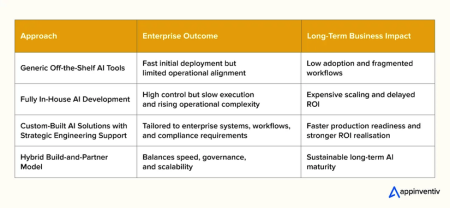
The pattern is becoming increasingly clear across enterprise AI programs. The highest ROI rarely comes from the most visible AI deployments. It comes from custom-engineered systems that solve operational bottlenecks, automate internal workflows and integrate deeply into how the business already operates.
The governance gap and shadow AI
While official AI programs stall, employees are quietly using ChatGPT, Claude and Copilot every day to actually get work done. This shadow AI economy is delivering more productivity than most sanctioned programs and creating real governance, IP and privacy exposure under the OAIC's tightening stance on automated decision-making.
Leaders who pretend this isn't happening lose twice; they miss the productivity signal and carry the compliance risk anyway.
What actually works
The organisations crossing the divide share four traits. They scope narrowly and ship before they scale. They invest disproportionately in data quality and observability. They partner with an experienced AI development company in Australia instead of building from scratch. And they assign a named executive, not a committee, to own each AI product line with revenue or cost-out targets attached.
AI isn't failing Australian enterprises. The operating model around it is. The companies that fix that in the next 18 months will be the ones writing the case studies everyone else reads in 2027.