The Coalition’s plan to index income tax scales to inflation may sound fair on paper, but critics argue it risks fuelling inflation, blowing out the budget and tying the RBA in knots, writes Stephen Koukoulas.
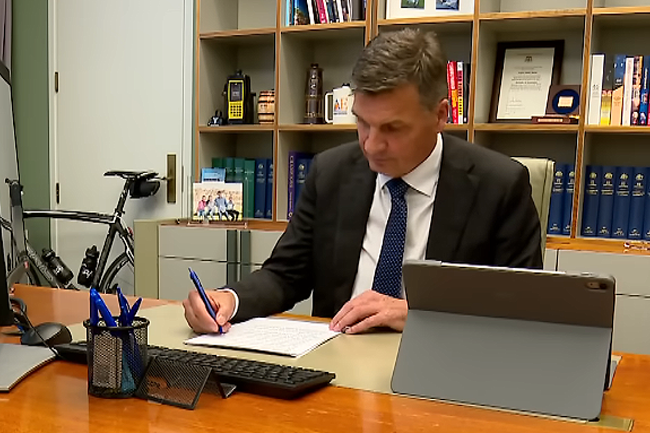
OPPOSITION LEADER Angus Taylor is promising, if elected, to index the income tax scales to the inflation rate.
While the specifics of the promise are scant, the concept is that once a year, the various income tax scales are increased by the amount of last year’s inflation rate.
At the moment, when wages rise, which they do every year by an average of about 4-5%, many workers move to a higher income tax bracket, meaning that a larger part of the pay increase they receive is taken away with tax.
This is one way the Budget is contractionary when inflation is high and rising, and why it does not undermine the economy when inflation is too low.
Taylor’s policy idea is not a good one for many reasons.
It has many black holes and consequences that make it an economic can of worms that would cause more damage and uncertainty in the economy than good.
First and foremost, indexing income tax brackets to the inflation rate is what we call in economics, “pro-cyclical”.
This means that when inflation is high and rising, indexation will give large and growing income tax cuts, which will stimulate the economy at the very time the Reserve Bank (RBA) is hiking interest rates to cool the economy to get inflation back under control. The best policy in this high inflation climate is to keep income tax cuts to a minimum, preferably none at all.
It is also true when the opposite occurs — low and falling inflation. When this occurs, the increase in the income tax brackets will be small and, as such, will do little to give the economy the stimulus it needs in such circumstances to boost growth and reflate the economy. The RBA will be forced to cut interest rates more than it would otherwise need.
An illustration
If inflation was 2.5%, the level of annual income at which a worker moves from a tax rate of 30% to 37% is lifted from $135,001 to $138,376. They are automatic income tax cuts on the $3,375 increase in income (plus the effect on lower income tax brackets, which would also be indexed).
If inflation is 5%, as it is now, that tax scale would rise from $135,001 to $141,751. This is a huge increase in the scales and a huge tax cut at a time when inflation is ripping along.
The problem with such a scheme is clearly that it is pro-cyclical.
This would see the policy working against the RBA's anti-inflationary stance in this example. Interest rates would be even higher as a result, and the RBA would be forced to hike interest rates over and above what it otherwise would.
In the current circumstances where inflation is high and rising, the RBA has been railing against what it sees as excessive stimulus from the government sector. The indexation of income tax scales would add fuel to demand and hence inflation.

The opposite is true in a low inflation era, where tax scales are not increased much and there is limited stimulus to the economy when it needs it.
The proposal would make it much harder for the RBA to meet its inflation target and/or will require much greater volatility in interest rates as the RBA fights to offset the pro-cyclical nature of the indexation of tax scales.
There are other issues with the proposal.
There is a massive cost to the budget. Based on the limited details in Mr Taylor’s proposal, there would be a cost of up to $35 billion in the first four years of its operation, rising to approximately $250 billion in the first ten years of its operation, adding to the budget deficit and level of government debt.
There is also an issue in the proposal that it doesn’t fully get rid of bracket creep. This is because wage growth is usually higher than inflation. Someone getting a 4% pay rise when inflation is 2.5% is still experiencing bracket creep, even with Mr Taylor’s indexation proposal.
This problem could be overcome if the tax scales to wage growth, but the cost would be huge and the pro-cyclical impact immense.
The indexation of income tax scales adds to economic volatility, imposes additional challenges to the RBA to meet its inflation target and would decimate the budget settings.
It is a quaint idea, but one that, in a practical sense, is not viable.
Stephen Koukoulas is one of Australia’s most respected economists, a past chief economist of Citibank and senior economic advisor to an Australian Prime Minister. You can follow Stephen on Twitter/X @TheKouk.
 This work is licensed under a Creative Commons Attribution-NonCommercial-NoDerivs 3.0 Australia License
Support independent journalism Subscribe to IA.