
Australia’s housing crisis is often blamed on tax incentives like negative gearing and the CGT discount, but the deeper roots may lie in decades of financial deregulation that transformed housing into a credit-fuelled asset class, writes Jemma Nott.
MAJOR PROGRESSIVE pundits have been running one line for some time now that the key to solving generational inequity is scrapping the capital gains tax (CGT) discount and negative gearing.
It’s hard to avoid the fact that the CGT discount and negative gearing both played a major role in creating the housing crisis that Australia is in. A crisis where productive wealth is devalued and static wealth, namely housing wealth, is overvalued to the point that Australia ranks 93rd on the Economic Complexity Index, behind Uganda and Kenya.
A glorified quarry where mining accounts for two-thirds of export revenue (and yet still could account for more with a gas tax) while employing just 2% of the workforce, and working people rely heavily on housing wealth as the primary way to get ahead. The best example of this is that 60% of Australia’s bank lending is directed towards housing, similar to the United States before the 2008 housing market crash.
The expansion of mass home ownership in Australia, ticking up to 70% in the 1970s and now hovering around 67%, meant that policies like removing the CGT discount or negative gearing have essentially been unelectable positions for decades.

Yet, it's because these policies serve as an incentive to treat housing as an investment vehicle that progressives have said for nearly two decades they must be scrapped. As the Government grandfathers these benefits, many critics to the Left will say that this doesn’t go far enough.
It’s hard to look at the data like this one below, a personal reproduction of similar data presented by groups like The Australia Institute and think the CGT discount is somehow inconsequential here.
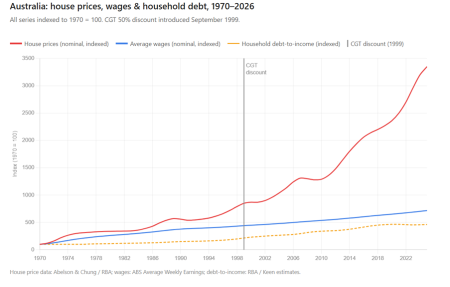
However, if you look a bit closer, you realise that the pretext for the introduction of the CGT discount is actually a bit more complicated. The dominant narrative is that the Howard Government introduced the CGT discount and that’s when everything went askew, so the recent changes in the Federal Budget are simply a return to a better pre-Howard era. What that narrative ignores is the significant financial deregulation that occurred before Howard.
The Fraser Government introduced a tender system for issuing government securities, which meant a move away from government control over monetary policy. Post Fraser, Hawke and Keating spurred on some major, foundational shifts towards financialisaton of the housing market.
Nominally, they lifted interest rate controls, meaning that banks could charge and pay customers what they wanted. Before this, banks couldn't compete for deposits by offering market rates, which capped their ability to grow their loan books. Once rates were freed, they could raise funding from wholesale markets and expand lending aggressively.
Then Hawke and Keating floated the dollar, which meant that interest rate ceilings on loans were removed, lending controls were lifted and restrictions on deposits were abolished. Floating the dollar meant Australian banks could now tap international capital markets for funding.
By 1985, foreign banks could enter the Australian market, which dramatically intensified the lending competition. Over the period 1983 to 1988, the amount of capital in the banking sector rose from $4.5 billion to $20 billion, the number of banking groups operating in Australia rose from 15 to 34 and the number of merchant banks increased from 48 to 111. Credit expanded by 147% between 1983 and 1988.
By 1999, banks could borrow globally, lend without limits and a decade of falling rates had doubled what households could borrow. The CGT discount then made residential property the obvious place to put all that money.
What the Labor Party did on Budget night was not inconsequential: it acted to close off three easy tax vehicles in one night. Some still remain, as one red-hatted landlord decided to glibly point out, self-managed super funds being one of them, but so do investing through company structures. They did it knowing it would make them unpopular.
However, the left-wing critique remains that without deregulation of finance, none of this would have been able to occur in the first place. So, what else could the federal and state governments or Australian agencies do from here if they are seriously committed to arresting house prices?
Option 1
Restricting mortgage securitisation
When a bank writes a mortgage the old way, it sits on the bank's books. If the borrower defaults, the bank loses money. So the bank has a strong reason to be careful about who it lends to and how much.
Securitisation breaks that link. The bank writes the mortgage, bundles it with thousands of others and sells the bundle to investors — superannuation funds, offshore institutions, whoever. The bank collects a fee and moves on. The risk now belongs to someone else. So the bank's incentive to be careful about the original loan is much weaker — volume becomes more profitable than caution.
For investor mortgages specifically, this is what makes credit supply feel nearly unlimited. A non-bank lender with no deposits at all can write investor loans all day, package them up, sell them and write more. There's no natural brake.
The proposed fix is simply to say: if you write an investor mortgage, you have to keep it. You can't sell it on. Now you're exposed if it goes wrong, so you'll charge more, lend less and scrutinise borrowers harder. Credit for investment property gets more expensive and harder to get — not because of an interest rate decision by the Reserve Bank (RBA), but because the people making the loans have skin in the game again.

Option 2
Debt-to-income (DTI) caps
A debt-to-income cap is a binding limit on how large a loan can be relative to what a borrower earns. If your household income is $100,000 and there's a cap of 6x, the maximum you can borrow is $600,000 — regardless of what the bank thinks you can service.
New Zealand introduced exactly this in July 2024, setting the limit at 6x income for owner-occupiers and 7x for investors. The Australian Prudential Regulation Authority (APRA) followed in November 2025, announcing a DTI limit effective from February 2026. On the surface, this looks like a meaningful intervention. In practice, it's considerably softer than it sounds.
The way APRA structured it, the limit isn't a hard ceiling — it's what regulators call a “speed limit”. Banks are allowed to lend above the 6x threshold; they just can't do it for more than 20% of their new mortgage lending.
There is also a significant loophole: the DTI limit only applies to banks and other authorised deposit-taking institutions. Non-bank lenders – the ones who fund themselves by packaging up loans and selling them to investors rather than taking deposits – are entirely outside it. These are precisely the lenders who skew most heavily toward investor mortgages and higher-risk lending.
What a genuine DTI policy would look like is something harder: a lower threshold (Ireland caps at 3.5x income, Canada at 4.5x), a stricter speed limit, or a hard ceiling for investors with no exceptions — combined with closing the non-bank loophole. APRA has the power to move on most of this without legislation.

Option 3
Loan-to-value ratio (LVR) floors
Rewinding the Government’s 5% minimum deposit scheme for first home buyers and stricter minimum deposits, particularly for investors. When house prices go up, property investors don't just sit on the gain — they borrow against it. Say someone bought an investment property for $600,000 and it's now worth $800,000 on paper; they haven't sold anything, but a bank will look at that $200,000 in new equity and let them borrow against it to fund a deposit on another property. That property then goes up, they borrow against that, too and so on.
The loop only works because you can get in with a small deposit in the first place. If you require investors to put down 30% or 40% upfront rather than 5% or 10%, two things happen: fewer people can start the loop at all and those who are already in it can draw down less each time prices rise because the equity gains don't stretch as far relative to what a new purchase requires.
Option 4
State-based rent control
There’s been much discussion about whether the Budget will lead to an increase in rent prices, while the average renter will happily tell you that we’re already close to an intolerable floor, regardless of what impact it has. While an increasing number of Australians are on the bread line and we are facing down a potential worsening economic crisis, while the Strait of Hormuz remains closed, renters need action now, not ten years from now.
State governments need to muster the political will to respond to possibly one of the worst economic crises in a generation barrelling down the corner and rent caps are an obvious form of immediate economic relief.
However, what makes some of these policy options, with more teeth, so much harder to achieve is that they aim at unwinding an entire credit system established in the ‘80s. What makes grandfathering the CGT discount and negative gearing, for some, much simpler is that it will slow the rise of prices while maintaining the asset class premium and not rocking an entire asset class (67% of the country) that has an interest in continuing house prices rises.
Jemma Nott is a Political Economy post-graduate student at the University of Sydney and a freelance writer.
 This work is licensed under a Creative Commons Attribution-NonCommercial-NoDerivs 3.0 Australia License
Support independent journalism Subscribe to IA.


Related Articles
- Forum reveals widening divide over housing strategy and affordability targets
- The human cost of Australia’s housing crisis
- The Great Australian Dream now belongs to landlords
- The Dom Pérignon buyers' scheme
- 'Insiders' ignores hard facts of housing crisis