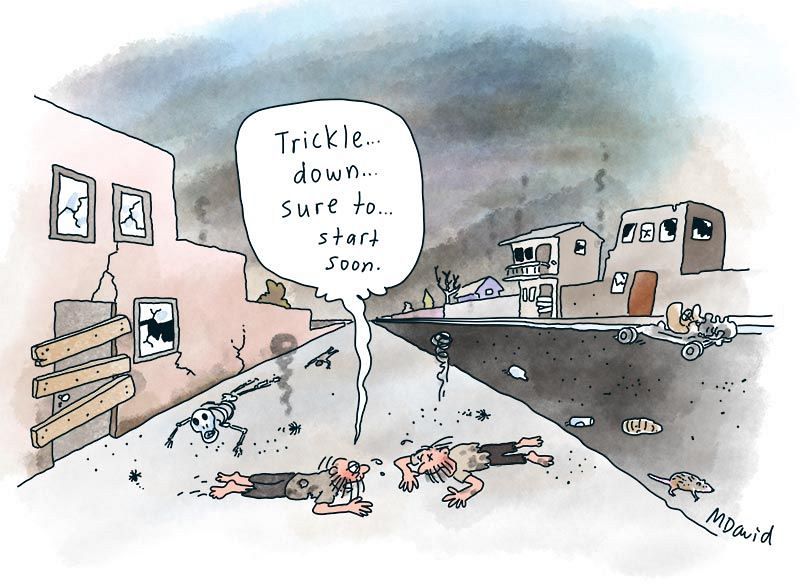
National wealth and economic growth mean little for democracy when prosperity is concentrated in the hands of the few and ordinary citizens are left behind, writes David Higginbottom.
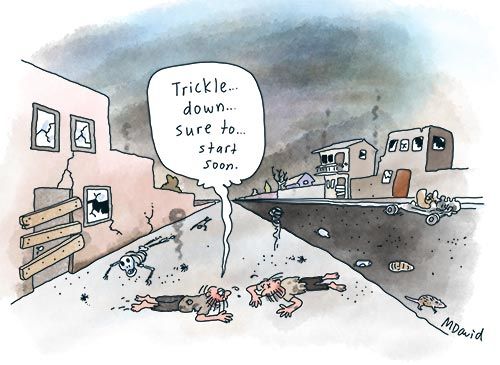
A COUNTRY CAN become rich while its people remain insecure. That should be obvious, but political debate often forgets it.
Governments announce Gross Domestic Product (GDP) growth as though it were a report card on national wellbeing. Commentators rank countries by the size of their economies. Wealth reports list average assets per adult. Whilst each number can be useful, none tell us whether people have security, dignity, influence or a fair share of national progress.
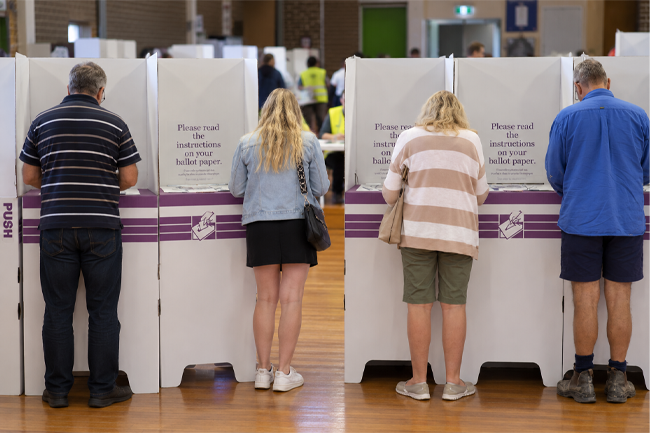
This matters because democracy is not only about who votes. It is also about whether citizens have the material capacity to use their rights. A person facing insecure housing, unmanageable debt, poor health or permanent financial anxiety has less time and confidence to participate, organise, campaign or challenge power. Economic insecurity does not remove political rights. It makes them harder to exercise.
The first distinction is between GDP at market exchange rates and GDP measured at purchasing power parity, or PPP. Market-exchange-rate GDP is important when the question is international financial power: trade, foreign debt, imports and the capacity to buy goods and services abroad. But it can distort comparisons of domestic living standards. In different countries, a dollar buys very different quantities of housing, food, transport, health care and labour.
PPP adjusts for those price differences, similar to the Big Mac Index, but for everything. It is generally more meaningful when asking about incomes and what this can buy within a country. The World Bank’s International Comparison Program makes a further refinement: for material wellbeing, comparisons based on household consumption or actual individual consumption can be more useful than GDP itself.
But PPP is still an average. It tells us nothing about whether prosperity is widely shared.
The 2026 UBS Global Wealth Report offers a striking illustration. In 2025, the United States ranked second among the markets measured for average wealth per adult, at US$696,277 (AU$996,503). It ranked only 28th for median wealth per adult, at US$68,998 (AU$98,738). The gap tells us that a relatively small number of extremely wealthy people lift the national average far above the wealth held by the adult in the middle.
UBS estimates that the United States had the sixth-highest level of wealth inequality among the 56 markets it measured. A country can be extraordinarily wealthy in aggregate while the typical citizen owns only a modest fraction of what the average implies.
This does not mean that the United States is not a democracy, or that national wealth is unimportant. It means that elections alone cannot guarantee equal political power. In a 2014 analysis of 1,779 U.S. policy issues, Martin Gilens and Benjamin Page found that economic elites and organised business groups had substantial independent impacts on policy, while average citizens and mass-based groups had little or no independent influence.
The BBC’s account of the study used the deliberately provocative headline ‘Study: US is an oligarchy, not a democracy’. Formal elections do not settle the question of whose preferences shape policy. Wealth buys time, expert advice, legal representation, campaign access, media reach and insulation from risk. A citizen who can vote, but cannot afford medical treatment and fears eviction, may possess formal rights without the capacity to use them.
Australia presents a more favourable, though still incomplete, comparison. UBS ranked Australia fifth in average wealth per adult and third in median wealth. That is a real achievement and should be acknowledged. It suggests that Australian wealth is less concentrated than America’s.
But no single measure ends the inquiry. Wealth includes homes, superannuation, shares and other assets less debt. A high national median can coexist with a severe divide between established homeowners and younger renters, between people who inherited assets and people who did not, and between cities, regions and communities.
A household that owns an expensive home may be wealthy on paper while struggling with income, service access or security. A renter may experience a country’s prosperity very differently from an owner.
My recent Great Decoupling analysis provides an Australian illustration. Its charts show that labour productivity and real hourly compensation tracked broadly together until about 2012, then moved apart. By the end of the series, productivity was 65 per cent above its 1994-95 level, while real wages were only 47 per cent above it. The point is not that one chart proves a takeover by an elite. It is that growth does not automatically become shared prosperity.
When the gains from productivity accrue disproportionately to assets, rents and high incomes, economic power can compound political influence and make democratic correction harder.
India and China make the same point from another direction. China’s record of poverty reduction is historically significant, but it does not answer every question about inequality, rights or power. India’s democratic elections and economic growth do not erase persistent deprivation or the unequal distribution of wealth and opportunity.
UBS estimates wealth Gini coefficients of 0.60 for mainland China and 0.74 for India. These figures are estimates of wealth concentration, not a final verdict on either society. They sit beside poverty, health, education, gender, caste, regional inequality and political freedom.
That is why democracy needs more than one measure. The World Bank’s Poverty and Inequality Platform is useful for poverty and distributional trends, though household surveys can miss the very richest people.
The UNDP Human Development Data Centre brings life expectancy, education and income together, while its inequality adjustment shows how uneven distribution reduces development. The World Inequality Database is useful for examining top income and wealth shares that conventional surveys often understate.
The purpose is not to bury readers in data. It is to ask a question that headline GDP figures avoid: Who benefits?
A government may boast of national growth while public housing declines, wages stagnate, medical costs rise, or young people are locked out of home ownership. Another may deliver infrastructure, health and poverty reduction while denying citizens the independent capacity to question the decisions made on their behalf. A third may produce more equal wealth but still tolerate exclusion through race, disability, geography or political influence.
No country is captured by one number. The democratic test is therefore demanding. We should ask whether people can participate and choose those in power; whether they can see and challenge its use; whether they have the material means to live with dignity; and whether national gains are broadly shared rather than captured by those already closest to wealth and influence.
GDP matters. PPP matters. Average wealth matters. But the middle matters more, and those left behind matter most.
A country is truly rich when its prosperity reaches beyond the averages and improves people’s lives.
This is part seven of our series on democracy. You can read part one here, part two here, part three here, part four here, part five here and part six here.
David Higginbottom is a member of the coordinating committee of the Independent and Peaceful Australia Network (IPAN) and coordinator of the Make Peace A Priority campaign (mpap.au).
 This work is licensed under a Creative Commons Attribution-NonCommercial-NoDerivs 3.0 Australia License
Support independent journalism Subscribe to IA.


Related Articles
- Democracy fails when corruption becomes a system
- Democracy begins before the ballot box
- Democracy must be measured by more than elections
- Democracy demands more than a vote
- Democracy and putting power back in public hands