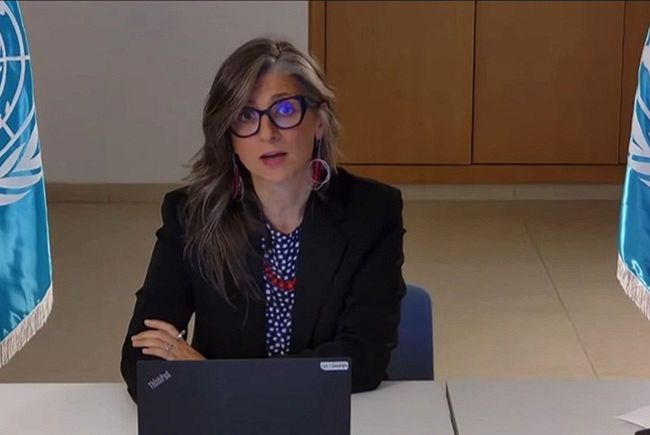
Francesca Albanese's report names the mechanism – Australian media should be ashamed – the exception is an Israeli newspaper, writes David Higginbottom.
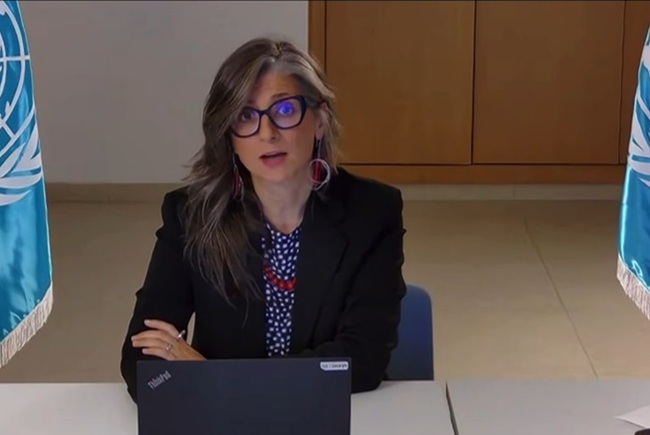
ON 26 OCTOBER, the UN Special Rapporteur on human rights in the Palestinian territory occupied since 1967, Francesca Albanese, presented her report to the General Assembly.
Genocide, she argues, is never sustained by killing alone. It requires destroying the conditions in which the killing can be seen, documented, remembered and judged.
She gave the mechanism a name: mediacide, the systematic destruction of the media's public function.
Her report, Truth under the rubble, counts the cost:
- Nearly 300 journalists and media workers killed since October 2023, more than 400 wounded, about 70 killed as reprisal for their work, and some 710 of their relatives killed.
- A hundred and fifty media offices and institutions destroyed, 81 per cent of Gaza's information and communications infrastructure destroyed, and foreign reporters still barred from Gaza.
The third pattern is harder to count: influential Western outlets reproducing the perpetrator's account, marginalising Palestinian voices and treating international law as an opinion.
Australia appears once.

Of 89 written submissions, 62 examined media ecosystems in Europe, North America and Australia.
The single Australian case is Antoinette Lattouf, unlawfully dismissed by the ABC over a Human Rights Watch report on starvation in Gaza; the broadcaster spent more than $1.7 million defending the dismissal before the Federal Court found it unlawful and noted that management had acted to 'appease the pro-Israel lobbyists'.
A single case is not definitive, but the Australian part of the story could be written from this week's news.
At Senate estimates, the Opposition communications spokesperson, Senator Sarah Henderson, held up an Israeli military list and declared that Roshdi Sarraj, a Palestinian journalist killed while filing for the ABC from Gaza, held a Hamas ID card. "And you don't think that's sufficient evidence?" she asked.
The Australian reported it under the headline:
'ABC investigates whether it hired Hamas terrorist for Middle East coverage.'
The ABC rejected the claim: the military had given it no evidence of active Hamas links. By the end of the week Henderson had written to the Senate committee to amend Hansard, having confused Sarraj with two other men on the list.
The correction went to Hansard. The headline reached a far larger audience.
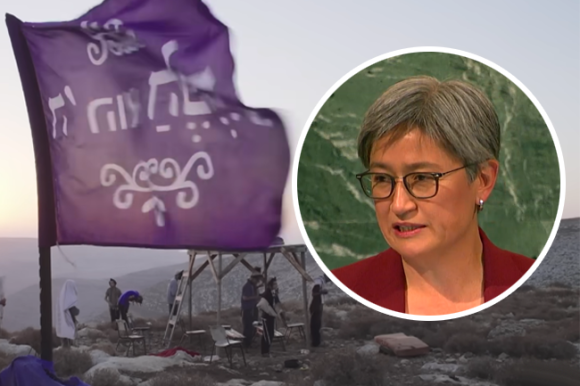
The paper investigating its own
Here is what should embarrass Australian editors.
On Israel's own media, the report says:
'Independent Israeli outlets, particularly +972 Magazine and Haaretz, have played a crucial role in exposing facts that most Israeli media have failed to scrutinise, often proving more critical, and ethical, than elements of the international media.'
The outlets it credits with the most searching work on Israel's conduct are Israeli.
On Gaza, Haaretz has done what no Australian newsroom has.
In three months: on 27 August, an investigation built on soldiers' testimonies, sources in Gaza and satellite imagery described Israel arming Palestinian militias to commit war crimes, then protecting them. Its lead editorial the next day was "Gaza Militias Are Israel's War-Crime Proxies".
On 12 October, testimony from four soldiers who served in Israeli military intelligence described how targeting rules were loosened after October 2023: buildings struck with residents inside and no evacuation; a drone unit authorised to strike where up to 20 non-combatants might be killed without approval outside the targeting cell; and, before the strike on Jabalia on 31 October 2023, a casualty estimate of 250 to 300 escalated to the chief of staff.
The military says the strike was repeatedly replanned to reduce harm.
On 20 July, its lead editorial was "The IDF Must Stop Killing Children and Investigate Those Responsible".
And on 20 August it published a piece addressed to us, on the killing of the World Central Kitchen aid workers, including Zomi Frankcom: "Australia, Don't Be Surprised. Israel Does This to Palestinians All the Time."
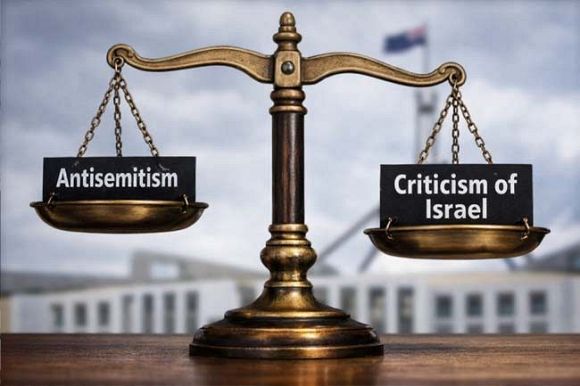
What Australian outlets have published
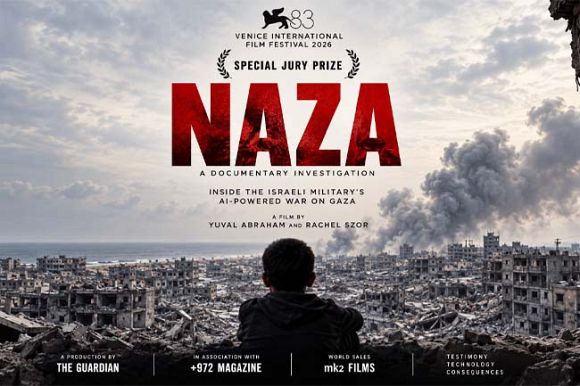
The ABC has reported the Hannibal Directive revelations, the NAZA procedure – an acronym for nezek agavi, Hebrew for collateral damage – and the fallout over Zomi Frankcom. Guardian Australia has done valuable work on the complaint campaigns against the broadcaster.
But the test is not whether Australian outlets cover the war. It is whether they investigate the party doing the killing — on this test the record is close to empty.
No Australian newsroom has produced an investigation built on testimony from inside the Israeli military. When Australians read such material, it is because Haaretz, +972, Reuters, the Associated Press or the BBC published it first.
The pattern is measurable. A peer-reviewed study in Media, War & Conflict analysed 5,183 articles from the ABC, The Australian, the Sydney Morning Herald, The Age and the Daily Telegraph, comparing the two years before October 2023 with the year after.
It found a shift to a crisis-conflict frame, Israeli victims personalised and Palestinian deaths rendered as statistics, and an "agency asymmetry" in which responsibility attaches to some actors and not others.
And the structure is defended by machinery. Content complaints to the ABC Ombudsman rose 107 per cent to 8,686 in the year to June 2026.
Forty-eight organised campaigns accounted for 5,259, and 1,148 concerned Israel and Palestine, with allegations of bias running about equally in both directions. Much of the volume was machine-written: one group told the Sydney Morning Herald it had sent more than 40,000 letters.
In May, the Ombudsman found Laura Tingle's analysis of the killing of journalists 'duly impartial' after a campaign against her.
Balance, honestly defined
Haaretz is a small liberal Zionist newspaper whose opinion page campaigns openly against the war, and its news desk works under military censorship: Israel's censor banned nearly 2,400 articles and redacted more than 11,000 across the Israeli press in 2024 and 2025.
But balance in wartime is not equidistance between two sides. It is fidelity to evidence about your own.
Judged that way, Haaretz has been more balanced than any MSM outlet in Australia. Its publisher, Amos Schocken, called Israel's rule over the Palestinians 'a cruel apartheid regime' and urged sanctions in November 2024; the government responded by ending state-funded subscriptions and advertising.
Ministers have since moved to bring media regulation under political control, and its journalists have been called traitors for reporting what soldiers told them.
The record is being kept, but not here
Australians who want to know what is being done in Gaza, in a war our supply chains and diplomatic cover are part of, depend on sources other than "Our ABC".
A good deal of the record is being kept in Hebrew, by a newspaper its own government has tried to put out of business, and reaches most Australians only through a curated English edition.
Albanese's central recommendation is that the record be preserved, and that journalists' notes, footage and archives be treated as evidence in the proceedings still to come."Accountability depends on the survival of the record," she said. She said it to a room almost empty of the press.
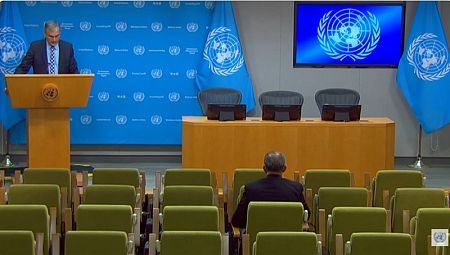
The room, Francesca Albanese noted, held the smallest press turnout, in person or online, of any report she has presented (Screenshot via YouTube)
The room, she noted, held the smallest press turnout, in person or online, of any report she has presented.
The least we can do is subscribe to the English edition, cite it, and ask our own editors a simple question: if an Israeli paper can investigate its own security services and army — why can't an Australian paper investigate its own government's complicity?
Further reading
Bearing Witness - Gaza, maintained by the Israeli historian Lee Mordechai of the Hebrew University of Jerusalem, is a sourced, chapter-by-chapter record of the war, last updated in July 2025. Its authors describe it as 'an accessible and reliable knowledge infrastructure' for researchers, journalists and decision-makers.
Forensic Architecture, the research agency based at Goldsmiths, University of London.
David Higginbottom is a member of the coordinating committee of the Independent and Peaceful Australia Network (IPAN) and coordinator of the Make Peace A Priority campaign (mpap.au).
 This work is licensed under a Creative Commons Attribution-NonCommercial-NoDerivs 3.0 Australia License
Support independent journalism Subscribe to IA.