Economic orthodoxy has survived repeated crises by protecting asset wealth and treating its own failures as exceptions rather than reasons for change, writes David Higginbottom.
GOVERNMENTS AND CENTRAL BANKS should act during an economic crisis. Allowing banks to collapse, unemployment to rise and businesses to fail is not an option.
However, after the recovery, few ask why successive crises produce ever-larger interventions, whilst the underlying economy becomes more indebted, asset prices become more politically untouchable and the gains flow ever more reliably to those who already own assets.
Why does a framework that repeatedly fails to anticipate these crises retain the status of settled science?
One answer is that economic orthodoxy operates as a secular faith. This is not a claim that all economics is unscientific. Economics does contain rigorous empirical work and analytical tools. The problem arises when a particular set of neoclassical assumptions and policy preferences becomes so institutionally entrenched that contradictory evidence is treated as an exception, rather than a reason to reconsider the doctrine.
A scientific model simplifies reality so that a question can be examined. A faith system begins when the assumptions and models are treated as reality itself, and its authorised interpreters are protected from challenge.

The creed and the sacrifice
The creed of modern orthodoxy is familiar:
- markets, left largely to themselves, allocate resources efficiently;
- prices contain the information that society needs;
- individuals are rational decision makers;
- the economy tends towards equilibrium;
- government action is more likely to distort than improve outcomes; and
- if inflation becomes troublesome, some rise in unemployment is an unfortunate, but a necessary sacrifice to return to stability.
Markets can convey information, incentives matter, public institutions can fail. However, an economy is also shaped by power, monopoly, bargaining institutions, inherited wealth, debt, social infrastructure, resource constraints and political capture.
The crucial change was to turn a limited proposition into an absolute one. The market becomes not one institution among many, but the ultimate judge. A budget deficit becomes not a fiscal position to be assessed against economic conditions, but a moral lapse. Unemployment becomes not a policy failure, but an acceptable instrument. The distribution of ownership becomes invisible, even though it determines who receives the benefit when asset prices rise.
Robert H Nelson's Economics as Religion traces the way economic ideas have performed faith-like roles in modern public life. The argument is that economic authority can be exercised through a similar pattern: foundational doctrines, specialist interpreters, ritual language, prescribed sacrifice and an extraordinary capacity to preserve the core belief against evidence of failure.
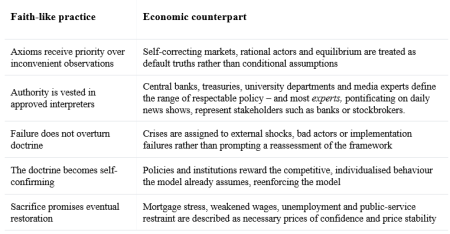
This last feature is especially important. Journalist and academic John Rapley argues that economic models are not merely descriptions of a society. When governments and firms organise incentives around narrowly self-interested behaviour, financial engineering and short-term asset returns, people are rewarded for conforming to the model and penalised for departing from it.
The result is a performative feedback loop: the theory helps make the world that, in turn, confirms the theory. This does not make all economic modelling circular, but it does mean that economists should distinguish between an observed behaviour and a behaviour induced by the policy architecture built around a model.
Rapley also recalls Russian-American economist Wassily Leontief's warning that the usefulness of an economic model depends on the empirical validity of its assumptions. That is an uncontroversial scientific principle. Yet, too often, the elegance of the model has been valued more highly than the reality it fails to capture.
The doctrine of rescue
The pattern can be traced through the crises of this century. It shows a sequence in which the remedy for a collapse frequently relocates risk, strengthens the political importance of asset prices and makes the next intervention harder to avoid.
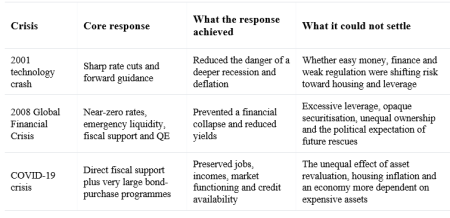
The British Academy's examination of the Global Financial Crisis (GFC) identified a legacy of the 2001 dot-com response. The relatively successful effort to avoid a severe recession helped entrench the view that it was better to clean up after asset bubbles burst than to restrain them beforehand. The Academy described a mixture of hubris, herd behaviour and faith in financial ingenuity.
A framework that regards markets as broadly self-correcting can see a bubble as an unfortunate deviation.
A framework attentive to debt, ownership, financial institutions and political power sees the bubble as evidence that the system has been rewarding the wrong behaviour for some time.

A path of dependency
Each rescue that prevents a collapse, without changing the underlying distribution of wealth, makes the system more dependent on the next rescue. Asset prices become too important to fall. Household debt becomes too large to service at normal rates. Governments become fearful of public investment, but are ready to guarantee financial markets in an emergency.
That is a reason to reject the theology of inevitability. Functional Finance, developed by Abba Lerner, asks that fiscal policy be judged by its function – employment, output and price stability – rather than by a moralised obsession with a balanced budget.
Modern Monetary Theory maps the monetary operations of a currency-issuing state and insists that the real constraints are productive resources, inflation, exchange conditions and ecological limits, not an arbitrary household analogy for public finance.
Both approaches remain contested; they are not substitute gospels.
Their value is that they restore the questions orthodox policy too often suppresses:
- What real resources are available?
- Who gets the income?
- What is the source of inflation?
- Which intervention expands productive capacity rather than inflating assets?
- What form of taxation or public investment will reduce the pressure without creating unemployment?
The test of an economic theory is not whether it preserves the prestige of its interpreters; it is whether it helps a society understand its own failures and distribute the benefits of its collective labour fairly.
Economics already has sophisticated tools for studying how beliefs, norms and institutions shape behaviour - as the Economic Journal's peer-reviewed collection on religion and economics demonstrates. It should apply comparable critical scrutiny to its own assumptions, institutions and distributional consequences.
We do not need another faith — we need an economics willing to learn from its mistakes.
David Higginbottom is a member of the coordinating committee of the Independent and Peaceful Australia Network (IPAN) and coordinator of the Make Peace A Priority campaign (mpap.au).
 This work is licensed under a Creative Commons Attribution-NonCommercial-NoDerivs 3.0 Australia License
Support independent journalism Subscribe to IA.


Related Articles
- Strengthening democracy in Australia an example worth demonstrating
- 'Democracy is a system in which parties lose elections.' So they should
- Get rid of running the gauntlet — bring back Democracy Sausages
- EDITORIAL: Dutton, Trump and the dangers of both-sidedness
- The pitiful decline of Australia's democratic institutions