China, India, the United States and Australia reveal why democracy must be judged not only by elections, but by who holds power, who benefits and who gets heard. David Higginbottom writes.
IT IS TEMPTING to divide the world into two boxes.
China is authoritarian; India, the United States and Australia are democracies. China does not permit open national competition between rival parties, independent opposition capable of taking power, or a free media able to hold the Communist Party to account.
India, the United States and Australia have electoral competition and legal protections that China lacks.
The question developed in this series is whether each gives people representation, participation, shared outcomes and the capacity to scrutinise power. Every country has strengths. Every country has failures. The test should be applied consistently.

China: Delivery without full political choice
China is the hardest case because its development record is too large to dismiss, while its restrictions on political competition are too serious to excuse.
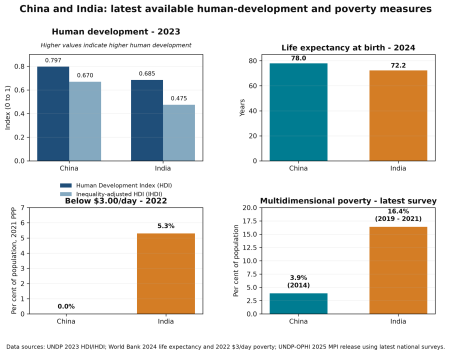
Over four decades, China reduced the number of people living below the World Bank’s international extreme-poverty line by close to 800 million — close to three-quarters of the global reduction over that period, according to the World Bank’s assessment. Its life expectancy reached 78 years in 2023, well above India’s 72 years and close to the United States at 78.4 years. Its Human Development Index was 0.797, above India’s 0.685.
These outcomes matter. Work, transport, electricity, education, health care and a path out of poverty are not politically irrelevant simply because they were delivered by a one-party state.
China’s leaders present this as ‘whole-process people’s democracy’: a system of elections, consultation, decision-making, management and oversight, judged partly by its capacity to solve practical problems.
Village committees and local people’s congress elections give this account some institutional content. But it has strict limits. Higher-level representatives are elected indirectly within a Communist Party-led system, as NPC Observer explains. Citizens cannot build an independent national opposition, freely organise against the governing party or replace the leadership through open competition.
China therefore demonstrates a central point: a state can deliver major public gains while failing the test of political choice and independent scrutiny.
India: Votes, voice and uneven outcomes
India demonstrates the opposite danger: accepting that elections automatically produce government for the people.
India’s democracy is a major achievement. It conducts elections at scale. Its constitutional system is federal, its political landscape is multiparty and its three-tier panchayat system attempts to bring government closer to the village.
All registered village voters belong to the gram sabha, while elected local bodies reserve seats for women, Scheduled Castes and Scheduled Tribes, as set out in the Government of India’s account of Panchayati Raj.
India has also made progress against poverty. The World Bank’s recent assessment reports a marked improvement from 2011-12 to 2022-23, while cautioning that the result depends on complex data and methodology.
In 2024–25, a nationwide survey claimed that no manual scavengers existed in any district of India — their existence is denied by the State, rendering them invisible in official records. However, ground reports tell a very different story.
Formal voting rights do not automatically overcome unequal power. Class, caste, gender, region and religion still shape whose voice is heard. Local bodies depend heavily on higher-level funding and can be constrained by local elites or weak administration. A citizen may vote yet still lack clean water, secure work, reliable health care or meaningful influence over decisions that shape daily life.
India’s lesson is not that elections do not matter. It is that “by the people” must connect to “for the people” and require institutions through which excluded groups can press their claims.
The United States: Wealth and unequal influence
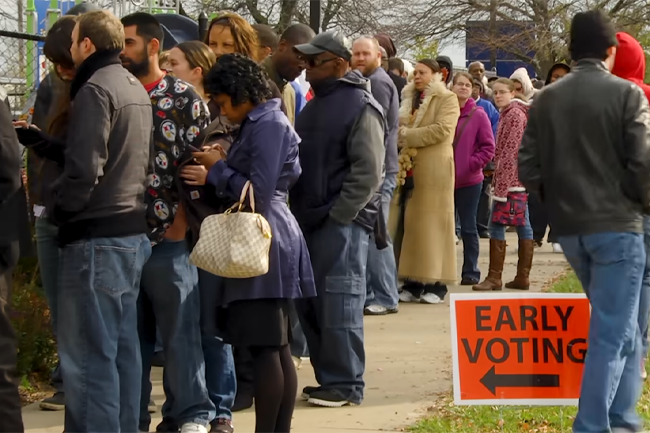
The United States remains a powerful example of liberal democracy. Citizens can campaign, organise, litigate, publish criticism and remove governments. Primary elections give voters a direct role in choosing party nominees, rather than ratifying candidates selected by a party machine.
But political freedom does not guarantee equal political power. The United States had a Human Development Index of 0.938 in 2023, placing it in the United Nations Development Programme (UNDP)’s very-high-development group. Once inequality in health, education and income is considered, that value falls to 0.832. Life expectancy was 78.4 years, well below Australia (83.1) and only marginally above China.
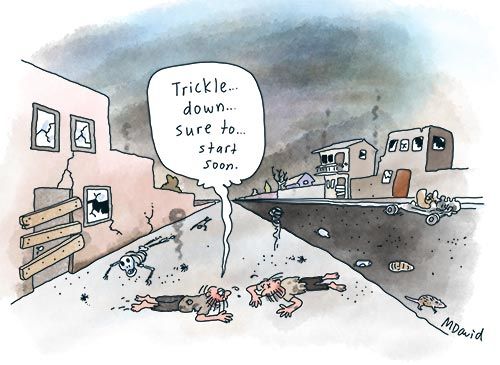
The United States also exposes the gap between national wealth and ordinary security. High medical costs, unstable housing, debt and the influence of large donors and organised wealth can leave citizens with formal rights but unequal capacity to use them. Primaries may open the gate to grassroots candidates, while campaign finance, media power and lobbying still narrow the field.
America’s lesson is that rights need a social floor beneath them and that electoral competition needs institutions capable of resisting capture by wealth.
Australia: High marks, improvements necessary
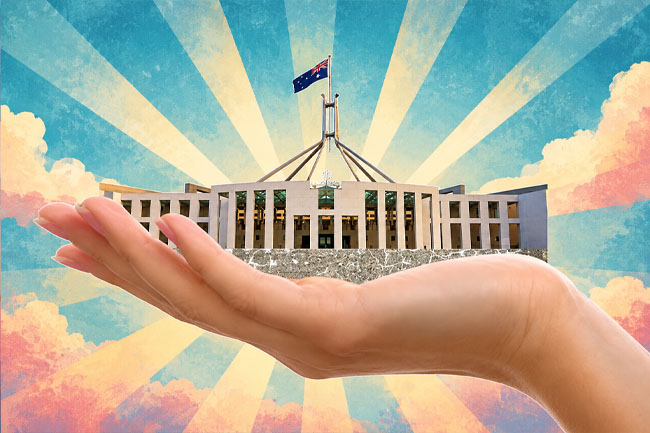
Australia performs well by international comparison. It has peaceful transfers of government, competent election administration, broad freedoms, a 2023 Human Development Index of 0.958 and life expectancy of 83.1 years. These are assets to protect.
But Australia is not exempt from the test. Party preselection can determine who is realistically electable. Lobbying and private access can occur out of public view. Donations, outsourcing, politicisation and weak transparency rules widen the distance between citizen and decision-maker.
Housing pressure and wealth inequality also affect who can participate with confidence and who must simply concentrate on getting through the week.
The economic gap has a political dimension. In my recent great decoupling article, the graphs show that Australian labour productivity and real wages moved broadly together until around 2012, then diverged.

By the end of the series, productivity was 65 per cent above its 1994-95 level and real hourly compensation 47 per cent above it. That 18-point difference does not by itself explain political influence, but it illustrates the question democracy must ask:
If collective productivity grows, who captures the additional gains, and do citizens have the time and security to challenge the system?
The Australian question is not whether its institutions are better than China, India or the USA. They are different and in key respects stronger. The question is whether Australians can see and correct the ways their own system protects power from public scrutiny.
A standard, not a league table
This comparison should not produce a winner. China’s material achievements do not erase the absence of open political contestation. India’s electoral system does not erase its social progress or its inequalities. America’s political freedoms do not make inequality irrelevant. Australia’s institutions do not prove that public power is always exercised in the public interest.
Democracy is not a badge awarded by one bloc to another. It is a continuing obligation: to represent people, enable them to challenge power, improve their lives and permit them to expose or correct capture.
Instead of asking only, “Does this country hold elections?”, we should ask: Who gets to decide? Who is left behind? Who can challenge power? And who shares in the result?
This is part four of our series on democracy. You can read part one here, part two here and part three here.
David Higginbottom is a member of the coordinating committee of the Independent and Peaceful Australia Network (IPAN) and coordinator of the Make Peace A Priority campaign (mpap.au).
 This work is licensed under a Creative Commons Attribution-NonCommercial-NoDerivs 3.0 Australia License
Support independent journalism Subscribe to IA.


Related Articles
- Democracy demands more than a vote
- Democracy and putting power back in public hands
- Democracy and the secular faith of economics
- Strengthening democracy in Australia an example worth demonstrating
- 'Democracy is a system in which parties lose elections.' So they should