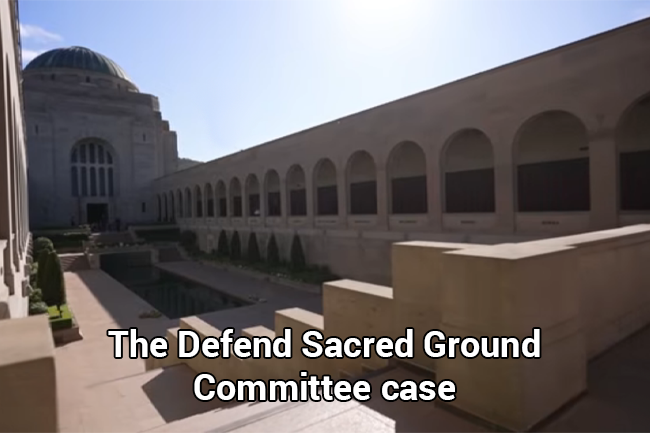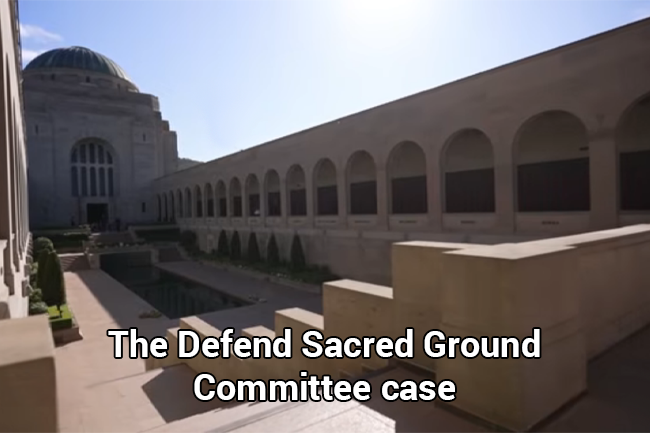
Defending Country and Defend Sacred Ground have different objectives, but they agree on the need for clarity in how the Australian War Memorial deals with frontier conflict in Australian history.
This forum has been organised with the agreement of the publishers of Independent Australia and Quadrant Online. The protagonists are each providing a 1,200-word article, a 600-word rejoinder, and a 100-word summing up.
Both publications provide for reader comment. Defending Country and Defending Sacred Ground thank Independent Australia and Quadrant Online.
THE ANSWER is simple – it shouldn’t.
On 11th November, four score and five years ago, Australia officially opened a memorial that would become a place of national remembrance, honouring Australians who served and died during active service.
Today, the Australian War Memorial is one of our nation's sacred places, a shrine to 103,140 souls whose courage, service and sacrifice have shaped Australia. It is incumbent on each generation to protect their memory and ensure future generations never forget those who served our country. It is sacrilegious for anyone to attempt to interfere with this shrine for political purposes.
Yet, that is what activists are attempting to do by stealth. They are pushing the War Memorial Council to act unlawfully and move outside its charter by redefining colonial conflict with Aboriginal people as “war”. The activists want these historical conflicts to appear equally within the memorial alongside Gallipoli, World War II and the Battle of Long Tan. This political activism is deeply concerning. Its sinister aim is to infiltrate one of Australia’s great institutions, the last one that has not yet fallen to an anti-Australian, woke ideology.
The Defend Sacred Ground campaign believes that colonial era conflict between settlers and Aboriginal people should not be included in the Memorial in any context.
Under the Act the only conflicts that qualify for inclusion in the War Memorial are those that involved ‘naval or military forces raised under the Crown in Australia’. This means Australians who donned our country’s uniform and signed up to serve our nation in fighting our enemies. All historians agree that there was no colonial conflict against Aboriginal people involving military forces raised in Australia. All agree that any violence that did occur in colonial times involved police forces or British regiments fighting against, at various times, settlers, miners, convicts and Aborigines. This does not qualify as “war” under the Act, nor in the general understanding of Australians.
Yet Memorial Council Chairman Kim Beazley wants to memorialise settler/Aboriginal conflict by selectively including Aboriginal fighters, none of whom adopted our country’s uniform, within the memorial. He claims “we” owe them “the dignity of resistance”. The Council claims their “broad interpretation of the Act”, plus so-called “broad community support” for the proposal, entitles them to push ahead; yet they refuse to provide the Australian people with any legal advice or surveys to support their claims.
In contrast, the Defend Sacred Ground Petition has garnered some 46,000 signatures within three months from Australians who strongly oppose Beazley’s proposal. We also back up our opposition with legal advice that shows the proposal is unlawful.
Prominent Australians agree with our position. Former Prime Minister Tony Abbott, whose affinity with and respect for Aboriginal people is unquestioned, believes the council’s plan is “misconceived”. He correctly explains that the role of the War Memorial is “to chronicle, to mourn, occasionally to admit and to explain, but above all to honour the deeds of the Australian armed forces, of the nation-in-uniform”. It was never intended to note the violence of “some Australians against other Australians”.
Even advocates, such as former historian at the War Memorial, Professor Peter Stanley, agree there is problem of legality. He believes the Act needs to be amended to provide clarity. We agree and invite the minister and parliament to consult the public and then amend the Act to categorically rule in the depiction of frontier violence or, alternatively, rule it out, as the case may be.
The historiography being used to support the activist takeover of the memorial is also deeply inaccurate and unfair to Australians.
Yes, there was violence between the Aborigines, settlers, police and British regiments during the hundred-odd years of colonial settlement, but its frequency and death toll is greatly overstated by the activists. It was not ubiquitous as many regions of Australia saw little or no violence. Most Aboriginal people ‘came in’ and joined the colonial project as pastoral workers, whalers, servants, wives, policemen, labourers and farmers. Relatively few took up arms as so-called “resistance fighters”. Only 11 British soldiers were killed during the century of imperial military presence. It’s absurd to call this a “war” – how could the British ‘conquer’ a continent, and kill 100,000 Aborigines in the process, all for the loss of 11 soldiers?
The 103,140 Australians memorialised in our shrine today are named and their service details known. In contrast, the activists have used a mathematical formula to calculate their alleged 100,000 Aboriginal death toll. Beyond a handful of documented cases they have no evidence and cannot name any victims, nor provide any details for such an absurdly large number.
Nevertheless, there was some colonial frontier violence between civilians – Aborigines, settlers, pastoralists and police, all of whom were equally recognised as British subjects under the law. This story about our country’s birth should be told. But you can’t have a formal “war” between equal British subjects, so the Australian War Memorial in not the place for this history. Rather, these “difficult stories” of violence are being told appropriately today, on Country, at the sites where they occurred: at Myall Creek and Pinjarra, and also at places of inter-tribal massacres such as Irbmangkara, where 100 Arrente men, women and children were massacred by 60 Aboriginal Matuntara warriors. The Australian Museum and the new ATSI precinct Ngurra also have a place in depicting this history.
Former Prime Minister Paul Keating was asked in 2013 what young Australians should take away from a visit to the War Memorial. He replied they needed to appreciate that our “country had depth. And that many people thought it was worth fighting for; and what we had created here, was worth defending; and, in the defence, they laid down the largest sacrifice of all, their lives; and I think that's what that memorial says.”
Politicising the War Memorial by including conflicts between Australians – the settlers and the Aborigines - will destroy Keating’s vision.
Young people will be made to feel guilty about the history of their nation. They will be taught and become indoctrinated in the belief that, as one activist state’s it, Australia’s settlement was based on an “original sin” of violent dispossession. Future generations will come to feel Australia’s birth was illegitimate, that the defence forces are not worthy of joining, and their country, because of this fabricated history, is not worth fighting for. Beazley’s proposal will thus have the perverse effect of discouraging young Australians to join the defence forces.
And yet, the most sinister aspect of the proposal, if it succeeds, is that it will forever depict the first peoples of Australia and their descendants, our fellow Aboriginal Australians, as ‘enemies’ – a people who fought the Crown. This is a repugnant idea.
Along with our two former prime ministers, who come from the opposite ends of the political spectrum, we want a united country where Aboriginal people are not falsely depicted as our enemies. They are our respected fellow Australian citizens who have always stepped up and willingly joined the defence forces in times of need. They, like us, believe our country is worth fighting for.
The Australian War memorial was conceived as a sacred shrine of national unity for all Australians. Let’s keep it that way.
Roger Karge is the director and co-founder of Defend Sacred Ground.
 This work is licensed under a Creative Commons Attribution-NonCommercial-NoDerivs 3.0 Australia License
Support independent journalism Subscribe to IA.


Related Articles
- Australian War Memorial must tell the whole truth of the Frontier Wars
- The Australian War Memorial's Rocky Horror Show
- War Memorial makes little effort to recognise Frontier Wars