Democracy demands more than elections, requiring both the power to challenge governments and the security and opportunity to share in national progress, writes David Higginbottom.
“That government of the people, by the people, for the people, shall not perish from the Earth.”
~ Abraham Lincoln, Gettysburg Address, 1863.
Lincoln’s definition is so familiar that we can all recite it. Political argument usually dwells on the middle term: government by the people. Do citizens vote? Are parties allowed to compete? Can a government be removed?
But Lincoln offered three terms, not one. Government must also be for the people. Governments often claim to know what is best for people while ignoring the people themselves and a road, a hospital or a rise in national income does not compensate for the absence of rights.
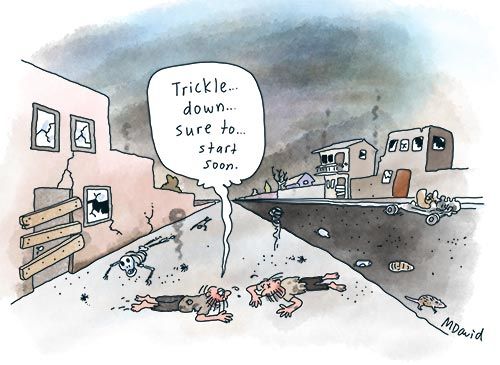
Yet a democracy that gives people a ballot, while leaving them unable to obtain housing, health care, education, secure work, or a reasonable share of national progress, is also failing part of its promise.
The political theorist David Beetham described democracy through two principles: popular control over public decisions and political equality in exercising that control. The two belong together. Popular control is weak if citizens lack the time, security, information and confidence to use it. Political equality is hollow if wealth, insecurity, race, gender, geography or inherited privilege determine whose voice can be heard.

Beetham’s formulation informs International IDEA’s account of democratic principles.
This is why economic statistics belong in a democratic argument. But they need to be used carefully. GDP at market exchange rates tells us something about a country’s international economic scale. It tells us much less about what people can buy where they live.
Purchasing-power-parity measures (PPP) are more useful for comparing domestic living standards because they adjust for differences in price levels — much as the Big Mac Index illustrates, the same money does not buy the same thing everywhere.
Even using PPP, an average conceals distribution. A rich country can have a very rich minority and a struggling majority. Median wealth, poverty, housing, health, education and inequality must sit beside GDP or PPP. The issue becomes unavoidable when we turn to China.
China is commonly described in the West as a one-party authoritarian state. The description is correct as far as it goes. There is no open national competition between rival parties, no independent opposition able to replace the Communist Party, and serious restrictions on expression, association, religion, protest and minority rights. These are not minor defects. They go to the heart of government by the people.
But the description is incomplete if it leaves out what has happened to living standards. The World Bank reports that over four decades, China reduced the number of people living below the international extreme-poverty line used at the time by close to 800 million — close to three-quarters of the world’s reduction over that period.
The change involved industrialisation, urbanisation, education, infrastructure, public investment and targeted support. It was neither miraculous nor costless and it does not prove that every Chinese policy has been wise or just.
China’s government calls its model ‘whole-process people’s democracy’. Its official account argues that democracy includes not only elections but consultation, decision-making, management, oversight and the practical solution of public problems. That account should be heard before it is rejected. It identifies something electoral democracies sometimes neglect: Public legitimacy is given by governments that deliver transport, schools, housing, health care, safety and opportunity.
Consultation is not the same as political choice. A village committee, a people’s congress, or a public consultation process does not replace the right to build an opposition, criticise rulers without fear, access independent information and remove a national government through open competition. Nor does economic success settle questions of arbitrary power, labour rights, censorship, religious freedom or the treatment of ethnic minorities.
China is not democratic because it has delivered material gains. Nor is it that those gains are politically irrelevant because China is not a liberal electoral democracy. Both responses evade the question Lincoln asked.
A government that delivers real improvements while denying citizens meaningful means to contest and change power is deficient. A government that permits electoral competition while allowing inequality, insecurity, capture and neglect to become normal is also deficient. The failures are different and not equivalent — but neither failure should be hidden because it challenges a familiar story or geopolitical framework.
This is where the fourth requirement becomes essential: scrutiny. A government can build roads, reduce poverty and deliver services, but unless citizens can investigate failure, organise independently, expose self-dealing and demand correction, achievements can become unanswerable power.
Equally, an electoral system can promise accountability, but then hides who influences parties, ministers, media and policy, elections can become a ritual that leaves underlying power untouched.
The democratic task is therefore larger than choosing between process and outcomes. We need both. People need the capacity to contest authority and the material capability to use that capacity. They need a vote and a voice; security and a right to question; delivery and a means of correcting those who deliver it.
In the next article, the same test will be applied to China, India, the United States and Australia. The question will not be which country is allowed to call itself democratic. It will be whether each system gives people representation, participation, shared progress and a genuine capacity to scrutinise power.
This is part three of our series on democracy. You can read part one here and part two here.
David Higginbottom is a member of the coordinating committee of the Independent and Peaceful Australia Network (IPAN) and coordinator of the Make Peace A Priority campaign (mpap.au).
 This work is licensed under a Creative Commons Attribution-NonCommercial-NoDerivs 3.0 Australia License
Support independent journalism Subscribe to IA.


Related Articles
- Democracy and putting power back in public hands
- Democracy and the secular faith of economics
- Strengthening democracy in Australia an example worth demonstrating
- 'Democracy is a system in which parties lose elections.' So they should
- Get rid of running the gauntlet — bring back Democracy Sausages