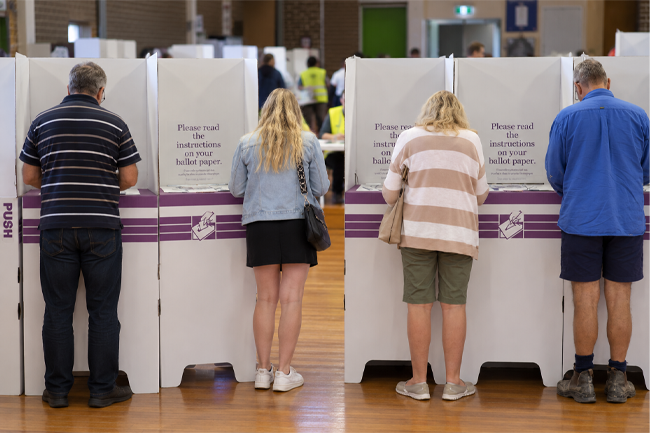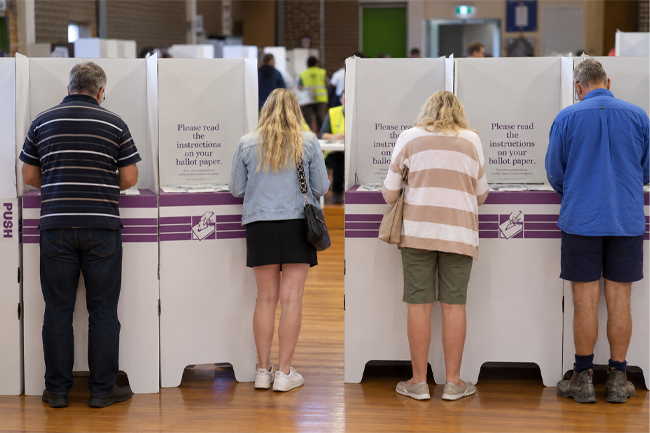
Australia’s elections give voters real choice, but democracy remains incomplete when political parties control who gets to appear on the ballot in the first place. David Higginbottom writes.
AUSTRALIANS CHOOSE their governments. On election day, we vote for parties, independents and minor candidates, and preferential voting gives us a meaningful capacity to rank alternatives.
However, who chooses the candidates we are asked to vote for?
Democracy begins before polling day. It begins at the gate through which a person becomes a viable candidate. If a small group of party officials, factional power brokers, donors, or established insiders controls that gate, the public is invited to participate only after the most important decision has already been made.
This is not an argument against parties. Large democracies need parties to organise ideas, recruit candidates and form governments. The question is whether parties remain vehicles through which citizens influence power or become systems through which power selects its own successors.

The political economist Joseph Schumpeter offered a minimalist definition of democracy: leaders acquire decision-making power through a competitive struggle for the people’s vote. That definition draws attention to an awkward fact. The struggle cannot be fully competitive if voters never get to choose who may compete. International IDEA’s account of the democratic tradition places Schumpeter’s electoral test in its wider context.
In Australia, general electors do not vote in a public primary to select Labor, Liberal, National or Greens candidates. Party members and party authorities do so under internal rules that differ between parties and states. Some local members have a genuine role. In other cases, state executives, factions or national bodies can override local outcomes.
It would be wrong to say that ordinary Australians have no alternatives: Independents and minor parties can contest, and voters can reward them. But it is accurate to say that most Australians first encounter a major party’s candidate after the act of endorsement has already occurred. See the Australian Parliament’s discussion of electoral and party systems.
This has consequences. A prospective parliamentarian learns that success depends heavily on party loyalty, internal relationships and acceptance by those who control preselection. The incentives are obvious — do not alienate the faction, avoid views that challenge the party’s policies, build networks among people who already have influence. None of this requires bad people; it is simply how a party's “funnel” shapes behaviour.
The United States primary system offers a useful contrast, although not a model to copy uncritically. Its rules vary by state: some contests are open, some restricted to party registrants and some use caucuses. Money, endorsements, media attention and party networks still matter. But primaries create a public contest within the party. They can allow voters to defeat a candidate favoured by prominent figures before the general election.
Zohran Mamdani’s New York mayoral campaign in 2025 illustrates the point. Mamdani was not the choice of the Democratic machine, which supported Andrew Cuomo. For this primary, a voter enrols as a Democrat (or Republican, or other) on the roll administered by the Board of Elections — they do not have to be a party member.

Mamdani won the Democratic primary against former governor Andrew Cuomo, as Politico reported, then went on to win the general election as a Democrat. Cuomo entered with exceptional name recognition and support from prominent Democratic and business figures; Mamdani’s victory was proof that grassroots organisation can sometimes open a gate that party leadership would prefer to keep closed.
There would not have been a contest in Australia; Cuomo would have been selected and elected.
U.S. primaries have serious flaws. Their cost can magnify the power of wealthy donors. Their rules can exclude non-registered voters. Low-turnout contests can reward intensely organised minorities. They can also encourage polarisation and celebrity politics.
However, the American primary system demonstrates a basic principle: citizens should have a meaningful say not merely over which endorsed candidate wins, but over who receives the endorsement in the first place.
China reveals the other end of the spectrum. Its people’s congress system includes elections and appointments, but the Communist Party controls nomination for central leadership through its nomenklatura system. Formal votes are not an open contest between independent political forces seeking to form a government. The distinction from Australia is qualitative: an Independent opposition cannot organise to win national power. NPC Observer’s explanation of the selection of China’s state leaders sets out this structure.
Yet the comparison is still useful. China, Australia and the United States all have gatekeepers. The difference is who may pass the gate, who controls it and whether citizens can contest the decision.
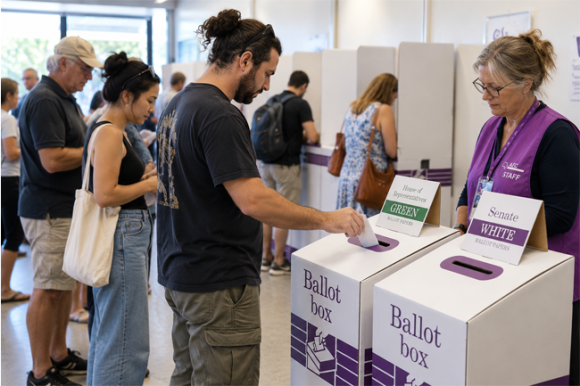
A serious democracy should be tested at four points:
- Entry: can people with diverse views realistically seek a place on the ballot?
- Selection: do ordinary voters, party members, or leaders choose the nominee?
- Contest: can candidates, parties, and Independents campaign freely against the endorsed choice?
- Accountability: can citizens (and independent authorities) observe and/or investigate the way power is used?
The satirical film The Rise and Rise of Michael Rimmer poses the question: Does reform give people greater capacity to understand, deliberate and influence power, or does it merely turn their fears and preferences into data for someone else to manage?
Australia does well on contest but does poorly on selection. This is not a reason to abandon parties. It is a reason to democratise them.
Reform need not mean importing the American primary system. Parties could open some pre-selections to a broader local electorate, require transparent rules and timetables, limit central interventions, publish membership and voting arrangements, and make safe-seat selections subject to genuine local competition.
Independents and new parties should be able to access ballots without unreasonable barriers. Political funding and campaign spending should be transparent enough that candidates are not silently filtered by access to sources of wealth.
These proposals would not guarantee wiser leaders; however, they would make a basic democratic promise more credible. The public is not simply being asked to endorse a choice made elsewhere.
Democracy does not begin with a ballot paper. If the ballot paper is the final product of an inaccessible system, then this is only a partial democracy. Before deciding whom to elect, we should ask how they were selected — and who selected them.
This is part five of our series on democracy. You can read part one here, part two here, part three here and part four here.
David Higginbottom is a member of the coordinating committee of the Independent and Peaceful Australia Network (IPAN) and coordinator of the Make Peace A Priority campaign (mpap.au).

 This work is licensed under a Creative Commons Attribution-NonCommercial-NoDerivs 3.0 Australia License
Support independent journalism Subscribe to IA.


Related Articles
- Democracy must be measured by more than elections
- Democracy demands more than a vote
- Democracy and putting power back in public hands
- Democracy and the secular faith of economics
- Strengthening democracy in Australia an example worth demonstrating