Coalition and One Nation promises to slash migration rely on unrealistic targets for reducing Australia's massive bridging visa backlog, writes Dr Abul Rizvi.
BOTH COALITION and One Nation immigration policies to reduce Net Overseas Migration (NOM) and the stock of temporary entrants in Australia are heavily reliant on reducing the number of people on bridging visas (BVs).
This is an admirable policy objective. The record number of people on BVs is an indication of a visa system in serious trouble.
I have been writing on this for almost a decade, after the problem first took off under the stewardship of former Home Affairs Minister Peter Dutton and secretary Mike Pezzullo (see Chart 1).
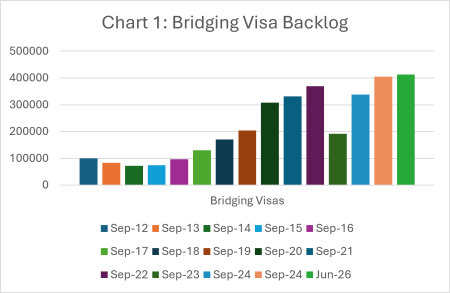
BVs are generally granted when a temporary entrant applies for a further onshore visa, but that application cannot be processed before the original temporary visa expires.
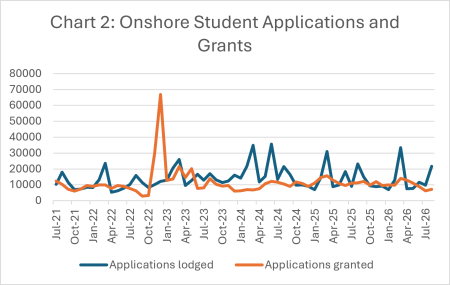
The dramatic fall in the stock of BVs in 2023 was due mainly to mass approval of onshore student and other temporary visa applicants (see Chart 2). That was not a sustainable solution and the stock rebuilt very quickly as onshore student refusal rates went up again to more usual levels.
Reducing the number of people on BVs is not nearly as simple as One Nation – and particularly the Coalition – assume. One Nation assumes it can reduce the number of people on BVs to around 300,000 (a reduction of well over 100,000) while the Coalition assumes it can reduce the number of people on BVs to around 20,000 (a reduction of almost 400,000).
Reducing the number of people on BVs would not make a major contribution to reducing NOM or to the stock of temporary entrants that these two parties hope for. Let me explain why.

The BV backlog is comprised mainly of the following:
- Students: around 25%;
- Permanent Family (mainly partners and parents): around 20%;
- Asylum: around 20%;
- Permanent Skilled: around 10%;
- Skilled Temporary: around 7%; and
- Other Temporary (mainly Temporary Graduates): around 6%.
The Government has been trying to reduce the student BV backlog using highly subjective criteria to ramp up refusals. However, this has led to the backlog shifting to the Administrative Review Tribunal (A.R.T.) — see Chart 3.
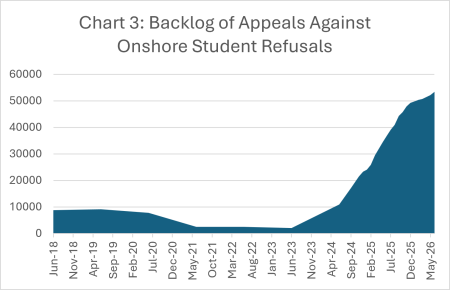
Cutting off appeals to the A.R.T. would not be the brilliant solution that some have suggested. Removing merits review just increases the likelihood the Federal Court will step in. Costs of dealing with appeals at the Federal Court are far greater on a per-case basis than at the A.R.T.
Measures to limit legally valid onshore student applications and Temporary Graduate applications, as Labor, the Coalition and possibly One Nation seem to be proposing, would be more effective but would take time.
Processing Skilled Permanent and Skilled Temporary applications more quickly would help reduce the BV backlog but would do little to reduce NOM as approval rates for these visas are very high.
Permanent Family applications could only be processed more quickly if there were places available for parents and partners. Under current practice (illegal for partners), such places are not available and hence these applicants will remain in the BV backlog for years to come.
Finally, there are asylum applications in the BV backlog. After the backlog of asylum applications, particularly at the A.R.T., blew out from 2015 (see Chart 4), the Labor Government has tried to process asylum applications more quickly. This has led to some decline in the backlog of asylum applications at the primary stage and at the A.R.T. That has reduced the growth in asylum applicants on BVs.
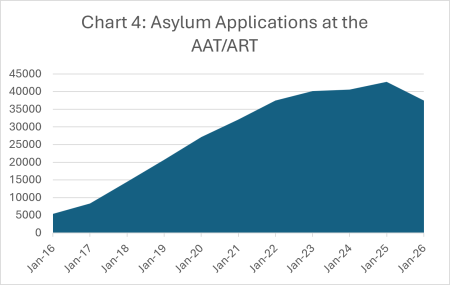
However, the number of unsuccessful asylum seekers in Australia has continued to grow. The Labor Government has recently announced it will put more resources into immigration compliance and associated detention capacity after this was massively cut back under Dutton and Pezzullo. That should lead to some increase in removals and voluntary departures.
But it won’t be anywhere near the levels the Coalition and One Nation are promising (around 80,000). That means the contribution of such departures to the lower NOM promised by the Coalition (100,000 in each of its first two years in Government) and One Nation (negative NOM in its first three years) will be significantly less.
The reduction in the number of people on BVs promised by the Coalition (400,000 by 2031-32) is just pie in the sky. The reduction promised by One Nation is more realistic, but then it is promising a much bigger reduction in NOM.
This is just one example of how ill-thought-through both Coalition and One Nation immigration policies are.
Dr Abul Rizvi is an Independent Australia columnist and former Deputy Secretary of the Department of Immigration. You can follow Abul on Twitter @RizviAbul or Bluesky @abulrizvi.bsky.social.
 This work is licensed under a Creative Commons Attribution-NonCommercial-NoDerivs 3.0 Australia License
Support independent journalism Subscribe to IA.


Related Articles
- Coalition boxed in by working holiday visa policy
- Monty Python homage: What have migrants ever done for us?
- One Nation's jittery demagoguery leads immigration policy
- Burke's immigration plan commits to net overseas migration targets
- Ramping up student refusal rates is wrong way to reduce net migration