The Coalition’s opposition to tighter working holiday visa rules is at odds with its lower migration target, leaving few politically palatable options for achieving it. Dr Abul Rizvi writes.
THE PLETHORA of conflicting views on Working Holiday Maker (WHM) visa policy is sure to have made heads spin.
They range from the flat-out wrong (Senator Matt Canavan’s argument that WHMs are not part of net overseas migration, or NOM) to the bewildering (Labor’s decision to initially pause processing and now to process these visas more slowly).
Let’s sort out the facts from the fiction.
The number of WHM and Work and Holiday (W&H) visa holders in Australia (WHM visas are demand-driven while W&H visas are capped) is at an all-time record, noting that June tends to be when many WHM/W&H visa holders leave for the Australian winter (see Chart 1).
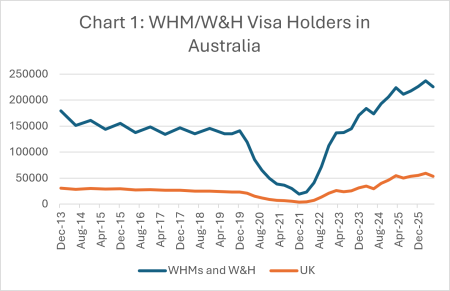
WHM/W&H visa holders make a significant contribution to NOM. They contributed around 17 per cent to NOM in 2024-25 and, behind students, were a major part of the NOM surge in 2022-23 to over 538,000.
If there is a record number of WHM/W&H visa holders in Australia – and it will likely rise through Spring and Summer assuming processing will now speed up – why are farmers complaining about the proposed policy tightening announced by the Labor Government?
While farmers will not say so, the problem is not a lack of WHM/W&H visa holders in Australia. The concern of farmers is that the new UK WHM visa arrangement and the wider changes announced by the Government have reduced the extent to which policy forces these visa holders to work on farms.
Nationals MP David Littleproud has said:
Under Labor’s changes, a ballot system will be introduced for backpackers who want to stay in Australia beyond one year, with eligible applicants for a second year WHM visa to be reduced from 57,000 to 45,000, while those wishing to apply for a third year will be cut from 31,000 to just 5,000.
“Introducing a ballot system is a measure that makes no sense. By pursuing this, the Government is basing our migration system on a raffle, rather than merit”.
Littleproud is right about the use of a ballot system — that is a poor policy tool. Apart from representing unnecessary bureaucracy and cost, there is a legitimate concern the ballot system will, contrary to intentions, disincentivise WHM/W&H visa holders from working on farms.
The disincentive of a ballot will be greatest for those seeking a third WHM/W&H visa but may also disincentivise those seeking a second WHM/W&H visa. A cleaner and more efficient approach would be to simply go back to pre-COVID policy and abolish the option of a third WHM/W&H visa while guaranteeing every first WHM/W&H visa holder who does work for 88 days on a farm gets a second WHM/W&H visa.

Another concern of farmers is that UK nationals on a WHM, by far the biggest cohort of WHMs, are no longer required to work on farms as they get an automatic three-year visa. This policy change was negotiated by former PM Scott Morrison when Littleproud was a minister in the Morrison Government. We do not know if he objected to that change, but it is likely to have significantly reduced the number of UK WHMs working on farms (possibly to nil).
Some farmers will also be concerned about the announced increase in immigration compliance resources. Historically, both in Australia and overseas, farmers have been major users of undocumented labour. With a record number of unsuccessful asylum seekers now in Australia, a substantial portion of whom were brought to Australia to work on farms from around 2015, farmers who are using this labour will be at risk of being caught by the larger number of immigration compliance staff.
In the USA, the Trump Administration has avoided undertaking Immigration and Customs Enforcement (I.C.E.) raids on farms even though U.S. farms are heavily reliant on undocumented labour — politically too sensitive and would risk further increasing food prices.
Will the Labor Government similarly avoid undertaking immigration compliance operations on farms? Will the Coalition and One Nation policy of mass deportation avoid farms, especially during harvest season when farmers are most likely to be using undocumented labour?
All parties have to date avoided talking about this, ignoring the elephant in the room.
The bigger problem for the Nationals is that they support the Coalition’s NOM target of 170,000 (55,000 less than the Labor target). The Coalition has not specified how it will deliver the reduction in NOM. But by quarantining WHMs/W&H visas and Pacific Australia Labour Mobility (P.A.L.M.) visas from any cuts, the Coalition will need to make much larger cuts in other areas.
There appears to be little understanding that the large number of WHM/W&H visa holders in Australia, particularly those who have remained long-term, will continue to put pressure on the capped and already over-subscribed permanent migration program.
While the Coalition may reduce places for parents (note, former Opposition Leader Peter Dutton quarantined parents from any cuts under his policy before the last election) and humanitarian migrants, these are a small part of NOM. The Coalition has no flexibility to reduce partner places. Indeed, both it and the Government will be under pressure to increase places for partners given the size of the backlog and the law requiring partner visas to be processed on a demand-driven basis.
The business community will strongly resist any policy tightening for skilled temporary entrants and the permanent skill stream. The recently released ABS data on how well skill stream migrants, including the partners of skill stream migrants, are performing in the labour market will strengthen the argument being put forward by the business community.
That leaves only students, temporary graduates and New Zealand citizens. Ultimately, the Coalition will need to make much bigger cuts to students and temporary graduates than Labor, which has a much higher NOM target (225,000) and has the advantage of having a tighter policy on WHM/W&H.
The Coalition has put itself in a position that requires a much bigger reduction in revenue for universities, very large job losses in the International Education sector and for businesses that operate around university precincts. It may also face pressure for a taxpayer-funded bailout of universities.
Because of its opposition to tightening WHM/W&H visa policy and its much lower NOM target, the Coalition has put itself between a rock and a hard place.
The One Nation policy of negative NOM of 250,000 per annum over three years, while also quarantining WHM/W&H visas and P.A.L.M. visas from cuts, is on another planet.
To deliver negative NOM of 250,000 per annum over three years would require not only massive cuts to almost all visa types (much larger than those listed in the One Nation policy manifesto) but also the weakest labour market in Australian history to drive out a sufficient number of people who have been living in Australia long-term. That would include a large number of Australian and NZ citizens.
One Nation supporters may have no idea about the self-harm they would be voting for if One Nation actually tries to deliver a negative NOM of 250,000 per annum over three years.
Dr Abul Rizvi is an Independent Australia columnist and former Deputy Secretary of the Department of Immigration. You can follow Abul on Twitter @RizviAbul or Bluesky @abulrizvi.bsky.social.
 This work is licensed under a Creative Commons Attribution-NonCommercial-NoDerivs 3.0 Australia License
Support independent journalism Subscribe to IA.


Related Articles
- Monty Python homage: What have migrants ever done for us?
- One Nation's jittery demagoguery leads immigration policy
- Burke's immigration plan commits to net overseas migration targets
- Ramping up student refusal rates is wrong way to reduce net migration
- Australia’s major parties converge on net migration targets