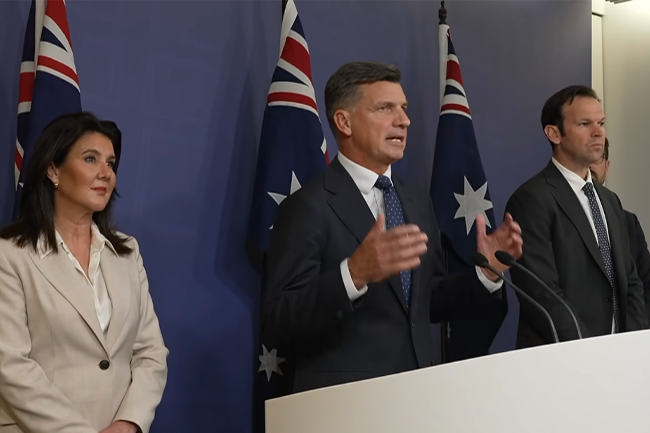
Tony Burke's immigration policy changes are good in parts, but the crucial question is whether it is enough to lower the NOM to the targets Burke has set for himself, writes Dr Abul Rizvi.
HOME AFFAIRS MINISTER TONY BURKE'S immigration policy changes are like the Curate’s Egg – good in parts. But the crucial question is whether he has done enough to get net overseas migration (NOM) down to the targets to which he has committed.
It is good Burke re-enforced his intention to deliver on his government’s NOM target (ie no longer just a forecast) of 245,000 in 2026-27 and 225,000 in 2027-28. He made it clear he will not blame anyone if he fails to deliver within some sensible range of the target.
I called for NOM targeting in this speech to the National Press Club in 2024. It would have been good if he or his predecessor Clare O’Neil had moved on this much earlier rather than:
- describing the NOM surge in 2022-24 as just being "catch-up" as if everything would fix itself (it wouldn’t as the increase in the stock of temporary entrants would have to be managed); or
- suggesting the Government has no role in managing NOM as the Treasurer did in 2023; or
- arguing NOM is just a statistical measure that can be ignored; or
- using the excuse that "there is no magic number"; or
- that managing NOM to a target range is too difficult so let’s not do it.
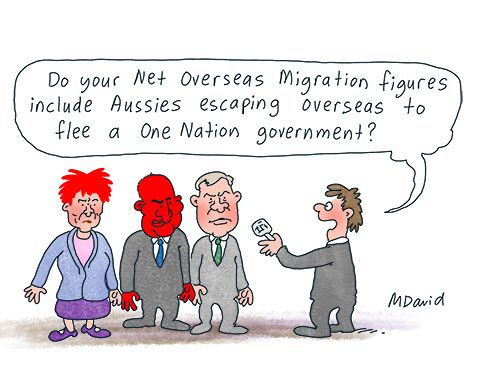
Moving on NOM targeting much earlier would have avoided giving One Nation so much oxygen.
From now on, no future Immigration Minister will pretend they are not responsible for delivering their NOM targets.
Irrespective of the politics, that reflects good government. It will prevent various ministers from free-lancing on visa changes with complete disregard for the impact on NOM (as former Prime Minister Scott Morrison did with his changes to the UK working holiday maker visa or Anthony Albanese with the changes to policy on NZ citizens).

The combination of changes Burke announced, in conjunction with the very high student visa refusal rate (a poor policy instrument), could deliver his NOM targets. It will depend largely on whether the Government still intends to deliver the student national planning level (NPL) of 295,000 in 2026 and 2027 or whether it will continue with the ramped-up student refusal rate that has contributed to the most recent decline in NOM.
If it is the former, delivering the NOM target becomes much more difficult.
The problem is the Government is unlikely to release Treasury’s latest NOM calculations (assuming these have been updated for the most recent visa changes).
Burke says regulations will be changed to prevent students from including spouse and dependent children with their visa application. There will be exemptions for Pacific Island nationals, ASEAN nations and students undertaking PhDs.
It makes sense to prevent short course students from including spouse and dependent children (eg 1-2 years) with their student applications.
But preventing married students accepted to do long courses (eg nurses; engineers; doctors) makes less sense. It may result in such high-performing students going to other nations, as it is these students that have options. That would be a poor result for Australia.
It’s also sensible to confine onshore student applicants to those who are making a progression up the Australian Qualifications Framework (AQF) hierarchy. That will further reduce students doing VET courses (which may be an objective) and it should also reduce appeals to the Administrative Review Tribunal (ART), assuming the rules are sufficiently objective to be included as a Schedule 1 criterion.
It is not clear, however, if a bachelor student moving from a Group of Eight (Go8) university to doing a bachelor course at a second- or third-tier university with a tiny campus in Sydney or Melbourne would be regarded as downgrading?
A better approach would have been to confine onshore student applications to those doing courses stipulated in Schedule 1 as being in long-term demand in Australia.
If the student NPL is to be delivered, as Burke suggested in his ABC 7.30 interview that evening, reducing the number of students who bring spouse/dependent children may not be enough to adequately reduce the student contribution to NOM.
Secondary student visa grants may just get substituted for more primary student visa grants. That would make the universities happy as it means more money for them but may not do as much as is needed to reduce NOM.
I was surprised the Government did not do more to tighten temporary graduate visa policy.
If the overall number of student visas is to be maintained at a level to deliver the student NPL, then the number of temporary graduate visa holders in Australia may remain around current levels. They will continue to put increasing pressure on the limited permanent migration places and prevent the rise in NOM departures the Government will need to deliver its NOM target.
The tightening of policy on working holiday makers was always needed if the NOM target is to be delivered. The Coalition and One Nation arguing such a large portion of NOM can be quarantined while delivering much larger cuts to NOM is just fanciful.
The Government has become obsessed with using ballots as a substitute for sensible visa design. Ballots just add a layer of unnecessary bureaucracy, cost and uncertainty.
It would have been much simpler just to abolish the option of a third working holiday maker visa and go back to policy as it was prior to COVID. There must be some deep political strategy behind the use of ballots (or not).
Increased use of the no further stay condition for visitor visas also makes sense. It is not clear, however, if this will apply to all visitor visa types or only some (eg will Electronic Travel Authority visas have a no further stay condition?).

Business visitor visas are often used by Australian employers to quickly bring in a worker with specialist skills and then apply for a temporary skilled visa onshore. That is to get around slow processing times for the offshore temporary skilled visa.
By applying a no further stay condition to business visitors, the Government will be under pressure to speed up processing times for skilled temporary visas.
Doing that would add to the already record number of skilled temporary visa holders in Australia. I was surprised the Government did not further tighten policy on skilled temporary entrants (eg by increasing the minimum salary).
Increased investment in immigration compliance and detention capacity was inevitable. The massive downgrading of the immigration compliance function under Peter Dutton and Mike Pezzullo when the Department of Home Affairs was created was a mistake.
Many will try to equate this with Trump’s mass deportation program. That would be wrong, as returning to normal immigration compliance activity is essential to maintaining a visa system with a high degree of integrity.
Highly trained immigration compliance officers who wear normal public service clothes, a name badge, no guns and only enter employer premises with permission or a warrant are very different to the way Trump’s ICE operates.
These measures will help reduce NOM somewhat, but the key question will remain.
Has the Government done enough to get NOM down to the targeted level and will that be enough to start reducing the:
- stock of temporary entrants;
- stock of bridging visa holders;
- backlog of migration appeals at the ART;
- rate of unmeritorious asylum applications; and
- number of unsuccessful asylum seekers who have not departed?
It certainly won’t do anything about the huge and rapidly growing backlog of partner applications.
Finally, Burke avoided giving much of an explanation for why his NOM target of 225,000 is the best for Australia long-term. He could have given greater explanation comparing his target with that of the Coalition or One Nation.
Burke still has a lot of work on his hands.
Dr Abul Rizvi is an Independent Australia columnist and former Deputy Secretary of the Department of Immigration. You can follow Abul on Twitter @RizviAbul or Bluesky @abulrizvi.bsky.social.
 This work is licensed under a Creative Commons Attribution-NonCommercial-NoDerivs 3.0 Australia License
Support independent journalism Subscribe to IA.


Related Articles
- Ramping up student refusal rates is wrong way to reduce net migration
- Australia’s major parties converge on net migration targets
- Canavan staggeringly wrong on working holidaymakers
- Tony Burke's immigration package must deliver the PM's net migration commitments and more
- Labor faces growing challenge on migration target