
From labour shortages to industry pressure, everything points to the Coalition failing to deliver on its latest promise to reduce migration. Dr Abul Rizvi reports.
THE COALITION has announced its immigration policy is for Net Overseas Migration (NOM) of 100,000 in 2028-29 and 2029-30, rising to 130,000 in 2030-31 and 160,000 in 2031-32.
But the details of the policy do not readily deliver these numbers. NOM under the Coalition’s policy would likely be much higher than these targets, particularly if the labour market remains strong.
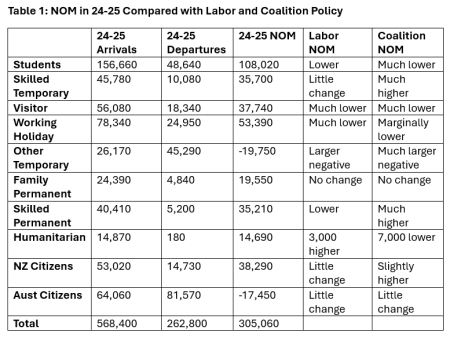
As NOM data for 2025-26 is not yet available and we don't have access to the details of the Government's NOM forecast, we have to use NOM data for 2024-25 as a benchmark.
Students
While Labor’s student National Planning Level (NPL) for new student commencements is 295,000 in both 2026 and 2027, it is highly unlikely that will be delivered due to a massive ramping up of offshore student refusals from November 2025.
In addition, Labor policy is to limit secondary student visas. These two policies will have lowered student NOM arrivals in 2025-26 and even more so from 2026-27. Student NOM departures under Labor will gradually rise due to tighter onshore student policy.
Coalition policy is to reduce new student commencements to 240,000. That may not be very different to the outcome under Labor due to the very high refusal rate. Coalition policy is also to restrict secondary student visa holders.
The major limits to Temporary Graduates under the Coalition may further reduce student NOM arrivals and significantly increase student NOM departures. It would also mean student commencements would be much lower than the 240,000 per annum claimed by the Coalition.
While the student contribution to NOM under Labor will be lower than in 2024-25, under Coalition policy it would be much lower than under Labor.
Under both parties, the International Education industry would shrink, with many more private education providers going bankrupt and some public universities getting into serious financial trouble due to a loss of tuition fees from overseas students. Unless these are bailed out by the taxpayer, there would be significant job losses at both private education providers and public universities. It is an open question as to whether the Parliamentary Budget Office took such a bailout into account in its costings.
The size of job losses in International Education under the Coalition would be much larger than under Labor. Potentially around 50,000 direct jobs would be at risk. In addition, most businesses near university precincts (small and large) would be heavily affected, with many likely to shut down.
Faced with a choice between a huge taxpayer bailout of universities and lowering visa standards for overseas students (such as risk ratings, financial and English requirements, genuine student requirement), the Coalition is likely to opt for the latter. That would put a massive hole in its ability to deliver its NOM target.

Skilled Temporary entrants
The boom in the Skilled Temporary visa since COVID has been despite a major increase in the minimum salary requirement to almost $80,000 after this had been frozen at around $53,000 from 2013 to 2023. The boom in Skilled Temporary visas has been driven by the rapid increase in the Temporary Graduate visa feeding into the Skilled Temporary visa due to a strong labour market.
Under Labor, the size of the Temporary Graduate cohort, as well as the large Working Holiday Maker cohort, will continue to drive up the stock of Skilled Temporary entrants even though many of these go on to become permanent residents via the employer-sponsored permanent category.
I was surprised Labor did not further increase the minimum salary for Skilled Temporary visas in order to dampen demand.
Against that background, it is astonishing that Coalition policy is to drive up demand for this visa category even faster from a current record stock of 260,600 to 321,000 by 2031-32. Apparently, this is to be achieved by adding more occupations to the Specialist Skills stream.
However, this would not make a net addition to the stock, as it would only transfer a very few applicants who are paid a salary of more than $146,576 per annum but currently enter the Core Skills stream into the Specialist Skills stream. The number of applicants in the Core Skills Stream with a salary of more than $146,576 would be tiny.
To achieve its larger target for this visa whilst also abolishing the Temporary Graduate visa (a major feeder group for the Skilled Temporary visa), the Coalition would have to revert to its 2013 policy of freezing or even lowering the minimum salary threshold for both the Specialist Skills stream and the Core Skills stream.
The Coalition also proposes to revise the Core Skills list. This list would have to be expanded (more lower skilled occupations added) rather than reduced if the larger stock of Skilled Temporary entrants is to be delivered.
However, both expanding the list and reducing the minimum salary would be contrary to the Coalition’s commitment to increasing standards. Because the Skilled Temporary entry visa is already managed on a demand-driven basis, with the Temporary Graduate visa a major feeder group, it would not be possible to significantly increase the stock of Skilled Temporary entrants without a major lowering of standards.
In addition, the Coalition is proposing to create a new “Project” visa that would have a target stock of 45,000. The details of this visa are not clear. If it is similar to the former Independent Executive stream of the Skilled Temporary visa, the risk of rorting would be huge.
Both the expanded Temporary Skills stock as well as the new Project visa would significantly increase the contribution of these visas to NOM compared to Labor policy. That is the reverse of the Coalition’s policy on this visa prior to COVID, when Peter Dutton tried to choke off this visa with some bizarre changes and slow processing.
If the larger stock of this visa that the Coalition is now seekingis delivered, pressure on the permanent Migration Program would be ramped up. The Coalition’s long-term ambition to reduce the Migration Program would be thwarted.

Visitors
Labor and the Coalition are both committed to limiting the ability of visitors to extend their stay after arrival. That will lead to a further reduction in the visitor contribution to NOM, although it would increase the propensity to apply for asylum. Under both Labor and Coalition policy, around 20,000 visitors applying for asylum may have to be assumed (up from around 10,000 to 15,000 per annum currently). That would be the case even with the proposed time limits on applying for asylum and still being able to access work rights.
It is not clear if either party has considered the cost of processing the additional asylum applications or of managing additional removals.
Working Holiday Makers (WHM) and Work and Holiday (W&H) visas
Labor policy is to use a ballot system to marginally limit the number of second WHM/W&H visas and significantly limit the number of third WHM/W&H visas. The ballot system is clumsy, bureaucratic, costly and opaque. But it will substantially reduce the record number of WHM/W&H visa holders in Australia and their contribution to NOM.
The question is whether Labor can resist pressure from farming lobby groups to reverse its policy. These farming lobby groups are not so worried about the total number of WHM/W&H visa holders in Australia but the number that the Government forces to work on farms.
The Coalition is promising to reverse Labor’s ballot policy but to increase visa application fees for WHM/W&H visa holders with a differentiation between regional and non-regional areas. As it is not possible to determine whether an initial WHM/W&H visa applicant will work in regional Australia, presumably this distinction will apply to WHM/W&H visa holders who work for 88 days in regional Australia and then apply for a second. That cannot be applied to UK WHMs as they automatically get a three-year visa.
The Coalition policy will mean a marginally lower contribution to NOM from WHM/W&H visas but substantially higher than that under Labor.
Other temporary visas
The major drivers of this grouping are Temporary Graduates and Bridging Visa E holders departing. That is why this grouping usually makes a negative contribution to NOM. It also includes Pacific Australia Labour Mobility (P.A.L.M.) visa holders arriving and departing (a net positive for NOM as a large number apply for asylum) as well as a range of smaller temporary visas.
The stock of Temporary Graduates under Labor will gradually decline as new student commencements fall and as existing Temporary Graduates secure other visas such as Skilled Temporary, Skilled Independent, Regional Visa and State/Territory Nominated visas. But departures of Temporary Graduates may not increase significantly if the labour market remains strong. They will look for other ways to extend their stay.
The Coalition is relying heavily on a mass departure of Temporary Graduates to drive NOM down to 100,000 in each of its first two years in Government. There are two key unknowns here.
First, the size of the exemptions for regional Australia, PhDs and Temporary Graduates who have a qualification in health and education. It is also not clear if this exemption will be extended to Temporary Graduates with construction skills and in aged care, but the Coalition will find it hard to resist the pressure from the relevant lobby groups. The larger the exemptions, the smaller the contribution to reducing NOM.

Second is the state of the labour market. If the labour market remains strong, the pressure to expand the exemptions will rise as employers will want to retain the students they have employed. The Coalition will find that its assumption that all Temporary Graduates are the same is wrong. For example, a construction engineer or a nurse who has graduated from a Go8 university will be at a vastly different level of demand compared with someone who has a management diploma from a private VET college. Driving the construction engineer or nurse out of Australia makes very little sense.
Both Labor and the Coalition have decided to leave the P.A.L.M. visa untouched. This will continue its current contribution to NOM, particularly from P.A.L.M. visa holders applying for asylum.
In addition, the Coalition proposes to bring back the Agriculture Visa from 2030 that Labor abolished. This is the archetypal guest worker visa that all politicians, including the Coalition, say they eschew.
The size of this visa is unknown, but pressure from farm lobby groups would force the Coalition into expanding it. That would turbocharge worker exploitation, very high death/injury rates of people without access to Medicare and abuse of the asylum system, with an unknown additional contribution to NOM. The Coalition would know that similar visas have been a disaster all over the world. Both the Coalition and One Nation appear to have succumbed to pressure from farm lobby groups on access to cheap farm labour.
It is not clear what the Coalition has assumed for the contribution of this visa to NOM or the costs of managing the appalling consequences of such a visa.
Labor has announced additional funding to increase removal of overstayers and unsuccessful asylum seekers. That should lead to a modest increase in NOM departures. The Coalition also intends to increase removal of overstayers and unsuccessful asylum seekers.
It is not clear what level of investment the Coalition is proposing in this regard, noting that from 2015 the Coalition significantly reduced funding for immigration compliance that contributed to the biggest labour trafficking scam abusing the asylum system in Australian history.
The Coalition is also relying on a massive decline in the stock of bridging visa holders from around 410,000 to 20,000 by 2031-32. It is possible to reduce the 100,000 backlog of onshore student visa applicants on bridging visas through tighter onshore policy for making a legally valid onshore student visa application and faster processing.
But the other three main cohorts on bridging visas – partners, parents and asylum seekers – are a different kettle of fish. The Coalition has proposed little in the way of an effective strategy to reduce the stock of these bridging visa holders.
The Coalition will not get anywhere near its target of reducing the bridging visa backlog to 20,000. Getting the backlog to 300,000 would be a major achievement. It cannot rely on its assumed reduction in bridging visas to help achieve its NOM target or its target of a 650,000 reduction in the stock of temporary entrants.
Permanent Family
Labor and the Coalition are proposing to leave this area untouched. But their respective hands may be forced in terms of partner visas if there is a class action or ombudsman recommendation to clear the massive partner visa backlog.
Partner visas are required by law to be managed on a demand-driven basis. Both Labor and the Coalition have been at fault in not abiding by the law on partner visas. Neither party has a strategy to address the massive and growing partner visa backlog (currently around 120,000).
It is impossible to properly manage migration without a credible strategy to address the partner backlog.

Permanent Skilled
Labor and the Coalition are proposing to maintain the skill stream of the Migration Program at current levels. The Coalition proposes to double places for the National Innovation visa for exceptionally talented global leaders, researchers, entrepreneurs and innovators.
As places for this visa are largely determined by the number of eligible expressions of interest received, it is not clear how the Coalition will generate additional demand for this visa without reducing standards. Prior to COVID, the Coalition used very low standards for a similar visa. It is also not clear which part of the skill stream will be reduced to make way for these additional places.
With a significant reduction in the Temporary Graduate visa, a major feeder group to the skill stream, the Coalition will need to source a much larger portion of the whole skill stream from overseas. That will significantly increase NOM and offset much of the reduction in Temporary Graduates.
Humanitarian Program
The Coalition is proposing to reduce the Humanitarian Program by 10,000 places. That will almost entirely convert to a 10,000 reduction in NOM. Under the Coalition, the Humanitarian Program would contribute around 7,000 per annum to NOM, assuming around 3,000 successful asylum seekers each year.
Labor proposes no change to the existing Humanitarian Program, which will continue to contribute around 17,000 per annum to NOM.
There is also the Pacific Engagement Visa that needs to be considered. This visa has 3,270 permanent resident places that, for no logical reason, are not counted in either the Migration or Humanitarian Programs. But the Australian Bureau of Statistics (ABS) will count them in NOM (it won’t play silly counting games), most likely in the permanent humanitarian grouping. This will add to NOM as this visa only started in 2025.
New Zealand and Australian citizens
The Coalition is expecting the stock of NZ citizens to rise steadily to 776,000 by 2031-32 (an increase of 45,000). Note that the stock of NZ citizens is net of those NZ citizens who acquire Australian citizenship. That is around 20,000 to 30,000 per annum. That suggests the Coalition is expecting NZ citizens to continue to make a sizeable contribution to NOM, possibly around 30,000 per annum.
Both Labor and the Coalition will need to allow for this in their respective NOM targets, especially if the Australian labour market remains substantially stronger than that of NZ.
Labor and the Coalition will likely have allowed around negative 15,000 per annum for the Australian citizen contribution to NOM.
Conclusion
There are two ways to approach the Coalition’s NOM target of 100,000 per annum over two years. Top-down, starting with either the 2024-25 outcome or the Labor target of 225,000 or bottom-up.
I have tried to do a combination of bottom-up by comparing the Coalition’s proposed policy with the 2024-25 outcome as follows:
- Skilled Temporary: likely NOM contribution of around 45,000 per annum.
- Visitors: likely NOM contribution of around 20,000 per annum.
- WHM/W&H: likely NOM contribution of around 40,000 per annum.
- Permanent Family: likely NOM contribution of around 20,000 per annum.
- Permanent Skill: likely NOM contribution of around 60,000 per annum.
- Humanitarian: likely NOM contribution of around 10,000 per annum.
- NZ citizens: likely NOM contribution of around 30,000 per annum.
- Australian citizens: likely NOM contribution of around negative 15,000 per annum.
That gives a total NOM of 210,000 but leaves the two areas where there is greatest uncertainty: Students and Temporary Graduates. If new student commencements are very significantly below 200,000 per annum (not the Coalition policy of 240,000 new commencements) and exemptions for students accessing a Temporary Graduate visa are kept very tight, it is possible (but highly unlikely) for Student and Temporary Graduate visas to make a combined contribution to NOM of negative 100,000 in each of 2028-29 and 2029-30.
The implications for the International Education industry would be severe, with major demands for a taxpayer-funded bailout of universities. Pressure from the International Education industry, the business community and state/territory governments to expand exemptions for Temporary Graduate visas would be intense.
There would also be pressure to freeze or reduce the minimum salary for the Skilled Temporary visa as the Coalition did from 2013 to 2023 and to make other reductions in visa standards. There would be more and more demands from the National Party for regional concessions and speedy implementation of the Agriculture Visa. The demand for labour in the health and aged care sector would continue to rise relentlessly, as would the demand for labour in the construction industry due to AI and housing.
The capacity of a new Coalition government to resist this range of pressures in a relatively strong labour market would be a major political test. Everything points to the Coalition failing to deliver on its promise to reduce NOM to 100,000 in each of 2028-29 and 2029-30 or reducing the stock of temporary entrants by 650,000.
Dr Abul Rizvi is an Independent Australia columnist and former Deputy Secretary of the Department of Immigration. You can follow Abul on Twitter @RizviAbul or Bluesky @abulrizvi.bsky.social.
 This work is licensed under a Creative Commons Attribution-NonCommercial-NoDerivs 3.0 Australia License
Support independent journalism Subscribe to IA.


Related Articles
- Cost of living pressures fuel Coalition policy folly
- Nationals out, One Nation in: A new Liberal Coalition partner rises
- CARTOONS: Coalition fight club — keeping cartoonists in business
- The death of the Coalition and a requiem for the Old Order
- CARTOONS: Mark David has got things backwards