While Pauline Hanson raises legitimate concerns about the cost of Australia's Humanitarian Program, drastic cuts would undermine refugee protections and ignore the need for better settlement support. Dr Abul Rizvi writes.
SENATOR Pauline Hanson has proposed reducing the Humanitarian Program from 20,000 per annum to 2,000 to save billions of dollars.
Some media reports suggest there is public support for this policy based on a Compass poll. Immigration Minister Tony Burke has argued that cutting the Humanitarian Program would weaken the case for offshore processing and reduce deterrence of people smugglers bringing irregular boats to Australia.
Both Hanson and Burke are putting forward flawed arguments. We desperately need improved policy in this space so that Australia can again be proud of its history of helping refugees.
What is the Humanitarian Program?
The Humanitarian Program provides permanent visas for both successful onshore asylum seekers as well as offshore humanitarian entrants that Australia chooses to bring to Australia. It is separate from the Permanent Migration Program.
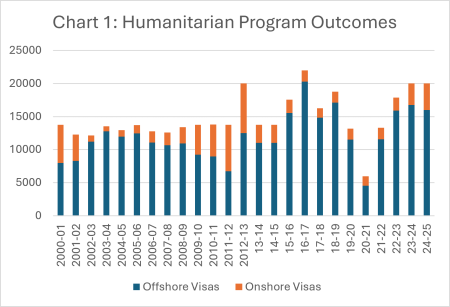
The large number of onshore humanitarian visas granted early this century was due to former Immigration Minister Philip Ruddock resolving boat arrival cases prior to and after Tampa (including repatriating successful asylum seekers from offshore).
The rise in offshore humanitarian visas in the years afterwards was a function of Ruddock’s promise to assist those in greatest need, particularly from refugee camps in sub-Saharan Africa, due to the Howard Government successfully reducing boat arrivals.
The rise in onshore humanitarian visas from 2009-10 was due to the first Rudd Government abandoning offshore processing, leading to a surge in boat arrivals. That surged again after the Abbott-led Opposition, combined with the Greens, to defeat the Gillard Government’s Malaysia Agreement legislation in the Senate.
Boat arrivals slowed significantly after Rudd Mk2 re-introduced offshore processing. Former Immigration Minister Scott Morrison awarded himself a trophy after he stopped the few remaining boats that were still coming.
In 2012-13, the Gillard/Rudd Governments abandoned the Ruddock-era discipline of a set limit on the size of the Humanitarian Program irrespective of the number of onshore humanitarian visas granted (more onshore visas meant fewer offshore visas). That led to a record 20,000 Humanitarian Program outcomes in 2012-13.
The increase in the offshore Humanitarian Program outcomes in 2015-17 was due to the special Syrian/Iraqi intakes of people fleeing ISIS that were established by the Abbott/Turnbull Governments.
Humanitarian Program visas granted fell sharply during COVID. After COVID, the Albanese Government increased the Humanitarian Program to 20,000 per annum.
The outcomes from 2022-23 do not include 26,437 Resolution of Status visas granted to end August 2026 (more will be granted in the coming months). These are humanitarian permanent residence visas granted to temporary protection visa holders who arrived by boat around a decade ago but, for no logical reason, have not been counted as part of the Humanitarian Program.
The policy of granting them permanent residence made good policy sense as removal was never an option (just think about Peter Dutton’s efforts to remove the Biloela family who were part of this cohort).
But not counting them in the Humanitarian Program is the kind of smoke and mirrors that brings administration of our visa system into disrepute. The Secretaries of the Department of Home Affairs should have insisted that these visas are properly counted. Refugee and asylum seeker advocates should also have also insisted on accurate presentation of humanitarian visa statistics.
Humanitarian Program and the Budget
Offshore Humanitarian Program migrants are provided with substantial assistance in terms of travel and settlement. Unlike skill stream migrants, they have immediate access to income support as they usually have no other means of supporting themselves. A key objective of the settlement services they are provided is to help them become self-sufficient as quickly as possible.
The Bureau of Statistics (ABS) provides comprehensive data on the settlement outcomes of all permanent migrants living in Australia since 2000. This is not a survey but is based on cross-matching administrative and census data with visa data. The key outcomes are in Table 1.
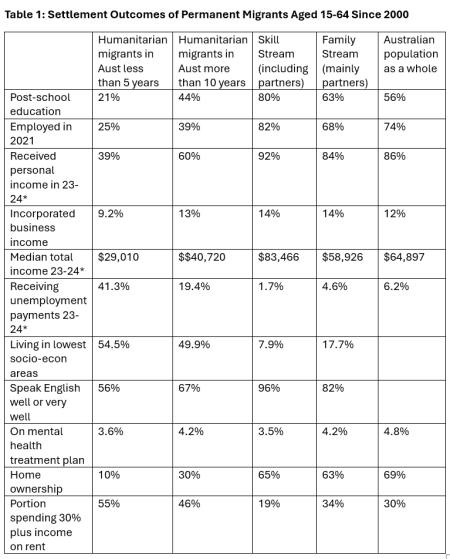
Two consistent points emerge. Skill stream migrants (including their partners) perform very well in the labour market compared to the Australian population as a whole while Humanitarian Program migrants consistently perform worse than the Australian population as a whole, even after having been in Australia for more than ten years.
It is that poor performance that leads to the significant cost of the Humanitarian Program to the Budget.
Policy considerations
Because around 4,000 people per annum are currently receiving permanent protection visas, Hanson’s policy to cut the Humanitarian Program to 2,000 places would require that either Australia withdraw from the Refugee Convention (something even the Trump Administration has not done) and amend domestic law accordingly or create an onshore queue for permanent protection (a very poor policy).
Withdrawing from the Refugee Convention would make Australia a pariah nation as 145 nations around the world, including some of the poorest nations on the planet, have signed up to the Refugee Convention. It would effectively mean the Australian Government would knowingly try to send people back to a place where they will be persecuted, possibly killed.
Reducing the offshore Humanitarian Program to around the long-term average of 14,000 per annum and putting the money saved into better settlement services would make more policy sense given the long-term unemployment rate of Humanitarian Program entrants.
The Social Policy Research Centre at the UNSW and ACOSS find that:
In the first year after arrival, the research shows that for humanitarian entrants:
- on average, around three in five (59%) live in households with $400 or less a week;
- 73% live in households with $500 or less a week;
- 75% of men and 80% of women were not in the labour force (meaning they’re not employed and not looking for work); and
- around nine in ten (almost 90%) refugee children under 15 live in households with $500 or less a week in their first year of arrival.
This is concerning. Research shows sustained poverty in early childhood impacts health, education and later life chances.
The ALP Conference policy of continuing to increase the size of the Humanitarian Program while there are such poor employment outcomes makes no sense at all.
Policy should aim to:
- encourage Humanitarian Program entrants to remain in Adult Migrant English Program (AMEP) classes for as long as needed;
- assist them to do bridging courses to get their skills recognised; and
- provide more tailored programs to help them navigate the labour market.
A key step should be to evaluate the Community Support Program (CSP), which had 2,239 visas granted in 2024-25, to gauge its effectiveness and expand it as appropriate. The CSP is a private sponsorship model for humanitarian entrants which assists Humanitarian Program entrants to achieve self-sufficiency within 12 months.
According to DHA, Approved Proposing Organisations (APOs) are responsible for managing the visa application lodgement process, securing employment and overseeing the settlement of CSP entrants.
The 12 appointed APOs are:
- AMES Australia;
- Assyrian Australian Association;
- Australian Migrant Resource Centre;
- Australian Refugee Association;
- The Brotherhood of St Laurence (before 1 February 2022);
- Cultura (formerly known as Diversitat);
- Eastern Christian Welfare Australia;
- Illawarra Multicultural Services;
- International Organisation for Migration;
- Multicultural Australia (formerly known as Multicultural Development Australia);
- Settlement Services International; and
- Spectrum Migrant Resource Centre.
Dr Abul Rizvi is an Independent Australia columnist and former Deputy Secretary of the Department of Immigration. You can follow Abul on Twitter @RizviAbul or Bluesky @abulrizvi.bsky.social.
 This work is licensed under a Creative Commons Attribution-NonCommercial-NoDerivs 3.0 Australia License
Support independent journalism Subscribe to IA.


Related Articles
- Abolition of parent visas is more complex than Hanson thinks
- CARTOONS: Pauline Hanson dishes it out but can't take it
- Hanson's plan will thwart Australia's potential
- One Nation's immigration plan: A dystopian future for Australia
- CARTOONS: Pauline's primitive penance