AUKUS critics warn the $500 billion submarine deal is sacrificing Australian sovereignty and social priorities to deeper integration with the U.S. war machine, writes Dr John Jiggens.
This article is the second part of a two-part story. Read part one HERE.
The Brisbane session
Members of the Queensland “peace not war” community, including myself, attended the Brisbane session of the AUKUS Public Inquiry on 25 August. Many academics, unionists and activists from other peace groups attended, too.
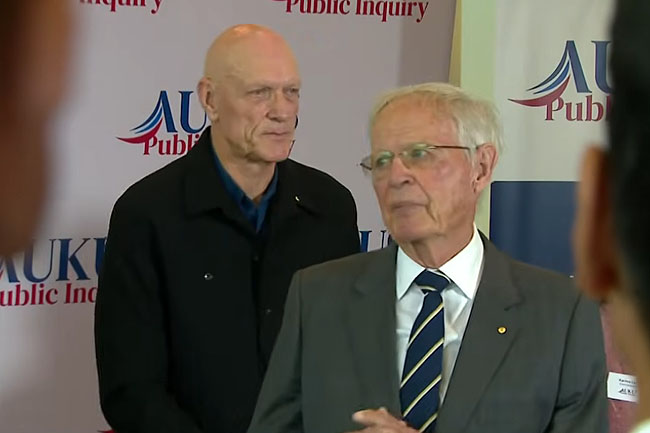
At the Brisbane session, only two of the five Commissioners were physically present: Peter Garrett and retired Admiral Chris Barrie, a former head of the Australian Defence Force. Two other Commissioners beamed in via the internet: Dr Carmen Lawrence, the first woman to become Premier of an Australian state and Karina Lester, a Yankunytjatjara woman whose people’s country had been poisoned by the UK Government in nuclear tests in the 1950s.
As lead Commissioner, Peter Garrett judicially ran the Public Inquiry, introducing the evidence-givers and reading the questions of the online Commissioners. His rockstar charisma enveloped him in a kind of awe, while his career as a powerful voice for change gave him enormous presence and credibility.
Sharing the bench with him was Chris Barrie. They seemed an odd couple: the peacenik and the former chief of Defence, but AUKUS had united them.
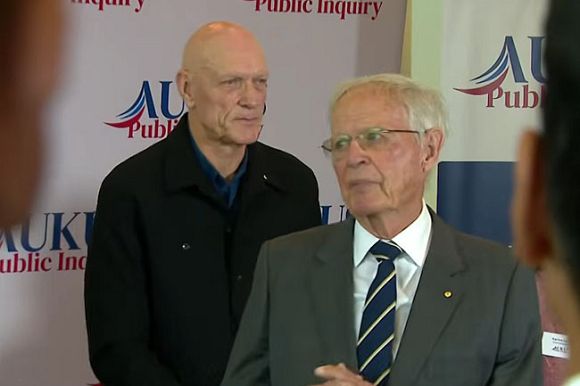
The Queenslanders who presented to the Public Inquiry at the Brisbane hearing included Marianne Hanson, an academic representing the International Campaign against Nuclear Weapons (ICAN); Margaret Pestorius from Wage Peace; Adrian Skerritt, a unionist, ALP member and housing activist; and Professor Warwick Powell from QUT, among others.
Pestorius argued that AUKUS wasn’t a Defence program: it was an economic program that aimed to enmesh Australia in the U.S. military-industrial complex to enable the flow of money to corporate warmongers who had an appalling record of destruction, genocide and ecocide.
Pestorius said former Defence Minister Christopher Pyne, now a military exports consultant and arms dealer, reshaped Australia's involvement in the weapons industry. This pathway was prefigured by other defence ministers who joined the board of major weapon manufacturers, such as Kim Beazley, who joined Lockheed Martin, and Brendan Nelson, who became CEO of Boeing Australia.
At the end of Margaret Pestorius’s evidence, Admiral Barrie asked her about several Australians employed by U.S. think tanks to profit from AUKUS:
I wonder if you know about American Global Strategies.
It's an organisation based in Washington, DC, and I wondered if you knew that Scott Morrison is the vice president of American Global Strategies, and he's assisted by a former ambassador and Liberal Senator, Arthur Sinodinos, and a former head of the Office of National Intelligence, Nick Warner.
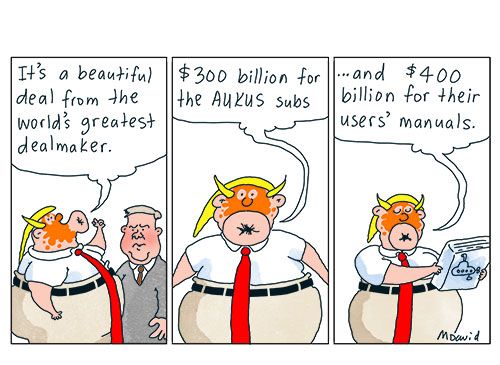
My own submission, ‘AUKUS is a boondoggle’, grappled with the problem of the afterlife of defence ministers. “Boondoggle” is an American word used to describe a government program that is expensive and wasteful yet continues to be funded because it is paid from the public purse, which fits AUKUS perfectly.
The Americans have another word, which explains why boondoggles go ahead, even though they are such incredibly expensive and wasteful uses of public money. That word is “grifter”.
In politics, the word “grifter” refers to people who use the political process to enrich themselves from the public purse and profit from the extraordinary waste of public money created by boondoggles, such as AUKUS.
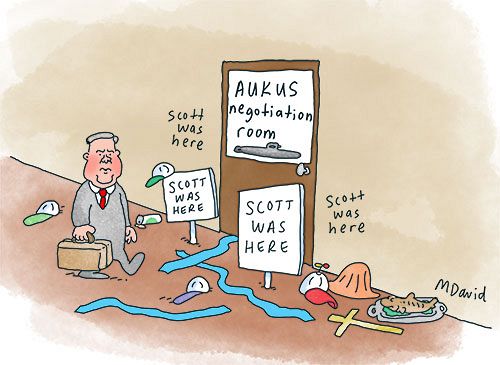
Prime Minister turned grifter
When Morrison became Prime Minister in 2018, the Future Submarine Project was running well behind time, and American voices were whispering about ditching the French deal and accepting the worst deal ever.
In his 2022 book, Morrison’s Mission, journalist Paul Kelly reveals that Mike Pompeo, the U.S. Secretary of State, was the U.S. voice who collaborated with Morrison in planning AUKUS. Evangelical Christians, the two men spoke every week about Jesus while plotting AUKUS. As they drew closer, Morrison, a geostrategic lightweight, became Pompeo’s pupil, who was co-opted by Pompeo into the U.S. strategic architecture.
In his role as Chair of the Strategic Advisory Board at the Hudson Institute, Mike Pompeo invited Morrison to join the Strategic Advisory Board at the Hudson Institute in November 2022.
The major originator of the AUKUS strategy was Mike Pompeo, who hijacked Australia’s Future Submarine Project and rebuilt it as AUKUS. His strategy was to lock Australia into a global war allied with the U.S. and UK against China, not an Australian-based strategy to deter invasion.
Adrian Pisarski, a veteran housing advocate and former CEO of National Shelter, championed purchasing the cheaper conventional submarines instead of AUKUS nuclear submarines, and using the hundreds of billions saved for addressing Australia’s major housing crisis and other social policies.
Pisarski said:
We could do free dental and Medicare for that sort of money quite easily.
We could have cheaper university education. Commonwealth rent assistance is something else that we could also lift very easily and start to assist people.
I caught the train down from the Sunshine Coast this morning and on the way, I observed no fewer than six homeless camps along parklands etc. We've just had a council to the north of Brisbane set up a permanent camp for homeless people. We haven't seen these conditions in Australia since the 1940s. We are in a genuine housing crisis.
The sort of money that we are talking about for AUKUS would solve our housing crisis.
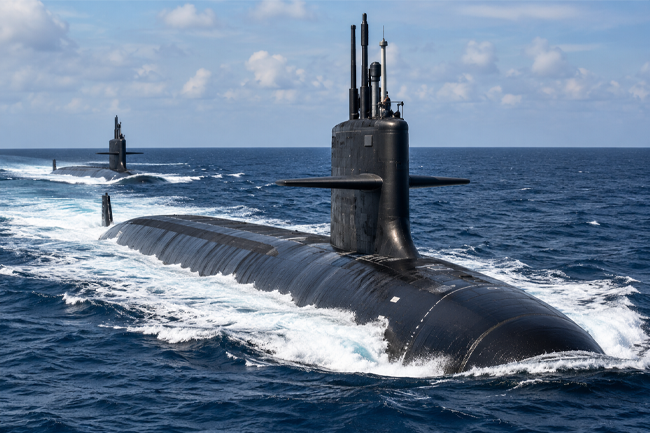
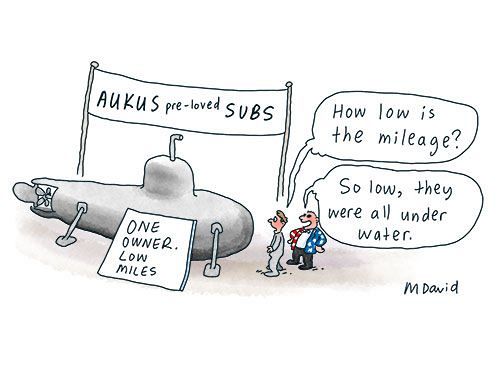
Admiral Chris Barrie followed this up. He had spoken to colleagues who suggested that for $78 billion Australia could get 12 conventional submarines, not the eight nuclear submarines for circa $500 billion from AUKUS.
Carmen Lawrence asked Mr Skerritt:
“As a fellow ALP member, why do you think the Labor Government has embraced AUKUS rather than prioritising social needs that you have identified?”
Mr Skerritt replied:
I don't know. I find it particularly unfathomable that when there was a change of government, and this being signed up to by a previous government, that there was no proper inquiry or government-led initiative to question whether this was in Australia's best interests in the long term.
In my view, it's not in our best interest and I would have really appreciated the Australian Government performing a proper inquiry that looked at those questions.
Another witness was Professor Warwick Powell, who argued that Australian foreign policy has long been trapped between two deep psychological anxieties: a fear of our own Asian geography and a persistent fear of being abandoned by a distant transatlantic protector.
For over a century, these twin fears have led us to seek security from Asia, rather than security in Asia.
Powell said:
AUKUS tells us that Australia is small, vulnerable, frightened and incapable of surviving in its own region without huddling beneath an overseas nuclear umbrella...
We do not need to choose between being a vassal state or shutting ourselves off from the world and building a fortress. We need the courage to be a sovereign middle power.
The Morrison-Pompeo AUKUS deal changed the Future Submarine Project from providing for the defence of Australia to providing a base for U.S. and UK nuclear submarines in Australia for forward attack operations by the U.S. military against China.
The claim that AUKUS is about the defence of Australia is a lie disguised by Orwellian misuse of language. The Government’s pretence is that U.S. and UK nuclear submarines won’t be based in Australia. Instead, they say that the U.S. and UK nuclear submarines will be “rotated” through Australia.
To assist this “rotation”, the Australian Government is building accommodation for 2,000 US. military personnel at the Stirling Naval Base in Western Australia. This base is only 20 kilometres south of Fremantle and it will be a nuclear target if the coming war with China eventuates.
The extraordinary cost of the project, its clear strategic misdirection from a defence of Australia policy to participating as a vassal in a U.S. war on our main trading partner, China, and the high probability we will never see these submarines were just a few of the many faults of this far-fetched and highly implausible deal discussed at the Brisbane Hearing of the Public Inquiry into AUKUS.
This article is the second part of a two-part story. Read part one HERE.
Dr John Jiggens is a writer and journalist currently working in the community newsroom at Bay-FM in Byron Bay.
 This work is licensed under a Creative Commons Attribution-NonCommercial-NoDerivs 3.0 Australia License
Support independent journalism Subscribe to IA.


Related Articles
- AUKUS public inquiry asks what Parliament won’t
- AUKUS serves America at Australia’s expense
- AUKUS — controversial, secretive but given a bipartisan blank cheque
- AUKUS offers Australia a nuclear solution to climate change
- Big Tech tightens its grip on Australia’s undersea cables