With AUKUS costs soaring and scrutiny lacking, a public inquiry is asking the questions Parliament has failed to confront, writes Dr John Jiggens.
AUKUS IS A HIGHLY controversial and wildly expensive nuclear submarine arms deal between Australia, the UK and the USA, created largely in secret by former Prime Minister Scott Morrison in 2021, working with the man who would become his mentor in grift, U.S. Secretary of State Mike Pompeo.
The epic failure in defence policy that led to AUKUS flows from the mismanagement by successive coalition governments of the Future Submarine Project. Realising that our Collins-class submarines would become outdated by 2024, the Labor Government initiated the Future Submarine Project in 2012 to purchase replacement submarines that would begin arriving by 2024.
France, Japan and Germany were invited to tender for eight conventional submarines for $20 billion with delivery to start by 2024.
After Labor lost government in 2013, the Coalition governed Australia for the next nine years under three different Prime Ministers: Tony Abbott, Malcolm Turnbull and Scott Morrison. Every time the Coalition changed leaders, the leader changed the contract for which country would build the submarines.
The Abbott Government had planned to purchase 12 conventional submarines from Japan for $30 billion, but Abbott was ousted by Morrison and Turnbull in 2015, resulting in Malcolm Turnbull becoming PM.
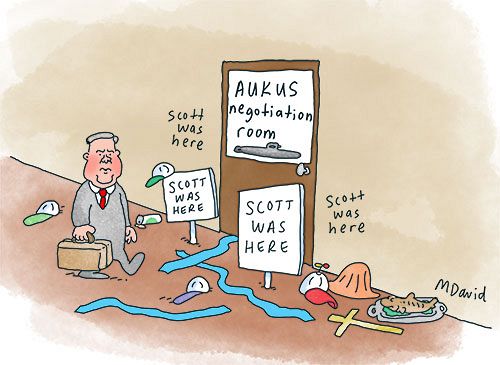
Malcolm Turnbull rejected the Japanese deal, preferring the French tender and he changed the submarine deal. Turnbull was ousted by Scott Morrison in 2018 and Morrison, in turn, broke the contract Turnbull had signed with the French and sought a different builder for the submarines.
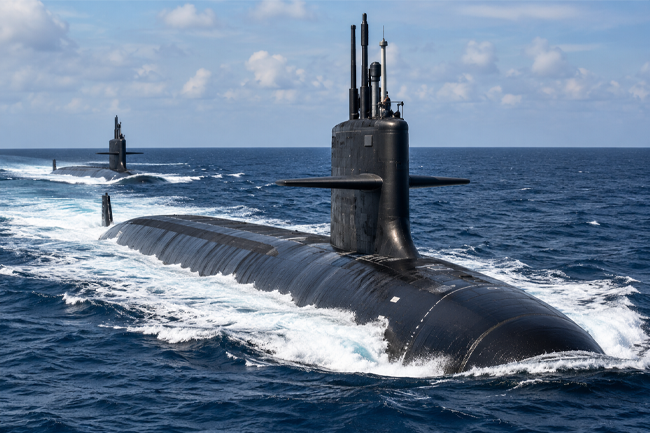
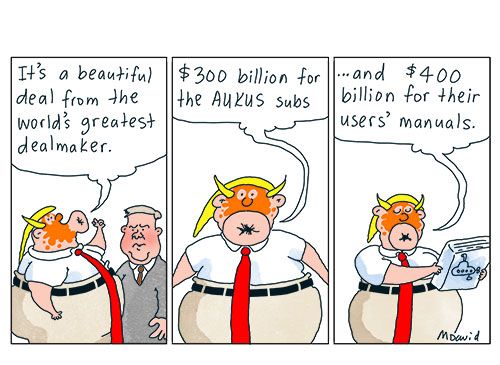
The deal Morrison signed off on in 2021 was for eight nuclear submarines from the U.S. at the mind-boggling cost of $368 billion. By then, eight years had been lost and under Morrison’s new AUKUS deal, the timeline for delivery of Australia’s submarines became sometime in the 2040s — two decades behind schedule.
The mainstream media never mention this disastrous mismanagement by Coalition governments of the Future Submarine Project and the cost blow-out from $20 billion to an astonishing $368 billion.
Rex Patrick, a submariner and former Senator, protested that this breathtakingly expensive AUKUS deal would bankrupt the Australian Defence Force. Former Prime Minister Paul Keating called AUKUS “the worst deal in all history”. They were just two of the numerous critics of this disastrous deal.
The worst deal ever
Besides wasting eight years changing contracts for building the submarines and putting the delivery date back two decades, as well as the extraordinary blowout in cost, there were many other outrageous provisions of the AUKUS agreement that justified Keating’s assessment of it as the worst deal ever.
Under Scott Morrison’s AUKUS deal, Australia will be responsible for disposing of the highly enriched uranium waste of all the partners of the AUKUS nuclear submarine fleets, the U.S., the UK nuclear submarines, as well as any nuclear submarines Australia obtains.
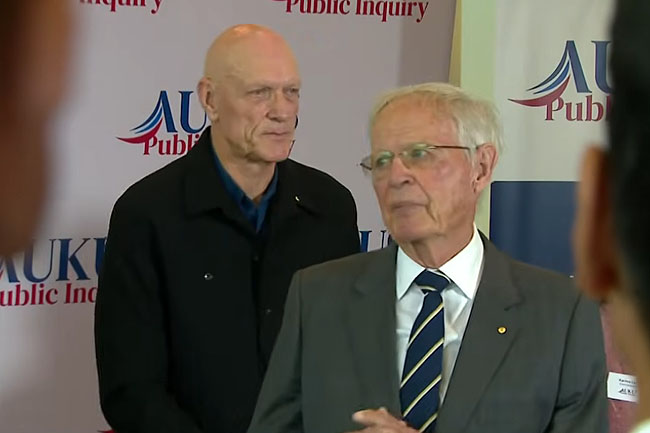
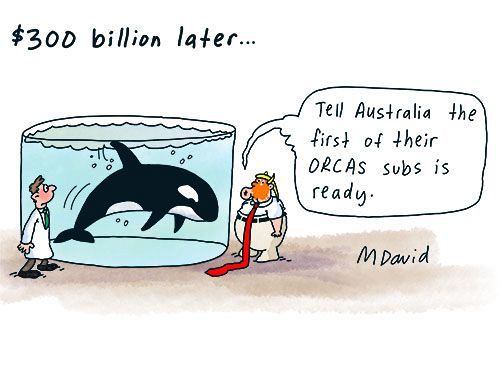
At the Brisbane session of the Public Inquiry into AUKUS, Commissioner Admiral Chris Barrie, a former head of the Australian Defence Force, disputed the claim that AUKUS would cost only $368 billion. Besides cost overruns, delays and material changes, which will add to that figure, there was one huge cost of the AUKUS agreement: the cost of disposing of nuclear waste that was never costed.
Admiral Barrie commented:
“But the other additional element which raises the question of whether costs can be contained and how that might affect the taxpayer in the long run is the requirement that Australia under the AUKUS pact is responsible for the disposal of highly enriched uranium waste.”
Admiral Barrie quoted an estimate of the expense of disposing of and securing the nuclear waste, which was derived from a South Australian royal commission that had costed a proposal that South Australia should become a repository for radioactive waste.
The South Australian Nuclear Fuel Cycle Royal Commission estimated construction, operation and decommissioning of a high-level nuclear waste repository at $145 billion over 120 years. The true cost of AUKUS will be over $500 billion.
A site for this radioactive waste facility has not been chosen, although possible locations on Defence land, including the Woomera Prohibited Area, have raised concerns among First Nations communities that traditional lands could again be targeted. No permission was sought from any First Nation’s people before Morrison signed off on this.
The coming war with China
Another reason why the AUKUS agreement is the worst deal ever is the replacement of conventional submarines with nuclear submarines. As Admiral Chris Barrie observed, nuclear submarines are designated as attack submarines.
The advantage of nuclear submarines over conventional submarines is that they are faster and can stay underwater longer. They are attack submarines and their naval purpose is to chase and attack enemy submarines. However, they are much bigger than conventional submarines, so they are more easily detected in the shallow waters of Australia’s continental shelf.
Conventional submarines are better suited for a policy of defending Australia, while nuclear submarines are designed to attack enemy submarines.
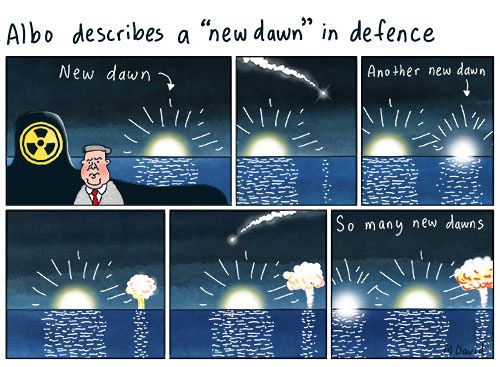
Scott Morrison devised AUKUS in 2021 in partnership with Mike Pompeo. While Morrison was an incompetent neophyte in terms of naval geostrategy, the more experienced Pompeo hijacked Australia’s Future Submarine Project, turning it from a strategy to defend Australia into a strategy for locking Australia into war with China.
The geostrategy embedded in AUKUS was an American strategy, designed to control the Indian and Pacific oceans and blockade China.
When the Pompeo-Morrison duo redesigned the Future Submarine Project in 2021, the USA had temporarily run out of wars, and U.S. geostrategy was turning into what was referred to by the U.S., their L-NP proxies and their media mates as “the coming war with China”.
China had emerged as a formidable economic and industrial power and was becoming a potential peer competitor with the U.S. Under the Wolfowitz Doctrine, the U.S. would not tolerate the rise of any power that can dispute its global dominance. The U.S. military was preparing for this coming war and was building up its nuclear submarine fleet for this purpose. This coming war with China was masked under the slogan of the Pivot to Asia.
AUKUS was announced shortly before the 2022 Australian Election, an election in which Morrison and his Defence Minister Peter Dutton ran on the China threat and “the coming war with China”. Repeatedly, Peter Dutton compared China to Nazi Germany, and declared China was backing Labor to win the election. Afraid of being wedged on foreign policy, the Albanese-led ALP pursued a “small target” strategy and went along with AUKUS.
However, in the following years, the U.S. military-industrial complex finds itself blessed with a surfeit of wars, led by a delusional and self-proclaimed “stable genius”, President Donald Trump: supporting Israel and its wars in Gaza, Lebanon, Syria and Iran, designed to build a Greater Israel; and supporting Ukraine in a proxy war against Russia in which the U.S. supplied the weapons, and Ukraine supplied the occupants of the body bags.
Ironically, this proxy war was designed to knock Russia out of the ranks of the great powers. Instead, these wars have weakened the U.S. severely.
Too many wars. And the Iran war has widened, creating a new war between Saudi Arabia and Yemen. The coming war with China, previously pencilled in for 2027, has been temporarily placed on hold.
The AUKUS Public Inquiry
Despite the astronomical debt AUKUS will saddle Australia with, deep public unease over nuclear submarines and the economic absurdity of using Australia as a base against its major trading partner, China, there has never been a parliamentary inquiry into AUKUS.
Our Parliament’s abject abdication of its responsibility for this ginormous boondoggle horrified a coalition of former MPs, retired military and naval officers, strategists, academics, union leaders and politicians. They noted the grifter-like silence of our political leaders and the failure of the mainstream media to question this looming disaster. They decided to organise an independent AUKUS Public Inquiry, under the auspices of the Australian Peace and Security Forum (APSF).
If the media and the Government refused to do their job, they would. They asked Australia two simple questions:
Will AUKUS keep us safe?
At what cost?
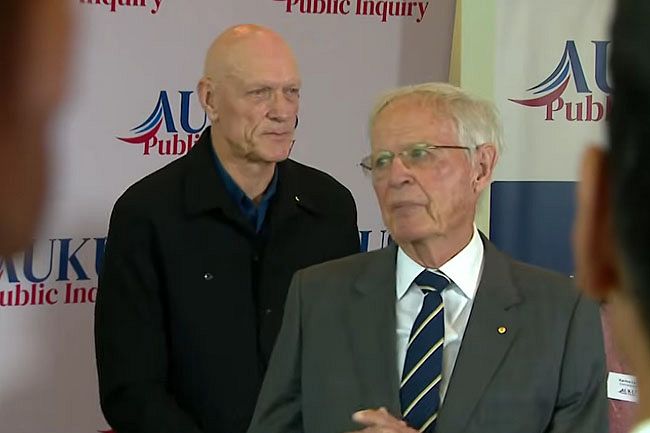
The Inquiry secretariat was headed by retired Major General Michael Smith and retired Labor politician Doug Cameron. They appointed five commissioners, led by Peter Garrett, former Midnight Oil vocalist and ALP Minister, as their lead commissioner and frontman. They invited Australians for submissions on AUKUS and received over 700 submissions.
Over the past three months, the five commissioners toured Australia, visiting all the state capitals, hearing from selected submission makers, including former Prime Ministers Malcolm Turnbull and Kevin Rudd, former Defence Ministers Bob Carr and Linda Reynolds, former Foreign Minister Gareth Evans and over 100 other concerned Australians.
Brisbane was the penultimate stop of the Public Inquiry on their tour of mainland states, before their concluding session in the Commonwealth capital, Canberra, after which they will write a report that they plan to release in November.
This is part one of a two-part story. Part two will be published soon.
Dr John Jiggens is a writer and journalist currently working in the community newsroom at Bay-FM in Byron Bay.
 This work is licensed under a Creative Commons Attribution-NonCommercial-NoDerivs 3.0 Australia License
Support independent journalism Subscribe to IA.


Related Articles
- AUKUS serves America at Australia’s expense
- AUKUS — controversial, secretive but given a bipartisan blank cheque
- AUKUS offers Australia a nuclear solution to climate change
- Big Tech tightens its grip on Australia’s undersea cables
- CARTOONS: The AUKUS caucus is decidedly raucous!