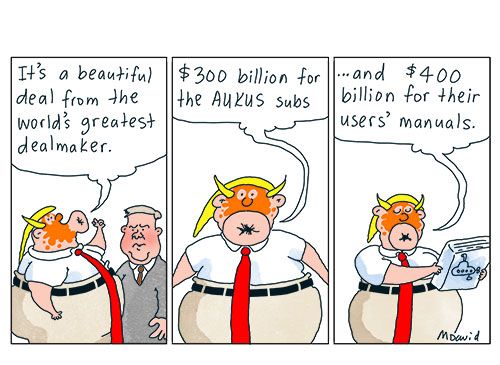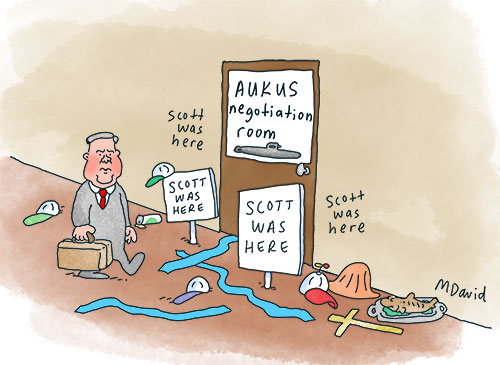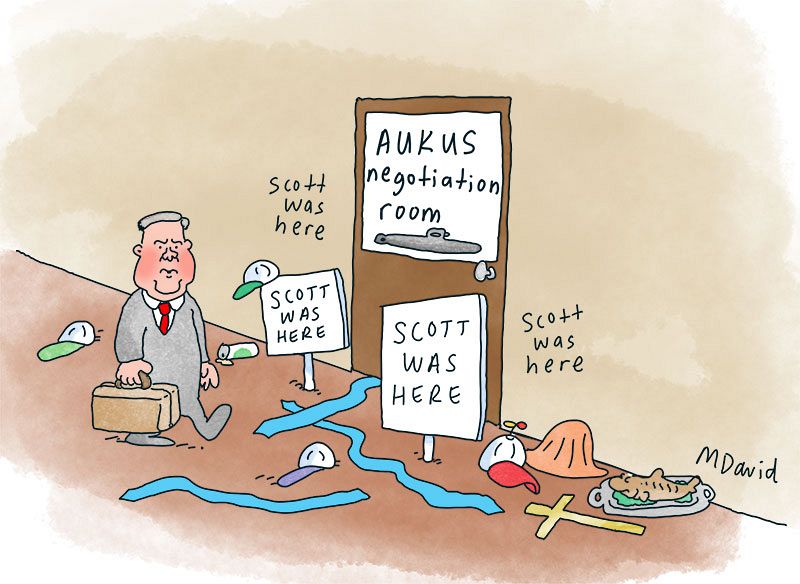
Boondoggle is a word usedby Americans to describe wasteful and expensive government projects, the perfect synonym for AUKUS, writes Dr John Jiggens.
I'D COME ACROSS the American word "boondoggle" and was puzzled by this strange verbal mishmash. What did this weird word mean?
"Boondoggle" definition:
'an informal term for an expensive and wasteful project, especially one funded by the public.'
So, I looked up “boondoggle” and found the word was used by Americans to describe wasteful and expensive government projects. It was a political word invented to critique the wasteful misuse of public funds by governments and corporations.
It caused me to wonder: Was AUKUS a boondoggle?
The AUKUS hijack
The AUKUS Submarine Project is an enormously expensive and controversial project that will impact the Australian economy for decades, the most expensive government project ever undertaken. Former Prime Minister Paul Keating denounced it as "the worst deal ever".
Former submariner and Senator Rex Patrick predicted:
"The AUKUS nuclear submarine project will bleed the Australian Defence Force white."
Surprisingly, the worst deal ever began life in 2009 as the Future Submarine Program, a sensible and modest proposal to purchase 20 off-the-shelf conventional submarines for $30 billion to replace Australia’s ageing Collins-Class submarines, which were due for retirement in 2024.
Japan, Germany and France were identified as potential suppliers, and they were given 15 months to submit their proposals, which Australia would evaluate before awarding the contract to the successful bidder, with manufacture beginning in 2016 and delivery starting in 2024. Tony Abbott, then PM of Australia, favoured the Japan proposal.
However, Scott Morrison and Malcolm Turnbull were busy sharpening the knives. Abbott’s political assassination by their forces resulted in the Future Submarine contract being unexpectedly awarded to France, resulting in a further three-year delay.
Following the AUKUS deal, Peta Credlin, Tony Abbott’s former Chief of Staff, contrasted Morrison’s AUKUS deal with Abbott’s Future Submarine Project. If Morrison had not betrayed Abbott in 2016, she said, the Japanese submarine deal would have gone ahead and conventional submarines would be arriving at the modest cost of $50 billion, whereas Morrison’s economy-crippling AUKUS deal cost $368 billion for eight nuclear submarines that may or may not arrive till the 2040s.
As Paul Keating has argued, the advantage of nuclear submarines over conventional submarines is that they can stay submerged for long periods of time, hiding in deep-ocean trenches to unleash a devastating surprise nuclear attack. They serve as part of the U.S. nuclear deterrence strategy.
Australia does not have nuclear weapons. Our defence relies on what Professor John Mearsheimer calls 'the stopping power of water'.
We are surrounded by nations of fish to the north, east, south and west. Any human invader faces the almost impossible task of transporting an army of a million or so soldiers thousands of kilometres across oceans.
Such a massive armada would be best repelled with missiles, drones, and conventional submarines that can operate in shallow continental waters and are many times more affordable than nuclear submarines. Buying three times as many conventional submarines would be much less expensive and more effective, as Hugh White argues.
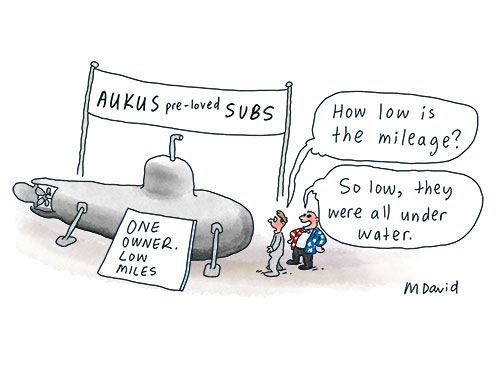
When Morrison became Prime Minister in 2019, the Future Submarine Project was running well behind time, and American voices were whispering about ditching the French deal and accepting the worst deal ever.
In his 2022 book, Morrison’s Mission, journalist Paul Kelly reveals that Mike Pompeo, the U.S. Secretary of State, was the U.S. voice who collaborated with Morrison in planning AUKUS. Evangelical Christians, the two men spoke every week about Jesus while plotting AUKUS. As they drew closer, Morrison, a geostrategic lightweight, became Pompeo’s pupil, who was co-opted by Pompeo into the U.S. strategic architecture.
In his role as Chair of the Strategic Advisory Board at the Hudson Institute, Mike Pompeo invited Morrison to join the Strategic Advisory Board at the Hudson Institute in November 2022.
The major originator of the AUKUS strategy was Mike Pompeo, the U.S. Secretary of State, who highjacked Australia’s Future Submarine Project and rebuilt it as AUKUS. His strategy was to lock Australia into a global war allied with the U.S. and UK against China, not an Australian-based strategy to deter invasion.
Enormous amounts would be spent on U.S. weapons to fund a war against Australia’s major trading partner, China, a war AUKUS architect Scott Morrison campaigned on in the 2022 Election.
There was little public discussion of AUKUS in parliament or in cabinet. Australia’s new security architecture was hatched largely in secret by Pompeo and Morrison. It was clearly aimed at China, Australia’s major trading partner, though the name "China" was as unmentionable as Voldemort. As the Utopia crew explained, AUKUS was about interrupting the trade routes of our major trading partner!
Presenting AUKUS as a fait accompli allowed Morrison to wedge Labor for being "soft on China" ahead of the 2022 Federal Election.
The "China Scare" – fearmongering about China – played a significant role in Morrison’s 2022 campaign. Morrison weaponised the "China Scare", accusing his Labor opponent Anthony Albanese of being the "Chinese government’s pick at the election".
Morrison went further, describing Labor’s deputy leader as a “Manchurian candidate.” The wedge proved unsuccessful, as Labor timidly folded and supported AUKUS, allowing Albanese to become PM.
Morrison departed from Parliament in January 2024, taking up global strategic advisory roles, drawing on his experience and networks in the region and the Pompeo connection. The private boards Morrison joined included DYNE Ventures (which employed Mike Pompeo as a strategic advisor), which said it "expected to profit" from Mr Morrison’s role as architect of AUKUS.
Shortly after Morrison’s resignation, the Australian Citizens Party (ACP) wrote to the National Anti-Corruption Commission (NACC), requesting that they investigate former Prime Minister Scott Morrison’s decision to join private companies that will profit from the massive defence expenditure resulting from his decision to establish AUKUS.
ACP Research Director Robbie Barwick explained the NACC referral was because Morrison was climbing aboard the AUKUS gravy train to cash in on the policy he created.
Smells like boondoggle!
Dr John Jiggens is a writer and journalist currently working in the community newsroom at Bay-FM in Byron Bay.
 This work is licensed under a Creative Commons Attribution-NonCommercial-NoDerivs 3.0 Australia License
Support independent journalism Subscribe to IA.


Related Articles
- Investigating the foolish: The AUKUS Public Inquiry is announced
- AUKUS: Australia gets what America can spare
- Australia didn't vote for this war, but it's fighting it anyway
- AUKUS ties nuclear anchor around Australia's neck
- Australia’s $300b AUKUS bet hinges on Britain’s submarine capacity