A memoir by author Peter Wilson explores dyslexia, self-discovery and the many forms intelligence can take, writes Jim Kable.
MY BROTHER, in his later adult life, believed himself to be somewhere on the dyslexic spectrum.
At least he always had a problem with spelling and I don’t think he read much at all during his school days, but there was nothing unintelligent about him. He gained his Clerk of Works as a builder and cabinet maker and travelled the world, working in Germany, Ireland, London and in the south of France building yachts for nearly two years.
He’d been conscripted into the armed forces before there was a change of government and our withdrawal from the American War in Vietnam. He built or transformed three homes and had worked with the Department of Community Services and as a youth worker. And in his later life, he read many books.
I was a teacher of English, history and, to a certain extent, languages. In secondary schools and briefly at TAFE level in NSW, but also teaching English in Spain, Germany and for many years in Japan. In NSW, I taught in rural areas and in the city, to native English speakers and to immigrants/refugees.
I taught students with all kinds of apparent difficulties and at all kinds of exam-based outcome levels (the iniquitous grading of students into supposed levels of intelligence), but the one thing I did not believe in (from my excellent Dip Ed studies at Sydney University in 1970) was the class-based, inequitable system of measuring intelligence known colloquially as IQ.

Over my 40 years of teaching, I saw evidence of intelligence exhibited in many different ways and so I was not fooled into thinking that aptitude at school, with its testing and examining strictures, was synonymous with “intelligence”. That testing did not so much prove intelligence as actually narrow that concept to success at testing.
Peter Wilson has written a book based on his own experiences of difficulties with reading and writing and feeling stupid, compounded by unsympathetic teachers and classroom bullying. He also writes of the incidents and insights which eventually came to him – and were tested by himself – into enabling him to succeed to the level of university success and success in his professional life.
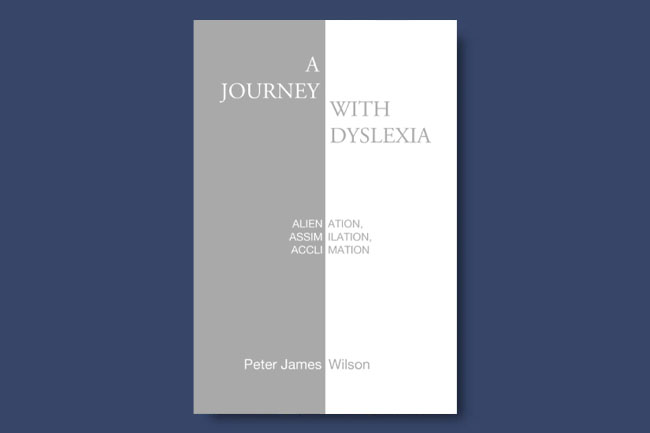
Wilson also aimed to assist others dealing with what had come to be called dyslexia, to the extent of finally writing this book. A Journey with Dyslexia: Alienation, Assimilation, Acclimation is a slim volume of only 69 pages, the final 12 pages of which consist of the Appendices offering an analysis of dyslexia – it is not a disease – along with Symptoms (or recognisable aspects), a Discussion of those symptoms and a useful Bibliography.
The real heart of this book, however, is Peter Wilson’s own journey to discover himself – his own intelligent, innate self – as opposed to how the system had made him feel. From the Preface forward, all the divisions (or chapters) are no more than a page or two in length. It begins with a brief history of its earliest descriptions, out of Germany in the 19th Century. Then he goes on with his personal journey. He references the successes from his childhood and teenage years with Cub Scouts and Scouts, and the scariness of dyslexic diagnosis or awareness for the child.
Wilson also writes of discovering that he could see better with one eye closed. Even though later ridiculed by a foreman on a building site, he had uncovered his first real strategy. And then he attended a Rotary Youth Leadership Award lecture by an educational psychologist who spoke on left brain and right brain and on how the eyes work in conjunction with those hemispheres, and of his own ambidextrous abilities.
A change in work leads to his first self-devised strategy. At home, he copies a sentence onto a blackboard. He covers his left eye and reads the sentence aloud. He repeats this with the other eye covered. Then he reads the sentence aloud with both eyes open, in a sense proving to both sides of his brain that they are seeing the same thing. This leads to further self-discoveries and he is on a pathway towards reading. I will let the reader find out what these were.
This is an important first-person account of how one man found his way.
A Journey with Dyslexia: Alienation, Assimilation, Acclimation is available from Xlibris.
This book was reviewed by an IA Book Club member. If you would like to receive free high-quality books and have your review published on IA, subscribe to receive your complimentary IA Book Club membership.
Jim Kable was a secondary school teacher of English (including EAL), History, and Japanese, before spending most of his final two decades of teaching English in Japan, 1990s and 2000s. For a brief two years, he was a member of the now-defunct New Liberals from 2020 to 2022. He takes a keen and informed view of politics.
 This work is licensed under a Creative Commons Attribution-NonCommercial-NoDerivs 3.0 Australia License
Support independent journalism Subscribe to IA.


Related Articles
- X Rubicon: The hidden casualties of secret wars
- BOOK REVIEW: Albert, Alan and the Guṯkuṯ
- BOOK REVIEW: 'Domination – The Fall of the Roman Empire and the Rise of Christianity'
- BOOK REVIEW: 'Fathering' — a century of change and what endures
- REVIEW: The Butterfly Women