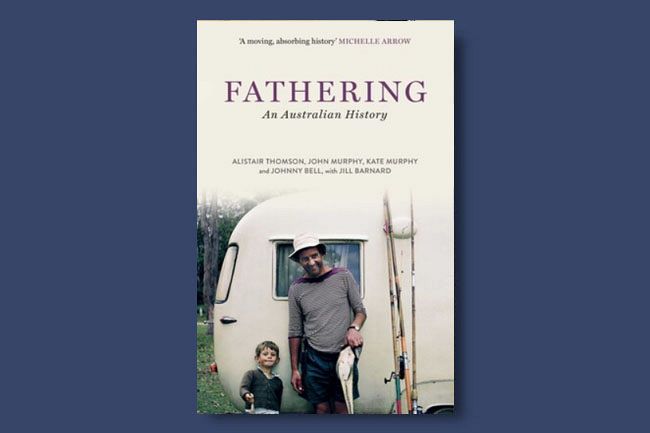
A sweeping exploration of fatherhood in Australia, from policy and history to deeply personal memory, revealing how much has changed and how much still hasn’t. Jim Kable reviews Fathering: An Australian History.
FATHERING IS A much-needed addition to the literature of parenting in Australia, focusing on the aspect of fathers and of being fathers. It runs from those born in the latter part of the 19th Century to references up to 2025, the year of its publication.
The book features interviews with Australians about their fathers (of both sons and daughters), of men who are fathers through the generations covered, of those born here or from elsewhere. But the most moving and ultimately most impressive, of fathers from First Australians backgrounds, of tragedy and of triumph against the very worst of the culturally genocidal and racist policies of the colonialist era, continuing, some would argue, till today.
(With thanks to Peter Read and John Maynard, among others, for the sharing of their expertise on these matters.)
And on to these days of Bluey and her family – and especially of her Dad and the portrayal of his fathering vis-à-vis Homer of The Simpsons or Peppa Pig's father – both fall-guy incompetents – and of the COVID-19 times, and of the latest contemporary iteration of the “new” father (beginning in the post-Great War 1920s), and of contemporary “new” dads “at home” (the negotiating of parenting — who, how and when) in the light of government policy and family support, or its lack.
From Harvester Judgment and its “male breadwinner” model, through the achievement of equal pay in 1975 and the dismantling of the so-called family wage, to the expansion of income support, childcare and parental leave, Australia’s policy landscape has evolved significantly — yet mothers still bear the greatest burden of parenting, household labour and the cost to their careers.
Following an Acknowledgements section and a note on punctuation/first-person accounts, there is the first of 15 “portraits” spread throughout the book and an important introduction.
This is followed by five parts:
- Fathering between the Wars (1919-1939);
- Fathering in WWII and Postwar Reconstruction (1940-1949);
- Fathering in Prosperous Times (1950-1972);
- Fathering in Turbulent Times (1973-1995); and
- Fathering into the Twenty-First Century 1996-).
Then it finishes with a summarising and a looking-forward Afterword. Almost 400 pages. Then follows a copious and meticulous section of Notes, References and an Index covering a further 65 pages.
The book invites a great deal of reflection from the reader. Let this reviewer do so as one who was born in the final year of Part II, both my parents in the middle years of Part I — their parents at the end of the 19th Century and around the turn of the 20th Century.
My beloved maternal grandfather was the second-last of 16 born in rural Kent; his father, then 50, had been born in 1843; his mother ten years later. His formal education lasted till he was 11. After some rural labouring and work on the railways, he arrived in Western Australia in 1912, not quite 19. Living a year in Wickepin, he decided to return to England, but working his passage, arrived in Sydney first where there was lots of work, building a green at the Mosman Bowling Club, on the construction of the new Helensburgh Railway Station, and finally in flour milling in Botany.
With the outbreak of the Great War, he was unable to enlist until later in 1915 when the minimum height limit was waived and he served with the AIF in France and Flanders. He suffered the near-inevitable gunshot wound (GSW) and shrapnel wounds and in late 1917 was repatriated back to his Sydney sweetheart and marriage, and her death in childbirth — the child a day later.
He later met my grandmother, whose mother had died of consumption in 1905 before she had turned three, and her father (out of a beef and dairy pioneering family from 1860s Fiji) when she was seven, thereafter raised by one of her mother’s sisters and husband, a shop-owning family in Camperdown/Newtown, till her marriage. My mother was the third child, the first girl, of eight.
She, in turn, became a kind of mother to her younger ones and speaks of often missing school to stay home and assist her asthmatic mother. In fact, though her teacher pleaded with her parents that she be permitted to stay on at school, at age 14, her father pulled her out of school to go into Domestic Service with his boss’s household.
She would only go on to get married. That was her fate. Her father’s reasoning. There was some later work in restaurants in the city, but after her marriage, two children and widowhood at 21, cleaning and housekeeping became her means, especially beyond the compensation case and with her eventual remarriage to what I can only describe as a war-damaged man who became my bullying stepfather.

It was only when I was in my 50s that my mother told me that my rakishly dark-complexioned, good-looking father – unusually for the times – would carry me around and refuse to hand me over to any of the aunts clamouring to take me. That I was his, he would say. I did not take my first steps till I was 16 months old, my little brother then a month old.
I was hoping to be lifted up by my Dad. And then he was gone. His father was the seventh of nine; two older siblings had already passed away in the mid-1880s in Cobar. He was born in 1890 in what was soon to become Parkes. A little chap. Some reading between the lines of family stories suggests bullying from older brothers.
His own father had lost his mother before he was one, the 15th and last child born, and raised by a big brother and wife, his father gone anyway by the time he was six. He enlisted in 1916, again with the minimum height requirement abolished — he was only five feet tall. He met his wife while recuperating from a GSW in the Scottish Borders, where she was a teacher. They married just before he was repatriated; she followed him to Australia by May of 1919.
Their child, my father, was the younger of fraternal twins; their birth in 1927 made a total of six siblings. My maternal grandfather, though a man laying down the parental law as he understood it, was loved by his children and even more so by his grandchildren, and lived till he was 91. As, too, my grandmother.
And with them I stayed when aged 11 at the end of my primary schooling and again during my first annual vacation while at university, aged 17. And listened to some of their stories, or was otherwise looked after. It was this grandmother, with support from my grandfather, who sent to me sets of encyclopaedia, of classical literature, a world atlas as encouragement towards my educational success.
I stayed with my paternal grandparents, too, when I was 11. Both sets of grandparents were then, in fact, fairly close neighbours. My Scottish grandmother began telling me stories of my father and of her illustrious ancestral connections, at which my grandfather chimed in with his tales. And though he had me help him in his vegetable gardens in a nearby shaded glen, he would also, for no reason that I could discern, pinch and twist my upper arm. I somehow knew not to react. What was it about? I have no idea, but years later, when I told my mother about it, she said she had seen him do likewise to his wife at the dinner table.
And my Scottish granny had pretended not to notice, too. There were stories from his twin sister that their father would beat my father, another little chap, and my granny, too, if she intervened. His war neurosis would see him maudlin — playing mournful harmonica and setting out on gold fossicking journeys in the NSW mid-west. Those times and the period in the NT during WWII, his family back in Sydney counted as their happiest, his presence clearly creating a lot of stress and tension.
I taught at all levels for many years in Japan. From age 40, more or less, to my retirement aged 60. Among the first questions always asked by new classes in our “getting-to-know-you” first lessons was “How many children do you have?”
I think back on it now and marvel that I knew right away how to answer as I did: “Well… there were three! A girl and (fraternal) twin boys. All three prematurely stillborn.”
When the meaning sank in, there were sad faces all around. How to rescue the moment? “But my wife and I have some nephews and nieces. And several godchildren (explanations of those terms) and all my past students, too, back in Australia and here in Japan — including you all, too. You are “my” children (their own parents not disregarded), my paedagogical children.”
My little brother had two children. I observe his son with his own two little chaps, whom he shares with their mother, a former partner. He has the boys half the week, more or less, Friday after school till Monday morning — it can vary during school holiday times when he might take them away. He is very much “with them”: visits to the local animal sanctuary or sporting practice, interviews with the school, and he enjoys a very easy relationship with them. Preparing their meals. Reading to them at bedtime. On visits, I have never seen any dramas or tantrums. I am very impressed.
And then, of course, there is for me being a mentor. My 77th birthday is the month after next. There is almost not a day that goes by when I am not in touch with one of our/my students, or with our godchildren this side of the equator or the other side, or with others.
My own childhood mentor was my mother’s long-term employer, whose birthday, fortuitously, was the same as my own. And who took a serious interest in me, my school reports and my future. Letters and gifts alerting me to the wider world, books and stamps were a part of that. And gone just about the time I turned 18. Suddenly. Never forgotten.
I thank Melbourne University Publishing and the authors of Fathering for the opportunity to read this fine book and for the opportunity to think deeply about the various ways in which fathering has been, is being and can be manifested.
Fathering: An Australian History by Alistair Thomson, John Murphy, Kate Murphy, Johnny Bell and Jill Barnard is published by Melbourne University Publishing.
This book was reviewed by an IA Book Club member. If you would like to receive free high-quality books and have your review published on IA, subscribe to receive your complimentary IA Book Club membership.
Jim Kable is a retired teacher who has taught in rural and metropolitan NSW, in Europe, and later, long-term in Japan.
 This work is licensed under a Creative Commons Attribution-NonCommercial-NoDerivs 3.0 Australia License
Support independent journalism Subscribe to IA.


Related Articles
- REVIEW: The Butterfly Women
- The Butterfly Women: Murder and survival in colonial Melbourne
- How 'The Introvert’s Guide' helped me leave the house (and like it)
- BOOK REVIEW: 90 Seconds to Midnight
- ‘Hear Me Roar’: What female animals can teach us about women and power