While CEO salaries in Australia soar to $39.5 million, the media normalises our country's economic inequality by calling it progress, writes Carl Rhodes.
EACH YEAR SINCE ITS INCEPTION in 2001, the Australian Council of Superannuation Investors (ACSI) has released a report on CEO pay in Australia’s biggest public companies.
Over the years, this report has, inadvertently, chronicled the travesty of economic inequality driven by neoliberal excess. It has always been sobering reading to find out just how much financial reward the captains of industry can command. The 2025 report is no exception.
Released in June, the report shows that the nation’s most highly paid CEO took home a staggering $39.5 million. That fortune went to Victor Herrero, who stepped down as CEO of global jewellery chain Lovisa on 21 May 2025.
Next up was Macquarie Bank chief Shemara Wikramanayake, who wrapped up the 2024 financial year with $29,762,181.
Across the biggest hundred Australian companies, the average realised pay was just over $5.7 million. That is 55 times greater than the average earnings of an adult in Australia.
A festival of inequality
Amidst the festival of inequality that the report so dispassionately documents, the title ACSI gave to the report’s press release on 19 June read:
‘Cords cut on golden parachutes for Australian CEOs.'
Of all the stories of corporate excess that might have been gleaned from the report, the folks at ACSI thought the biggest news was that:
‘...termination payments to CEOs of Australia’s largest listed companies have shrunk to their lowest levels in 15 years.'
According to ACSI’s executive manager, Ed John, this change was the result of company boards using the laws available to them since 2009. Clearly, they were in no rush! Anyway, all it means is that when big bosses leave the top job, for one reason or another, they are not getting as big a payout as they used to.
Australia’s mainstream media deemed it newsworthy. The ABC’s coverage pretty much parroted the ACSI press release, headlining 'Golden parachutes for Australia's top corporate leaders drop to lowest level in 15 years'.
It was the same at Nine Entertainment’s Sydney Morning Herald, Brisbane Times and The Age, which all ran with the same article, ‘CEO wages are falling and golden parachutes have collapsed’.
Normalising economic injustice
It would be easy to put the mainstream media response to the ACSI report down to lazy "churnalism" — a term that has been in circulation since the mid-2000s to describe the process where journalists recycle media releases and wire service stories, passing them off as original reporting.
Maybe it is a simple case of idle reporting, or maybe it is harried reporters responding to the unrealistic demands of editors. Whatever the reason, churnalism risks reducing journalism to the reproduction and distribution of views from elite sources.
ACSI would certainly qualify for this elite position, given that its membership includes, in their own words:
“Australian and international asset owners and institutional investors with more than $1.9 trillion in funds under management.”
The effect of this churnalism is corrosive. The outlandish level of economic inequality heralded by the ACSI report deserves to be a national scandal. Instead, gross economic injustice is passed off as being relatively benign. It is even implied that things are getting better in Australia when it comes to inequality.
Is the mainstream media simply normalising inequality? The article in the Sydney Morning Herald portrays investors as having heroically reined in corporate excess by shrinking the golden parachute.
They also downplay our problems by pointing out that the median realised pay for CEOs of the top 100 companies has marginally fallen in the past 10 years, while still being well below what top bosses earn in the United Kingdom and the United States.
Double standards
That we are not as bad as those countries where CEO pay is most obscene is hardly an excuse. The reality is that over the past 40 years, Australian CEOs have been pocketing a massively increasing share of the economic value created by Australian workers, with precious little of the gains being shared with those workers themselves.
While ACSI reports that today’s Australian CEOs’ earnings were 55 times as much as the average worker, back in the 1990s, that ratio is estimated to have been 17. The rate has zig-zagged over the intervening period, but the general trajectory has been strongly upward.

Does that mean that today’s CEOs are more than three times better than their 1990s counterparts? No. It just means that they take a bigger slice of the pie for themselves.
Meanwhile, home ownership has become out of reach for more and more Australians, and wage growth has been flat. That’s not going to change if business leaders have anything to do with it. Employer groups continue to lobby the government to curtail increases to minimum and award wages.
The Australian Chamber of Commerce and Industry (ACCI) has argued that increasing wages can only lead to business failures, and that any increments should only be justified by raised worker productivity. CEO productivity is not mentioned, of course.
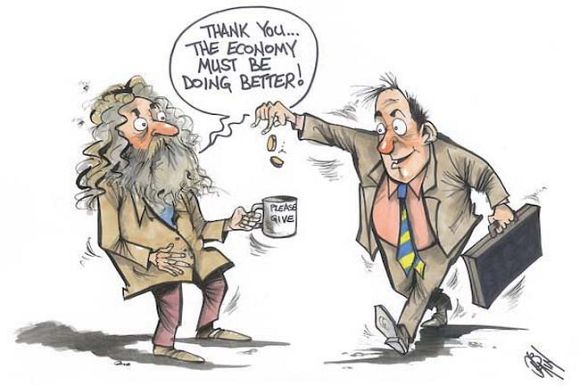
It walks and talks like a double standard. When CEO pay jumps from 50 to 55 times that of average workers in a year it passes with little remark. But the idea that workers might get a meagre increase of more than 2.6 per cent sparks outrage in the boardroom and the newsroom.
Fair go
Australia has long prized itself as a land of the "fair go"; an ideal of an egalitarian society where character rather than class matters when it comes to both opportunities and outcomes. A belief in shared prosperity has always been aspirational, but the extravagance of CEO pay spits in its face.
Economic inequality in Australia is on the rise, with CEO pay being a conspicuous dimension of the injustice. Sadly, questions of what would constitute an economically just Australia are largely absent from political discourse in Australia these days.
At times like this, the media needs to rise to its democratic responsibility to inform, educate, and stimulate debate about the country’s most important social, political and economic issues.
Churnalism won’t cut it.
Carl Rhodes is Professor of Business and Society at the University of Technology, Sydney. He has written five books on the relationship between liberal democracy and contemporary capitalism. You can follow him on Twitter @ProfCarlRhodes.
 This work is licensed under a Creative Commons Attribution-NonCommercial-NoDerivs 3.0 Australia License
Support independent journalism Subscribe to IA.


Related Articles
- Australia's economic future: The neoliberal lie
- Putting an end to neoliberalism
- The corporate criminals killing off democracy
- Democracy: An unachievable work in progress
- Vast executive salaries: undemocratic, unethical and unproductive