Last month, the Trump Administration confirmed that, for the first time, the U.S. has weapons in space in violation of international law, writes Professor Karl Grossman.
'U.S. says for 1st time it now has weapons in space' was the headline last month in USA Today.
The subhead: 'Air Force Secretary Troy Meink became the first U.S. official to publicly announce that the military has deployed weapons to space.'
The article began:
'The U.S. has confirmed in a landmark revelation that the nation has deployed operational weapons in space.'
The news swept the world.
The headline in the British newspaper, The Guardian:
'U.S. confirms for first time it has deployed weapons in space.'
The subhead:
'Analysts warn of an acceleration in high-risk arms race with Russia and China in Earth’s orbit.'
It should not have come as a surprise.
As the Associated Press subsequently reported:
'The revelation comes as the Trump administration puts a growing focus on space. In 2019, during his first term, Trump created the Space Force as a separate military branch. In his second term, he has announced the ‘Golden Dome’ missile defense system, which includes plans to put U.S. weapons in space.'
An earlier AP story published just after Donald Trump took office as U.S. president a second time also reported on 'plans to put U.S. weapons in space' as part of its planned 'Golden Dome' program.
This article by Tara Copp, an AP Pentagon and national security correspondent, said:
'The system was ordered by Trump during his first week in office, and if successful, would mark the first time the U.S. would place weapons in space that are meant to destroy ground-based missiles within seconds of launch.'
Trump is seeking U.S. “superiority” in space, as he stated in an executive order titled 'Ensuring American Space Superiority.'
Issued in December 2025, Trump asserted:
“Superiority in space is a measure of national vision and willpower.”
In his role as Secretary of War, Peter Hegseth is a highly aggressive partner in Trump's aim.
As Hegseth said in a tour of U.S. aerospace companies in February 2026:
“We have to dominate the ultimate high ground.”
He also declared on that speaking tour:
“The fight for space is the fight for the future of the world as we know it” and “We cannot afford to have a fair fight in space — I’m not interested in orbital parity. We demand orbital dominance plain and simple. Whoever controls space controls the fight.”
Adding to the acknowledgement of the U.S. deploying weapons in space, the AP also reported this month:
'American troops need to prepare for combat not only in Earth’s orbit but around the moon, President Donald Trump’s top military adviser said Wednesday, looking ahead to a new frontier in warfare after the U.S. revealed for the first time that it has deployed weapons in space. Gen. Dan Caine, chairman of the Joint Chiefs of Staff, told service members and industry figures at the Air, Space and Cyber Conference outside Washington that the U.S. military should adapt now so it "is prepared to fight, endure and win ... from the seabed to cislunar space".'
Cislunar space, AP added, “is a term that describes the region between the Earth’s surface and the moon.”
Not only is none of this new, or going back just a few days or years. It goes back many years.
As Bruce Gagnon, coordinator of the Global Network Against Weapons & Nuclear Power in Space, noted in an interview, plans by the U.S. for dominating space go back decades. The Trump Administration is conducting a major replay of these plans.
Gagnon cited, as an example, the 'Vision for 2020' plan released in 1998 by the U.S. Space Command, the predecessor of the U.S. Space Force. It’s best to be seen to be believed. It can be viewed here.
'Vision for 2020' opens with a photo of four-star General Howell M. Estes, commander in chief of the Space Command, saying the publication 'serves as a bridge in the evolution of military space into the 2lst Century.'
Below those words of Estes and presented like the crawl in the Star Wars movies is:
'U.S. Space Command — dominating the space dimension of military operations to protect U.S. interests and investment. Integrating Space Forces into warfighting capabilities across the full spectrum of conflict.'
Yes, 'to protect U.S. interests and investment.'
On the next page, on 'Historical Perspective — the Evolution of Space,' it says:
'Historically, military forces have evolved to protect national interest and investments — both military and economic. During the rise of sea commerce, nations built navies to protect and enhance their commercial interests. During the westward expansion of the continental United States, military outposts and the calvary emerged to protect our wagon trains, settlements, and railroads….As air power developed, its primary purpose was to support and enhance land and sea operations.'
'The emergence of space power follows both of these models,' it continues. 'During the early portion of the 21st Century, space power will also evolve into a separate and equal medium of warfare. Likewide, space forces will emerge to protect to military and commercial national interests and investments.'
Or, as General Joseph W. Ashy, then commander in chief of the U.S. Space Command, in a 1996 article titled 'Future Combat Missions in Space' in Aviation Week and Space Technology wrote:
'It's politically sensitive, but it's going to happen. Some people don't want to hear this, and it sure isn't in vogue, but absolutely—we're going to fight in space. We’re going to fight from space and we’re going to fight into space. That's why the U.S. has development programs in directed energy and hit-to-kill mechanisms.'
There’s been keen interest by some U.S. administrations – the Reagan administration with its “Star Wars” scheme the leading example – in placing weapons in space.
The formal name of the Reagan scheme was the "Strategic Defense Initiative", and it involved positioning orbiting battle platforms in space with on-board hypervelocity guns and particle beams and laser weapons, with the high energy they need provided by on-board nuclear reactors and plutonium systems.
There have been mixed views. The Obama Administration, for example, was opposed to weapons in space.
Starting with Trump’s first term, there were expectations that Trump, as U.S. president, would be totally for, gung-ho on, space weaponisation. And that’s what has happened.
Trump declared in March 2018, a year after the start of his first term:
"My new national strategy for space recognises that space is a war-fighting domain, just like the land, air, and sea. We may even have a Space Force…We have the Air Force; we'll have the Space Force. We have the Army, the Navy."
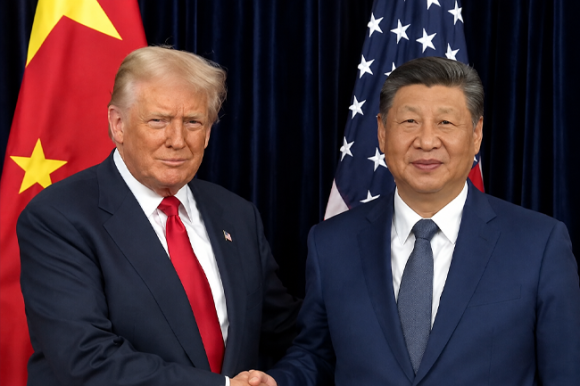
And a U.S. Space Force (USSF) was formed.
With the start of Trump’s second term, then U.S. Representative Trent Franks, a Republican from Arizona, predicted in November 2026 in Roll Call:
“A big payday is coming for programs aimed at developing weapons that can be deployed in space."
That “big payday” has come.
The weaponisation of space is a violation of the intent of the Outer Space Treaty of 1967.
Created by the U.S., the United Kingdom and the former Soviet Union — it, as The Planetary Society, based in Pasadena, California, explains:
'Is an international agreement that governs how nations act in space. Formally known as the ‘Treaty on Principles Governing the Activities of States in the Exploration and Use of Outer Space, including the Moon and Other Celestial Bodies,’ it is one of international space law’s foundational documents. The overall purpose of the Outer Space Treaty is to keep space peaceful.'
There have been repeated attempts since then at the United Nations to pass a resolution titled 'Prevention of an Arms Race in Outer Space' (PAROS) to ensure that space is used for peaceful purposes.
As noted by the Federation of American Scientists, based in Washington, PAROS 'reaffirms the fundamental principles of the 1967 Outer Space Treaty and advocates for a ban on the weaponisation of space.'
It was first passed at the U.N. General Assembly in 1981 by a vote of 129 in favour, zero against and 13 abstentions.
But the PAROS agreement to be enacted requires a unanimous vote in favour by the UN’s Conference on Disarmament, which consists of 65 nations based on global regions.
The U.S. has continually baulked at supporting PAROS, and without unanimity it cannot be approved. I have been in Geneva and watched as, at a meeting of the Conference, the U.S. representative announced that the U.S. would not support PAROS.
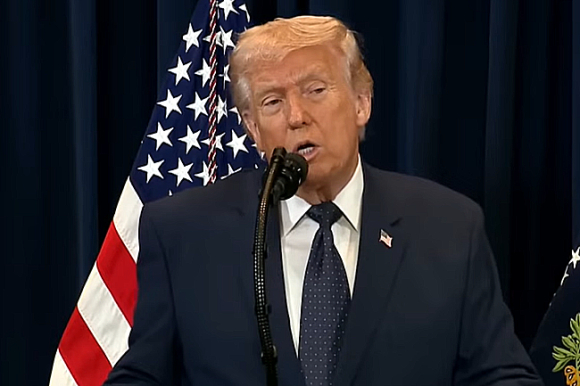
Meanwhile, the argument by the U.S. – including now with the acknowledgement by the U.S. of it deploying weapons in space – is that there is a threat of Russia and China doing this.
“This is a flagrant in-your-face lie,” says Alice Slater, a member of the board of the Global Network Against Weapons & Nuclear Power in Space and an attorney.
She faults media generally for “parroting” the U.S. claim and “disregarding the constant effort” by Russia and China to get the PAROS agreement enacted.
She also cites the “joint statement” by Russia and China last year upon, as its heading notes, the “80th anniversary of the victory in the Second World War,” in which the U.S., Soviet Union and China were allies.
'The two sides [Russia and China] oppose the attempts of individual countries to use outer space for armed confrontation,' says their statement. It cites the need for the PAROS agreement 'that would provide fundamental and reliable guarantees of preventing an arms race in outer space, weaponisation of outer space.'
Immediately following the acknowledgement by the U.S. of having weapons in space, The New York Times reported a Russian government spokesperson saying, “We believe that space must be free of any weapons,” and a spokesperson for China’s Foreign Ministry saying:
“We urge the U.S. side to stop…preparing for war in outer space,” and that China opposed an “outer space arms race.”
Gagnon, the coordinator of the Maine-based Global Network Against Weapons & Nuclear Power in Space, said he believes the U.S. has acknowledged its deployment of weapons in space in a move to:
“make Golden Dome sound inevitable, thus forcing Congress to appropriate the massive funds to secure the controversial project in the Pentagon pipeline.”
The cost for the Golden Dome system would run as high as $3.6 trillion, as estimated by the American Enterprise Institute.
Taxpayers for Common Sense, also based in Washington, in its report this year titled 'Missing the Mark: Why Golden Dome is Bad for American Taxpayers' says:
“Pursuing Golden Dome also poses serious strategic risks, including the potential to accelerate nuclear arms and space arms races and to undermine opportunities to secure verifiable arms control agreements that reduce the nuclear threat. The program has also raised troubling conflict-of-interest concerns involving individuals within the Trump Administration and companies vying for Golden Dome contracts.”
Said Gagnon:
“Taxpayers should be wondering who will pay for the trillions of dollars” for this and other “offensive space programs—especially when the U.S. is $40 trillion in debt.” He said “the aerospace industry long ago identified the ‘entitlement programs’ as their preferred source of funds” and “taking from Social Security, Medicare, Medicaid and the now tattered social safety net.”
As to consequences of war in space, he told of Apollo Astronaut Edgar Mitchell – “the sixth person to walk on the moon” – speaking at a “peace in space rally" I organised in the now re-named Cape Canaveral Space Force Station.
Mitchell told the assembled that a war in space would be the:
"One and only because so much space junk would be created – on top of the existing huge debris field – that we would not be able to get a rocket through the deadly trash orbiting the Earth. He said it would be like trying to ‘get through a piranha-laced river’ in the Amazon.”
Gagnon spoke of:
“A spiritual disconnection in the minds and hearts of those ‘leaders’ in Washington who believe that four per cent of the global population in the U.S. should be the ‘Masters of Space’ [the motto of the Space Delta 8 unit of the U.S. Space Force]. It is a deep sickness. The time has come for the American people to take the toys away from the boys.”
The Global Network Against Weapons and Nuclear Power in Space was formed at a meeting in Washington, D.C. in 1992. Each year it holds a “Keep Space for Peace Week," this year between October 3-10, with events. The 2026 theme is “Space Is a Global Commons—Not To Be Dominated.” The Global Network’s website can be found here.
A book I authored, published in 2001, Weapons in Space, quotes Gagnon as saying:
'If the U.S. is allowed to move the arms race into space, there will be no return. We have this one chance, this one moment in history, to stop the weaponisation of space from happening.'
Similar warnings are made by Gagnon and others in TV documentaries I wrote and presented: Nukes In Space: The Nuclearisation and Weaponisation of the Heavens, first out in 1995 and viewable now here, and Star Wars Returns, out in 2012, which can be seen here.
I concluded another book I wrote, The Wrong Stuff, published in 1997, with:
'As for space weaponry, we are living at an historic junction. We have the opportunity now to halt the expansion of a new round of the arms race into space. The Star Wars of the Reagan administration is clearly not over, as the U.S. military seeks to attain the "ultimate high ground" and with nuclear-powered weaponry to dominate space and the Earth below. We have a chance to stop something wrong and dangerous before it happens, before it is too late.'
Karl Grossman is a professor of journalism at the State University of New York. He is also an award-winning investigative reporter. Click here to go to Karl's website.
 This work is licensed under a Creative Commons Attribution-NonCommercial-NoDerivs 3.0 Australia License
Support independent journalism Subscribe to IA.