While Australia debates the $368 billion AUKUS bill, a quieter surrender of sovereignty is happening in our defence software — and unlike submarines, this is one we could actually build ourselves, writes Wayne Hawkins.
IN FEBRUARY THIS YEAR, the Department of Defence signed its largest-ever contract with Palantir Technologies — a $7.6 million deal to supply an ICT platform for Defence's Cyber and Electronic Warfare Division. It was awarded under a limited tender. No open market. No competition. No opportunity for an Australian firm to even put its hand up.
If you haven't heard of Palantir, here's the barbecue version: it's a U.S. data analytics company co-founded by Peter Thiel, one of the most influential backers of the Trump political project. Its software helps governments fuse enormous datasets into operational intelligence. It runs deportation logistics for U.S. Immigration and Customs Enforcement (ICE), and it supplies targeting-support technology to the Israeli military.
This is the company we've invited into the engine room of Australian defence.
And invited is the right word. A contract obtained by Crikey in March revealed that Palantir's arrangements with Defence include embedding company staff inside the department and handling Australian data, on contractual terms notably favourable to the company.
Defence has now spent more than $26 million with Palantir since 2013. AUSTRAC – the agency that watches every significant financial transaction in the country – has seen its Palantir contract swell past $12 million through repeated variations.
And the Future Fund, our sovereign wealth fund, holds roughly $100 million in Palantir stock — meaning Australians are simultaneously the customer, the dataset, and the shareholder.
The pattern should look familiar
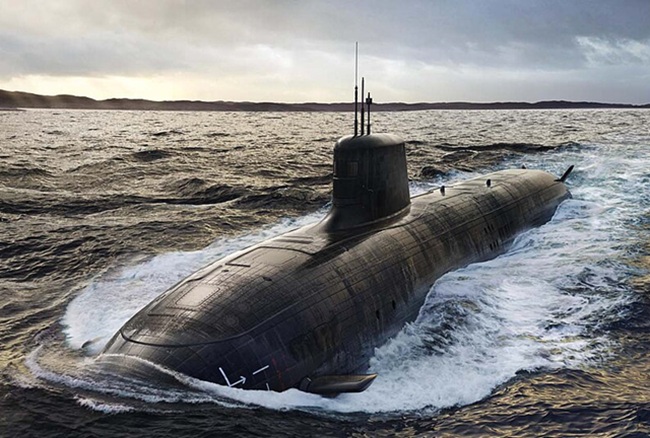
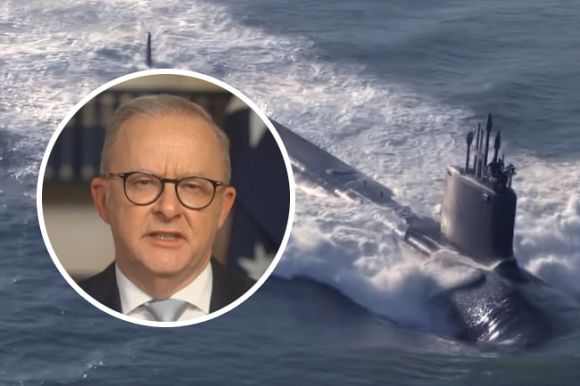
In my submission to the AUKUS Public Inquiry, I argued that the central failure of the AUKUS debate is the conflation of capability with sovereignty. Virginia-class submarines require U.S. fuel, U.S. maintenance, U.S. supply chains and U.S. operational integration. That is not strategic independence — it is strategic dependency under a different name.
Palantir is AUKUS in miniature. Same dependency, different layer.
The submarines bind our hardware to Washington; the software binds our data. Researchers have warned that Palantir's highly specialised tools create vendor lock-in — the more an agency relies on the platform to make sense of its own information, the harder and more expensive it becomes to ever leave. Once a foreign company's proprietary system sits between the Australian government and the Australian government's own data, sovereignty over that data is a courtesy, not a fact.
Consider what Defence has actually asked Palantir to do. Under an earlier contract, the company was engaged to map Australia's defence industry capability and capacity — an "Industrial Intelligence Capability". Sit with that for a moment. A foreign corporation, aligned with a foreign administration, has been paid to build the definitive map of Australia's sovereign industrial base. Whoever holds that map knows our strengths, our gaps, our dependencies and our pressure points — knowledge we do not hold about them in return.
Defence assures us the data is "strictly sovereign", hosted on local infrastructure and accessed only by vetted Australian staff. Perhaps. But sovereignty guaranteed by a vendor's contractual undertaking is sovereignty on loan. Ask the officials who assured us the AUKUS delivery schedule was solid — right up until June's announcement that all three Virginia-class boats would now arrive second-hand.
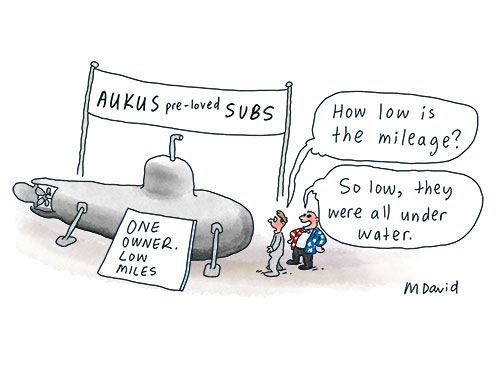
Here's the part that should make every Australian genuinely angry: unlike nuclear submarines, this is a capability we could build ourselves.
Australia has no nuclear industry, no nuclear engineering workforce of scale. Fair enough — that gap took decades to create.
But software? Data analytics? We produced Atlassian and Canva from scratch — two of the most successful enterprise software companies in the world. CSIRO's Data61 is a world-class data science research organisation. Our universities produce AI and machine learning graduates that Silicon Valley actively poaches. The talent exists. It is ours. Much of it leaves precisely because contracts like this one go offshore without a tender.
This is the resource sovereignty story all over again, in a new key. We export iron ore and buy back steel. We export lithium and buy back batteries. Now we export our brightest data engineers and buy back – at a premium, under limited tender, from a Thiel-aligned firm – the software layer of our own national security. Your country. Your data. Where's your share?
None of this requires attributing bad faith to anyone. Defence officials under delivery pressure buy the mature product; that is a structural incentive problem, not a conspiracy.
But structural problems have structural fixes, and they are not complicated:
- First, no more limited tenders for core national security data platforms. If the market can't be tested, Parliament should be told why, in public.
- Second, a legislated sovereign capability requirement: government data platforms above a threshold value must be Australian-owned, Australian-hosted, and Australian-auditable — with the source code escrowed here.
- Third, take a fraction of the money. The AUKUS commitment now exceeds $368 billion. One tenth of one per cent of that – around $370 million – invested in a sovereign defence data capability, built by Australian firms and researchers, would return more genuine strategic independence than any second-hand submarine.
- Fourth, the Future Fund should explain to Parliament why we hold $100 million in a company whose deepest commercial incentive is to keep Australian agencies dependent on it.
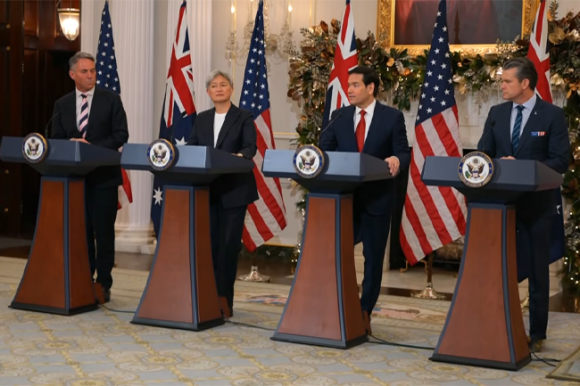
The question is the same one I put to the AUKUS inquiry: not whether Australia should have capability, but whether Australians were consulted about who controls it.
Accountability without consequence is not governance — it is performance.
And handing the keys to our defence data to a foreign billionaire's company, without so much as an open tender, is a performance we can no longer afford tickets to.
 This work is licensed under a Creative Commons Attribution-NonCommercial-NoDerivs 3.0 Australia License
Support independent journalism Subscribe to IA.


Wayne Hawkins is an independent commentator based in Tasmania and an independent candidate for the federal seat of Clark.