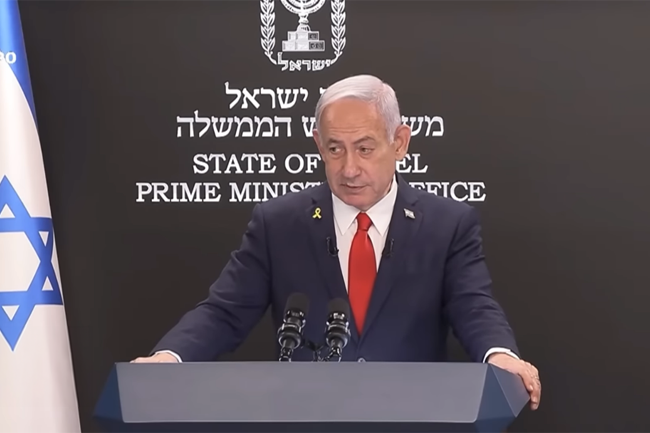
Israel has been losing battles in the war of propaganda and morals, while stepping up its war on the ground against Gaza.
Dr Lee Duffield writes that Benjamin Netanyahu’s walking in on Australian politics, attacking Prime Minister Anthony Albanese, was a fresh case of the global extreme-right ignoring normal boundaries.
NOT LAUNCHING bombing raids as Israeli Prime Minister Benjamin Netanyahu does against neighbouring states – Lebanon (1 October 2024), Syria (8 September 2024), Iran (12 June 2025) and Yemen (25 August 2025) – in the ongoing hunt for terrorists, it was a rough enough go at a friendly country.
Enraged and unsettled at getting crossed – Australia opted to recognise a state of Palestine at the United Nations in September – Netanyahu once again pulled out antisemitism: those who go against Israel’s position must be betraying Jewish people, he said.
That refrain accompanies the strategy of outright denial, right now, denying there is starvation in Gaza.

Taking hits in the propaganda war
The bombardment of Gaza around its destitute and terrified population has become a gathering defeat for Israel in the crucial propaganda war, because of the relentless suffering and the cut-off of the international food supply operation last March.
Once more for the record: hundreds of depots organised by skilled and resourced United Nations agencies and non-governmental bodies were “replaced” by four, set up by the Americans and the Netanyahu Government in exposed military zones. Hundreds have been killed trying to get to them. By authenticated accounts, others have begun to starve in large numbers.
Was it done for population control, to be able to move out the Palestinians later? Would it be, as claimed by Israel, because the Hamas terrorists were commandeering all the supplies? The latter demands more evidence about the level of theft that was being achieved, and how much of the food and medicine was being stolen. In the mute and intransigent logic of propaganda, emotion and opinion, the claim does not stack up that well against the stacks of dead bodies: “talk-talk-talking” set against cruel facts.
State of the Israeli forces?
The episode calls fresh attention to the questionable quality and discipline of the Israeli troops, mostly militia on call-up, who seem able to operate with impunity — too many mass killing incidents, too many thugs, scared, enabled to get away with anything. Any new outrage gets denial, fatuous talk about a military inquiry, assertions with scant evidence that the school building or hospital brought under fire was being used by the terrorists. The power of the Israel Defence Forces has been formidable, especially in its exploitation of air superiority in its region, but the respect it earned in the great battles for survival of 1967 and 1973 has been fast evaporating.
Military progress against Hamas guerrillas is unclear due to secrecy protocols, including the general exclusion of outside media, or actual lethal assaults on media groups that do operate locally. At the start of the conflict, Hamas was known to have concentric defensive positions in the Gaza City area and a tunnel system. There have been earlier Israeli assaults on that area, where Palestinians have yet remained concentrated. The assault that got underway against Gaza City in the second last week of August looks to be much bigger.
It certainly scotches the idea that after hammering Hamas, Israel might have taken a victory and negotiated a settlement much to suit itself, from a position of advantage. Writing earlier, I illustrated the idea by suggesting that, through a highly effective and symbolic act, such as catching or killing degenerate Hamas chieftain Yahya Ibrahim Hassan al-Sinwar, it could then declare itself the winner and lay down terms. In the event, Yaya’s death, caught by a drone, came and went. The campaign continued for the “elimination” of all of Hamas.

What people think
Users of social media may have noticed a stepping-up of propaganda effort from Israel: dancing girls in army uniforms, or costumes (inheritors of the uniformed calendar girl campaigns of the past, designed in part to rile Islamic sensitivities about “liberated” womanhood).
Other gestures reminding the “West” that Israelis are “Western”, with tourist promotions for a normal world of beach holidays, camping and evenings out around the restaurants and bars — just not far away from the chaos of Gaza. A stepping up also of reminders of the Holocaust. (Hardened sensibilities about that terrible time; to the world, criticism of Israel need not be antisemitic, but to very many Jewish people, it is.)
Such activity, though, is not washing that well with the great majority in the political middle ground in countries like Australia, where the ghastly abuse of the Palestinian civilian population has caused shock and is being reviled.
The Australian Government has taken up a position something like the “even-handed neutrality” declared by Labor Prime Minister Gough Whitlam during the 1973 Yom Kippur War. Support for a ceasefire seemed justifiable in that close-run battle, with the existence of Israel on the line. (See a plausible treatment of the crisis in the recent film, Golda.)
A successor to Whitlam, Bob Hawke, had an emotional sympathy for Israel, moving the Labor Party more into its corner. His position reflected the evident sympathy of the great majority of Australians, supportive of Israel defending itself, although as it turns out, up to the point now reached by the current government of that country.
Over 80% of Australians have been saying in 2025 that the blockage of food, water and medical supplies is not justified; support for a Palestinian state, the “two states” solution, has been running 45% to 25%, the rest evenly split. The street marches in sympathy – 50,000 here, 90,000 there – are eloquent.

Problems to come
Yet, governments, including Australia, lining up to recognise Palestine as a state at the United Nations General Assembly in September, have to deal with grave weaknesses in their pitch.
They insist that the dominant and domineering Palestinian party, Hamas, a declared terrorist formation as well, should and can be excluded from the formation of a new state. But Hamas has been controlling an administration in Gaza, still not entirely shattered; it has roots in the Palestinian community, supporters and sympathisers outside, like Qatar; still armed, it is despotic and brutal enough to intimidate and crush any local political opponents.
Has Hamas not, as well, got its propaganda advantage by ruthlessly making its own population hostages?
And what about the outrage of 7 October 2023, that barbaric foray into Israel that brought on the present revenge and collective punishment against tens of thousands — does that not, still, give moral credence to Israel’s case? Never forget, again, the hostages. Netanyahu may have neglected them badly, but should there ever have been hostages taken?
Except that, there remain so many civilians, whose lives have been ruined or lost. And now so many are in a dire condition, suffering hunger and thirst in the rubble of their towns. It is, once again, a most powerful, wordless appeal to the conscience and judgment of civilised people, to get it ended.
FOOTNOTE: The actual act of going to the United Nations General Assembly this September in New York may get difficult. The Israeli Government has been cancelling visas and generally interfering with movements needed to carry out diplomacy, such as for Australian delegates to the Palestinian Authority.
What if the Trump Administration takes the same attitude on access to the General Assembly? In 1988, when former Palestinian leader Yasser Arafat was due to tell that body he had renounced terrorism, supported Israel’s right to exist and wanted a Palestinian state, the outgoing Reagan Administration broke agreements with the UN and blocked his entry through American territory. The Secretary of State, George Schultz, who had always seen Arafat as an out-and-out terrorist, would not budge on the visa.
The entire assembly was moved to the old League of Nations palace in Geneva. Watch for possible disruptions of that kind. (Extremist parties on both sides, Israeli and Palestinian, in the 1980s, contrived to defeat the two-states proposal, Arafat, and moderate Jewish politicians.)
Amongst Dr Lee Duffield’s vast journalistic experience, he has served as ABC's European correspondent. He is also an esteemed academic and member of the editorial advisory board of Pacific Journalism Review and elected member of the University of Queensland Senate.
 This work is licensed under a Creative Commons Attribution-NonCommercial-NoDerivs 3.0 Australia License
Support independent journalism Subscribe to IA.


Related Articles
- How Israel’s allies hijacked U.S. democracy
- No bomb, no peace: Israel and Iran collide
- Israel implementing its horrendous final solution
- The politics of violence and repression in the wake of Israeli embassy shooting
- Israeli genocide reveals double standards of European leaders