Our new series, WARFARE TO WEALTH, is a progressive critique of the Federal Government's defence and foreign policy trajectory. It provides in-depth analysis of Australia's $368 billion AUKUS commitment and the broader militarisation of our economy.
It is timed to precede the ALP national conference (23-25 July) – which will shape the Government's policy platform and strategic direction for at least the next two years – in the hope that, along with growing pressure from the broader community, the arguments against this militarisation may be compelling enough to make their mark.
This article is part three of the series, Warfare to Wealth: Redirecting Australia's Future. You can read the other chapters in this series HERE. The next chapter will be published soon.
Part 3: The myth of American idealism
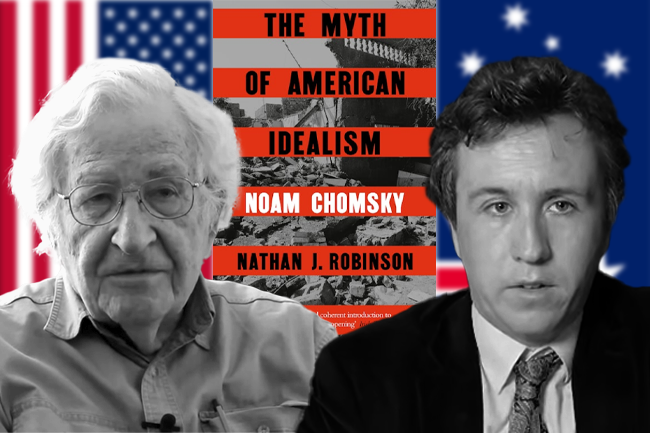
Noam Chomsky and Nathan J Robinson challenge the mythology of American exceptionalism and its consequences for Australia, writes David Higginbottom.
IT IS RARE to find a single volume that captures the world we have inherited. The Myth of American Idealism does exactly that.
Co-authored by Noam Chomsky, one of the most prominent public intellectuals of our time, and political commentator Nathan J Robinson, this book is an essential read for anyone who wants to understand what the America-led world order has truly created.
It is a stark revelation of what our averted gaze didn't show us and a compelling argument for why we must fundamentally reject the self-serving image of American benevolence.
It is worth noting that the book was published in October 2024, before Donald Trump's return to the White House. The authors' central argument is that American foreign policy has always been driven by the pursuit of dominance, rather than the promotion of freedom — and that this has been true regardless of which party holds power.
Trump's second term does not refute this thesis; if anything, it confirms it in the starkest possible terms — what previous administrations achieved through idealistic mythology, Trump dispenses with entirely. His hubris is so complete that he does not bother to disguise his real intent. The mask has not slipped; it has been thrown away. Chomsky and Robinson's argument that the myth was always a myth is now visible to anyone paying attention.
From the overthrow of democratically elected governments in Guatemala and Chile to the devastating wars in Southeast Asia and the Middle East, the record reveals a pattern of intervention designed to maintain control, not to promote liberty.
The Mafia Doctrine and the ‘Fifth Freedom’
The central premise of the book is simple: the United States, like all great powers throughout history, operates not on matters of principle or of human rights, but on the pursuit of strategic and economic dominance. The authors dismantle the persistent narrative of American exceptionalism — the idea that the U.S. is a “shining city on a hill” whose foreign policy is driven by a desire to spread democracy and freedom.
Instead, Chomsky and Robinson argue that U.S. foreign policy is guided by what they call the “Mafia Doctrine”. The Godfather's word is law and those who defy the Godfather will be punished. If a nation disobeys, it is not just brought back into line; it is made an example of, so that others do not get the idea that disobedience is permissible.
This dynamic is what the authors term the “Fifth Freedom” — the freedom to dominate, which supersedes Franklin D Roosevelt's famous Four Freedoms whenever they conflict with the interests of American elites.
This framing is crucial for understanding the post-World War II era. The book meticulously documents how the U.S. has consistently opposed democratic movements and social reforms in the Global South whenever they threatened the interests of American investors or strategic planners.
From the overthrow of democratically elected governments in Guatemala and Chile to the devastating wars in Southeast Asia and the Middle East, the record reveals a pattern of intervention designed to maintain control, not to promote liberty.
Internal documents, declassified and cited throughout the book, make clear that the primary threat Washington feared was not aggression but the “threat of a good example” — the danger that a nation choosing its own path might inspire others to do the same.
An Australian lens
For Australian readers, this book is not merely an account of distant events. It is a mirror held up to our own strategic choices — and the reflection is uncomfortable.
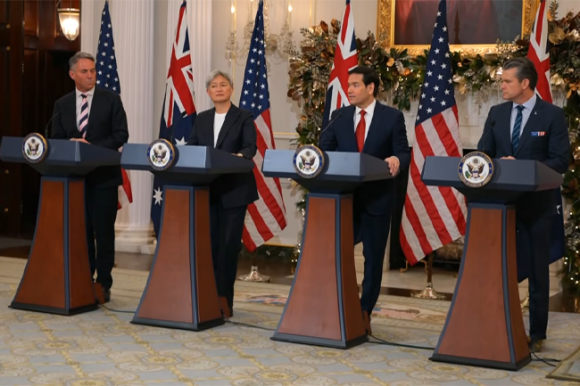
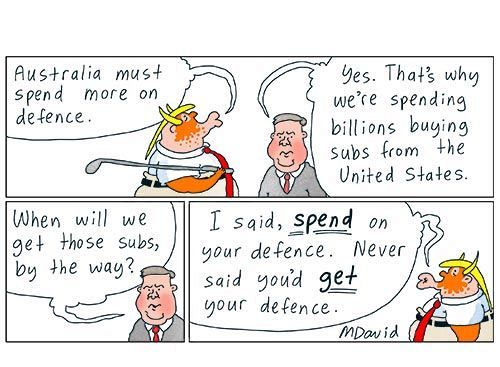
Australia's commitment to AUKUS represents a deepening integration with precisely the power structure Chomsky and Robinson describe. We are committing hundreds of billions of dollars to a security model built around U.S. strategic primacy at the very moment that primacy is becoming both more aggressive and more unstable. We are cementing our involvement with a weakening and increasingly erratic regime when the wiser course would be to embrace and actively work towards peace.
The Make Peace a Priority campaign has articulated what that alternative looks like in practical terms: expanding Australia's diplomatic capacity for conflict prevention, consolidating peacebuilding functions within government and increasing our participation in the UN Peacebuilding Commission. These are not utopian aspirations — they are the kind of concrete, funded institutional reforms that would redirect Australia's extraordinary resources toward human security rather than military dependency.
This double standard allows the public to avert its gaze from the human toll of U.S. policies. The book forces us to look at the consequences of this wilful ignorance — to learn, after the event, what we chose not to see at the time.
Averted gazes and manufactured mythologies
One of the most powerful aspects of The Myth of American Idealism is its exploration of how this reality is obscured. How can a nation responsible for such widespread suffering continue to view itself as the greatest force for good in the world?
The answer lies in the manufacture of mythology. The authors detail how compliant media and a complicit intellectual class consistently frame acts of aggression as “mistakes” or “blunders” rather than crimes. The U.S. is always assumed to act with noble intentions. Victims are “collateral damage”, while the victims of adversaries are evidence of their inherent evil.
This double standard allows the public to avert its gaze from the human toll of U.S. policies. The book forces us to look at the consequences of this wilful ignorance — to learn, after the event, what we chose not to see at the time.
The structure of the book itself mirrors this argument. ‘Part One — The Record: Idealism in Action’ moves chapter by chapter through the Global South, Southeast Asia, Afghanistan, Iraq, Palestine, China, Russia and the nuclear and climate crises, building an overwhelming evidentiary case. ‘Part Two — Understanding the Power System’ then explains the domestic and ideological machinery that keeps this record hidden.
Together, they constitute something rare: a complete account of the world the American Century built, as opposed to the world its mythology describes.
The threat to human survival
The final chapters pivot from critique to urgent warning. The authors argue that the U.S. pursuit of global hegemony is driving humanity toward two catastrophic endpoints: nuclear war and climate collapse.
The current arms race with China is presented as a tragic example of America's preference for threats over diplomacy. By refusing to accept a multipolar world and insisting on maintaining “international primacy”, the U.S. is creating a vastly more dangerous environment.
We are at a unique moment in history. We can continue to accept the mythology of American idealism, or we can recognise that the world created by this ideology is fundamentally unsafe.
At the same time, the focus on military dominance crowds out the cooperation necessary to address the climate crisis. The Bulletin of the Atomic Scientists' Doomsday Clock, now at 85 seconds to midnight, is cited as the clearest measure of how close the current trajectory is bringing us to the end of everything.
For Australia, this is not an abstract concern. World military expenditure reached a record US$2.887 trillion (AU$4.18 trillion) in 2025, the 11th consecutive annual rise. Australia's own defence spending is being driven to 3 per cent of GDP by 2033.
Every dollar committed to this trajectory is a dollar not invested in climate resilience, regional diplomacy, housing, health or the peacebuilding infrastructure that the Make Peace a Priority campaign argues is the only credible path to genuine security.
The obligation to resist
The Myth of American Idealism is not a counsel of despair. While the record of crimes can be numbing, Chomsky and Robinson emphasise that the system of thought control can collapse quickly when people choose to look reality in the face.
We are at a unique moment in history. We can continue to accept the mythology of American idealism, or we can recognise that the world created by this ideology is fundamentally unsafe. Trump's second term, with its open contempt for international law, multilateral institutions, and even the pretence of democratic norms, is not an aberration from the American tradition Chomsky and Robinson describe. It is its logical culmination — the same system, stripped of its disguise.
For Australia, the choice is concrete. We can continue to deepen our integration with a power with a record of violence and deception. Or we can take the alternative seriously: an independent foreign policy, a genuine commitment to peace as a funded national priority, and the courage to say, as Whitlam once tried to say, that our sovereignty and our values are not for sale.
By rejecting the myth, we can begin to build the future that the Make Peace a Priority campaign envisions — and that this essential book demands.
The Myth of American Idealism: How U.S. Foreign Policy Endangers the World is published by Penguin and available in paperback or ebook from all bookstores.
David Higginbottom is a member of the coordinating committee of the Independent and Peaceful Australia Network (IPAN) and coordinator of the Make Peace A Priority campaign (mpap.au).
This article is the third in a multi-part series, FROM WARFARE TO WEALTH, examining the real costs of our current defence trajectory and exploring the alternatives proposed by the Make Peace a Priority (MPAP) campaign.
Read the other chapters in this series:


 This work is licensed under a Creative Commons Attribution-NonCommercial-NoDerivs 3.0 Australia License
Support independent journalism Subscribe to IA.


Related Articles
- FROM WARFARE TO WEALTH — Australia's struggle for strategic independence
- FROM WARFARE TO WEALTH — The $368 billion question: What AUKUS is really costing us