This article is the final instalment in our in-depth series, WARFARE TO WEALTH. A compilation of considered reports from former diplomats, politicians and academics, this series provides a detailed critique of the Federal Government's defence and foreign policy trajectory — including analysis of the $368 billion AUKUS commitment and the broader militarisation of our economy.
With the ALP national conference due to commence later this week (23-25 July), it is hoped that the arguments contained here may help inform the Government's policy platform and strategic direction away from its current focus on militarisation.
This article is part eight, the final of the series, From Warfare to Wealth: Redirecting Australia's Future. You can read the other chapters in this series HERE.
Part 8: A tale of three conferences
Three Adelaide conferences expose the competing visions for Australia's future, from militarisation and AUKUS to peace and sovereignty, writes David Higginbottom.
IN LATE JULY 2026, the city of Adelaide will host an extraordinary confluence of events.
Over the same few days, three distinct conferences will convene in the South Australian capital. Together, they represent the competing forces battling for the soul of Australia’s foreign policy and the future of our national wealth.
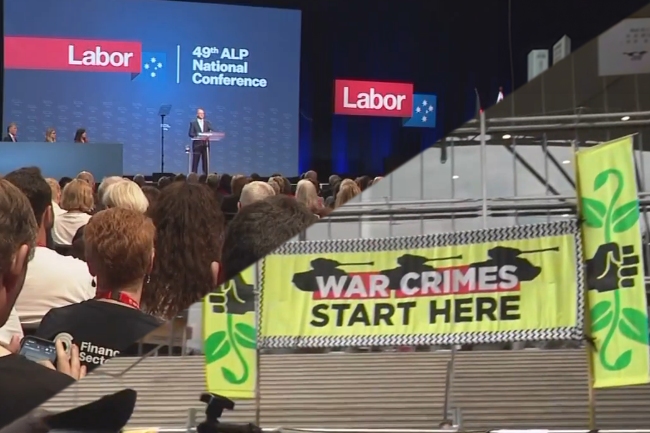
The first is the Australian Labor Party’s National Conference. Here, the governing party will debate its National Platform, facing mounting pressure from its own rank-and-file to reclaim Australia’s sovereignty, reform war powers and question the massive fiscal drain of the AUKUS pact. And then either rubber-stamp the militarisation of the economy or rethink the policy platform.
The second is the Independent and Peaceful Australia Network (IPAN) national conference. Gathering peace activists, unionists, environmentalists and First Nations leaders, this event is building a movement to cancel AUKUS and demand an independent foreign policy. It features the U.S. filmmaker Abby Martin’s documentary, Earth’s Greatest Enemy, which exposes the U.S. military as the world’s largest institutional polluter.
But it is the third conference that reveals the true nature of the challenge we face. Just down the road at the Adelaide Oval, the military-industrial complex is holding its own gathering: the Global Information Summit Australia 2026. Hosted by the newly formed Information Power Institute of Australia (IPIA), the summit brings together defence contractors, state government agencies and intelligence operatives from across the Five Eyes nations.
If you want to understand why Australia is committing $368 billion to nuclear submarines while the world burns, you need to look closely at who is in the room at the Adelaide Oval — although you will need a high-level security clearance to do so.
It is all taxpayer money, laundered through the machinery of strategic consulting and information warfare.
The business of war
The Global Information Summit is not an independent academic exercise. It is an Australian franchise of a U.S. military-origin “information operations” conference series, co-hosted with U.S. professional associations deeply embedded in the Pentagon’s cognitive warfare apparatus.
The summit’s sponsorship list reads like a directory of the modern influence industry. Platinum sponsors include M&C Saatchi World Services – a private strategic communications contractor with a track record of government-funded influence operations – and the South Australian Government.
More revealing is the summit’s Gold Sponsor: Elysium EPL. Founded by military veterans, this Canberra-based consulting firm has won roughly $74 million in Commonwealth contracts, including a recent $9.7 million contract for “Submarine Support Services” from the Department of Defence. Notably, one of Elysium EPL’s directors simultaneously serves as a director of the IPIA, the very institute hosting the conference.
This is the military-industrial complex in action. It is a closed ecosystem where government agencies fund defence contractors, who in turn sponsor opaque institutes that host conferences to lobby those same government agencies for more funding.
It is all taxpayer money, laundered through the machinery of strategic consulting and information warfare.
We are pouring our national wealth into the machinery of war at the exact moment we need every available dollar to transition our energy grid, build climate resilience and fund genuine human security, including Closing the Gap for First Nations people.
Humanity’s final exam
The contrast between these three Adelaide conferences could not be starker. While the IPAN conference discusses how to promote peace and prevent climate collapse, and the ALP debates its democratic soul, the Global Information Summit will dedicate a full day to a classified “hands-on war gaming scenario” facilitated by the United States Irregular Warfare Centre.
As I argued previously in Independent Australia, we are currently sitting humanity’s final exam. The Bulletin of the Atomic Scientists’ Doomsday Clock remains poised at 85 seconds to midnight. World military expenditure has surged to a record US$2.9 trillion (AU$4.1 trillion), marking the 11th consecutive annual rise. The economic cost of violence drains nearly 10.5 per cent of global GDP.
We are pouring our national wealth into the machinery of war at the exact moment we need every available dollar to transition our energy grid, build climate resilience and fund genuine human security, including Closing the Gap for First Nations people.
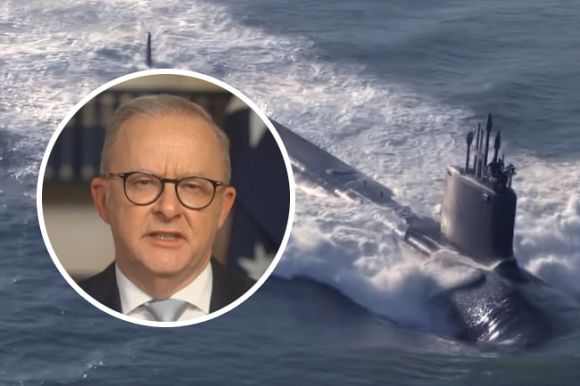
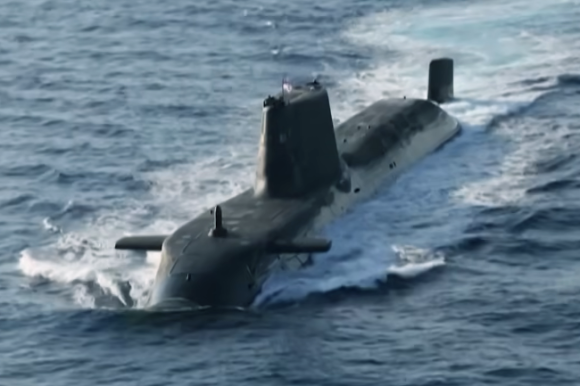
The AUKUS pact is the ultimate expression of this misallocation. We are told that nuclear-powered submarines are essential to protect us from China. Yet China is our largest trading partner, taking one-third of our exports and driving $200 billion in two-way trade. The threat narrative deliberately obscures the reality that China is already surrounded by a massive array of U.S. military bases, from Japan to the Philippines to Australia.
We have chosen to treat our problems as military threats, addressing the symptoms of a planet in distress rather than the disease — and we have allowed the architecture of our foreign policy to be captured by the very contractors and lobbyists who profit from perpetual tension.
They have the power to say that Australia’s sovereignty is not for sale to the highest-bidding defence contractor.
Reclaiming our future
The convergence in Adelaide is not just a coincidence of scheduling; it is a manifestation of the choice facing Australia.
Will we listen to the voices at the Adelaide Oval, who view the Indo-Pacific as a theatre for “irregular warfare” and “information dominance”? Or will we listen to the voices at the IPAN conference, who understand that true security comes from diplomacy, demilitarisation and regional cooperation?
The burden of that choice falls squarely on the delegates at the ALP National Conference. They have the power to demand that the Government redirects our national wealth from warfare to security. They have the power to insist on parliamentary control over the decision to go to war. They have the power to say that Australia’s sovereignty is not for sale to the highest-bidding defence contractor.
The three conferences in Adelaide offer a clear view of our possible futures:
- one path leads to an endless, escalating arms race, managed by consultants and underwritten by the Australian taxpayer; and
- the other path leads to a genuine peace dividend, where our extraordinary resources are finally used to build a sustainable, independent and secure nation.
It is time to choose.
David Higginbottom is a member of the coordinating committee of the Independent and Peaceful Australia Network (IPAN) and coordinator of the Make Peace A Priority campaign (mpap.au).
This article is the eighth and final in a multi-part series, FROM WARFARE TO WEALTH, examining the real costs of our current defence trajectory and exploring the alternatives proposed by the Make Peace a Priority (MPAP) campaign.
Read the other chapters in this series:

 This work is licensed under a Creative Commons Attribution-NonCommercial-NoDerivs 3.0 Australia License
Support independent journalism Subscribe to IA.


Related Articles
- FROM WARFARE TO WEALTH — The 1984 warning: Why the AUKUS debate cannot be silenced
- FROM WARFARE TO WEALTH — The path to peace requires investment in conflict prevention
- FROM WARFARE TO WEALTH — Why parliament must decide before Australia goes to war
- FROM WARFARE TO WEALTH — The AUKUS illusion and the death of statecraft
- FROM WARFARE TO WEALTH — The myth of American idealism