A universal public housing system could turn redistribution from an abstract promise into visible security while rebuilding the common institutions a plural democracy needs, writes Rob Powell.
IN MY PREVIOUS two articles, I took a pessimistic view of a couple of deep and systemic political problems that obscure the real sources of the economic insecurity faced by working-class people.
In ‘The monoculture myth at the heart of Hansonism’, I argued that economic insecurity can be redirected towards migrants and minorities, converting class pain into culture war. In ‘Why inequality survives democratic politics’, I argued that aspiration encourages workers and renters to identify with the property owners they hope to become, while identifiable private losses remain politically stronger than uncertain public gains.
So what is “a” solution? Any credible response must address factors that drive both Hansonism and the inequality sustained by a neoliberal economic order. Hansonism offers belonging through exclusion, while neoliberalism offers security through escape. Universal public housing would offer something different: belonging through community and security through a shared public institution.

An Australian Housing Commons
Public housing should become a universal public option rather than a residual element of the welfare system. We ought to create an Australian Housing Commons, delivered through a reinvigorated national housing commission built from Housing Australia, working with state and territory housing authorities, First Nations housing organisations and not-for-profit cooperatives.
The Australian Housing Commons would build and retain permanent public housing and offer secure, long-term tenancies to low, moderate and middle-income households. Priority access would remain for people experiencing homelessness, disability, violence, poverty or severe housing insecurity. Rents would be based primarily on cost recovery rather than market rates, with income-related reductions for people unable to afford them.
Universal would not mean an immediate home or an equal subsidy for everyone. It would mean broad access, while assistance remained greatest for those with the greatest need.
These homes should be constructed near employment, schools, transport, healthcare, parks and public services. Over time, the policy should expand Australia’s social housing stock from about 4 per cent of all dwellings towards a long-term target of at least 10 per cent.
The Australian Housing Commons would not eliminate private ownership or private rental. It would create a permanent non-market component of the housing system, give renters a genuine alternative and constrain what private landlords could charge under conditions of scarcity. It would also reduce reliance on demand-side subsidies, a proportion of which research suggests can be absorbed into higher private rents, enriching private property owners without leaving the public with a corresponding asset.
Turn rent into limited equity
Public housing must answer the legitimate desire to build personal security and pass something on to one’s family. Public support should not merely prevent destitution. It should give people a hand up.
Tenants could make an affordable equity contribution alongside their rent. That contribution would purchase a limited-equity share in the Australian Housing Commons, while lower-income tenants could receive government assistance. Their equity would be held in a publicly managed fund and earn a regulated return or be indexed to inflation.

This equity would be portable. It would belong to the tenant within the system rather than to a particular house. Tenants could move within the Australian Housing Commons without losing what they had accrued. They could eventually redeem it for a private home deposit, use it in retirement or pass it to their children.
Ownership of the land and dwellings would remain within the Australian Housing Commons. This would avoid the problems created by Right to Buy-type schemes, under which homes can leave public housing systems without equivalent replacements. Aspiration would be preserved but decoupled from luck and market speculation.
A shared and visible public institution
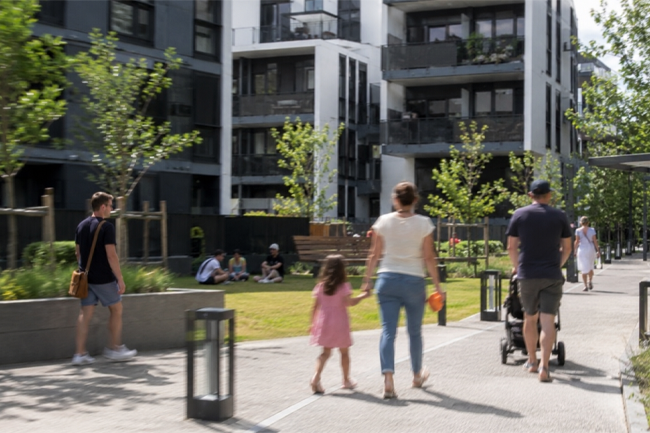
Housing can help create the common life that a multicultural society requires without demanding cultural sameness. Developments should be mixed-income, located throughout existing communities and designed so that public housing is indistinguishable from private housing. They should foster community through shared public spaces and elected tenant or cooperative boards, rather than becoming areas designed merely to contain and manage poverty.
Australian research shows that the residualisation of public housing has contributed to concentrated disadvantage and stigma. Neither is an inevitable feature of publicly provided housing.
This approach could give culturally different people common material interests and a direct role in civic participation. Think Medicare, the ABC and public libraries. Australians collectively fund these shared institutions and have a vested interest in maintaining them.
Universal public housing would also make redistribution visible. Removing a tax concession can feel like a loss, even to someone who may never benefit from it. Public housing would provide something tangible. A household could see its home, compare its rent with market rates, experience greater security and watch its equity grow.
An Australian Institute of Health and Welfare survey found that social housing tenants commonly reported economic, health and social benefits, including feeling more settled and better able to manage their finances.
This is redistribution presented as collective insurance rather than assistance for somebody else.
Funding and implementation
Make no mistake, this policy would be expensive. However, public housing creates assets and continuing rental income.
The Australian Government already has the $10 billion Housing Australia Future Fund (HAFF). It can be expanded by dedicating additional revenue from the 2026 negative-gearing and capital-gains-tax reforms, progressively restricting concessions that reward existing ownership rather than construction and expanding Housing Australia’s social and sustainability bonds.
Suitable government land should be transferred to the Australian Housing Commons rather than sold to the highest bidder. Land-value capture could recover some of the increases in surrounding property values created by public transport and infrastructure. Net rental income should fund maintenance and additional construction, while tenant equity balances must remain ring-fenced because they belong to residents.
Long-term construction pipelines should also support apprenticeships, modular construction and regional building capacity, giving us a two-for-one: more homes and a larger skilled workforce. Public contractors should meet ambitious apprenticeship employment and completion targets supported by adequate supervision and TAFE capacity.
Australia cannot immediately build hundreds of thousands of homes without worsening labour and material shortages. Infrastructure Australia identifies labour and skills shortages as a substantial threat to project delivery. Construction must therefore be staged and coordinated with workforce development. Existing HAFF commitments provide a starting point, but building must ramp up over time.
The relevant comparison is not simply the policy’s upfront cost. Governments must also count the land, dwellings, rental income, workforce skills and greater housing security that the expenditure creates. Tax concessions can strengthen privately held property values without necessarily producing additional homes or a corresponding public asset.
Public construction, by contrast, leaves a house behind. That dwelling remains on the public balance sheet, provides a secure home, generates income and can serve Australian families for generations.
Bringing it all together
Hansonism and grievance politics offer people a revolution that somebody else pays for while leaving the capital-owning classes largely untouched. Neoliberalism offers escape to those fortunate enough to become property owners before the ladder is pulled up. Neither can provide a secure and enriching common civic life for all citizens.
Universal public housing would offer a different bargain. Nobody would need to become wealthy to obtain security, but neither would people be denied the opportunity to build a modest stake of their own. Different cultures would be connected through an institution they collectively owned and used.
People do not abandon grievance politics simply because its claims have been fact-checked. They abandon it when democracy gives them something more credible to belong to.
Australia does not need everyone to own an investment property. It needs everyone to have a secure home and a meaningful stake in the country they share.
And, to quote Maria Márkus ad nauseam, Australia needs to become a decent society.
Rob Powell is a retired mature-aged student currently studying politics and philosophy, focusing on how ethical frameworks shape public policy and political behaviour.
 This work is licensed under a Creative Commons Attribution-NonCommercial-NoDerivs 3.0 Australia License
Support independent journalism Subscribe to IA.


Related Articles
- Good news! Housing is getting more and more affordable
- Navigating the Australian housing market: What new buyers need to know about LVR
- Housing affordability improves — get set for a deluge of new first home buyers
- Debate on housing and intergenerational equity is just beginning
- Why we have a housing crisis and why government cannot fix the problem