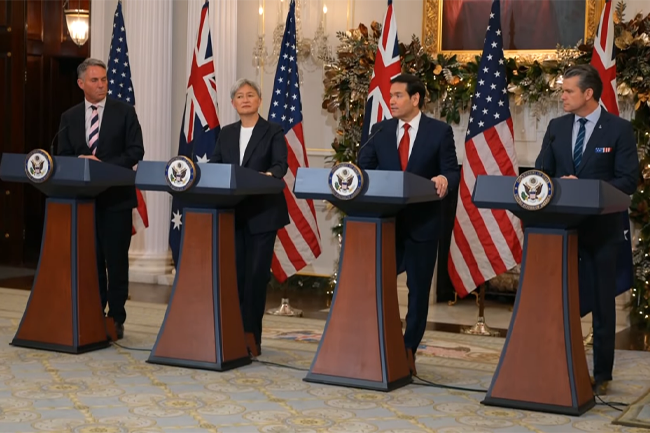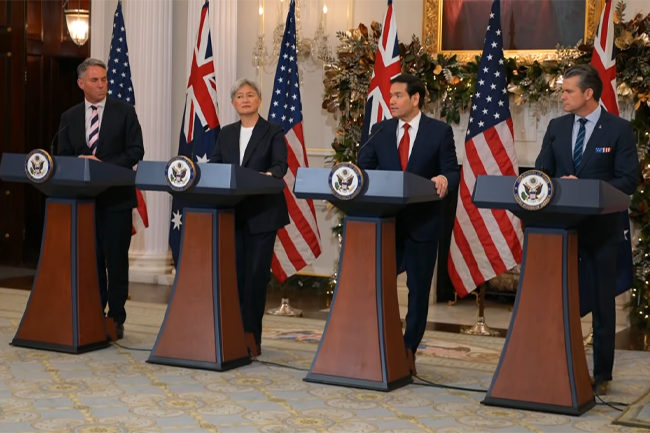
Our new series, WARFARE TO WEALTH, is a progressive critique of the Federal Government's defence and foreign policy trajectory. It provides in-depth analysis of Australia's $368 billion AUKUS commitment and the broader militarisation of our economy.
It is timed to precede the ALP national conference (23-25 July) – which will shape the Government's policy platform and strategic direction for at least the next two years – in the hope that, along with growing pressure from the broader community, the arguments against this militarisation may be compelling enough to make their mark.
Part 2: Australia's struggle for strategic independence
This article is part two of the series, Warfare to Wealth: Redirecting Australia's Future. You can read part one HERE. The next chapter will be published soon.
Australia's security lies not in deeper military dependence, but in investing in genuine sovereignty, regional cooperation and national resilience. Dr Mark Beeson writes.
LEADERS OF DEMOCRATIC STATES frequently assure the people they represent that they are acting in the “national interest”.
While this idea is rarely explained, it gives a veneer of legitimacy to whatever policymakers and other powerful economic and strategic actors think is appropriate. Sovereignty – another under-specified notion – is the desired outcome, even if it’s unachievable for most states, especially the “middle power” variety, like Australia.
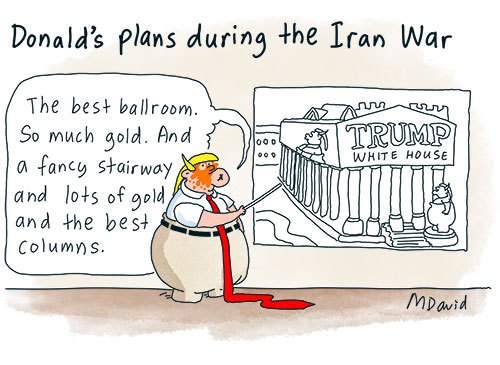
“Great” or “hegemonic” powers, by contrast, can usually get what they want and compel or persuade other states to do their bidding. But as U.S. President Donald Trump is currently discovering, even overwhelming military power may not be enough to convince some states to bend the knee.
Before the increasingly unhinged and aggressive administration of Donald Trump, however, persuasion and voluntarism were much more effective tools of American preponderance. And to be fair, in the period following World War 2, many countries, including Australia, benefited enormously from the much-invoked “rules-based international order” that was directly associated with an unparalleled period of economic expansion and political stability, in the “global north”, at least.
Ceding a bit of influence and economic leverage to foreign multinationals and the global financial markets seemed a small price to pay for unprecedented economic expansion, not least because, as Margaret Thatcher claimed, there seemed to be no alternative. Even China’s state-dominated form of capitalism is not impervious to market forces.
Good while it lasted
The price of being part of an American-made post-war international order, however, was a willingness to become part its “empire of bases”, or the hundreds of military outposts the U.S. maintains around the world.
While this may have been understandable during the Cold War when the Soviet Union posed a very real strategic challenge and even a role model for some countries, it looks a less compelling driver of national policy priorities now.
Or it does unless you accept the view that the rise of China presents a similar challenge to the U.S. and its allies, none of which is more reliable or enthusiastic than Australia. Indeed, America’s unilateral, illegal and profoundly wrong-headed attack on Iran marks a rare occasion when Australia has not rushed to follow its principal ally into war, no matter how misguided or tangential to any notion of Australia’s national interest it may have been.
Sceptics argue that Australia is involved in the conflict in Iran, as it has been in the levelling of Gaza. But even if we accept that the absence of active military support in Iran marks a rare exception, there are enduring material constraints on Australia’s ability to make independent policy decisions that make any deviation from American priorities literally unthinkable for policymaking and strategic elites in Canberra.
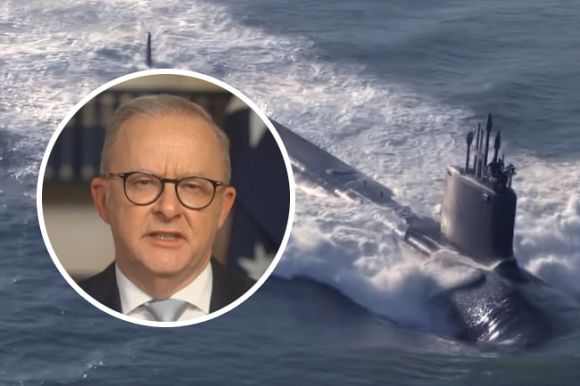
Australia remains a very ‘suitable piece of real estate’ and has proved to be the perfect place for the U.S. to establish “joint facilities” for intelligence-gathering, bases for aircraft, a “rotational” force of marines and now, of course, nuclear-powered submarines. It’s safe to assume the latter will also be nuclear-armed, as they must be ready for any strategic contingency.
The joint intelligence gathering facility at Pine Gap remains controversial because it reflects American strategic priorities and has been implicated in the destruction of Gaza. Likewise, the Harold Holt Naval Communication Station in the Northwest Cape allows the U.S. to send encrypted messages to its fleet of nuclear-armed submarines without any Australian oversight or consultation. This necessarily increases the risk that Australia will be dragged into yet another American-inspired conflict.
The role of nuclear-powered and armed submarines operating in the Indian Ocean will inevitably increase following the construction of a new submarine base at Garden Island near Perth. If Perth was not a nuclear target before, it undoubtedly will become so once it hosts what its admirers like to refer to as the “apex predator”: Virginia-class submarines of a sort that Australia may or may not receive in the coming decades.
Progressive patriotism
Against this backdrop and a rising tide of scepticism about the utility of a handful of nuclear-powered submarines in an increasingly “transparent ocean” policed by cheap undersea drones, the Government’s Minister for Defence Industry, Pat Conroy, tried to explain why AUKUS remains a “critical part” of “progressive patriotism”.
Conroy celebrated the fact that “the Albanese Government is delivering the largest increase in peacetime defence investment ever”.
Not only does this not sound very “progressive”, but it was rather undermined by Conroy's subsequent observation that:
“You can announce all the money in the world for Defence capabilities, but if you’re not buying the right capabilities, or able to deliver them on time, then what’s the point?”
Good question. This is precisely the point a growing number of former prime ministers, senior military personnel and even grumpy academics have been making for some time: we’re not buying the right kit and it’s as certain as anything can be that it won’t be delivered on time, if at all.
Even in the unlikely event that a handful of second-hand or even new subs eventually turn up, what possible difference could they make in a world potentially dominated by competing spheres of influence? Indeed, if China isn’t deterred by America’s overwhelming military might, what possible difference can Australia make — even if we assume that our notional protector has not packed up and gone home?
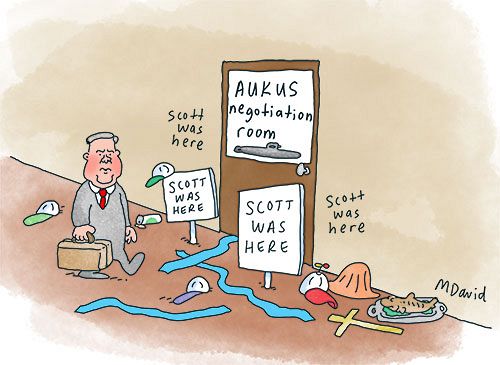
Assuming that the world will go back to “normal” following Trump’s departure, or that democratic principles and the rule of law will be restored in the U.S., doesn’t look like a sensible policy. There may, indeed, be something to be said for becoming more “self-reliant”, but only if that reflects Australia’s literal and metaphorical place in the international scheme of things.
All other things being equal, China – our biggest trade partner – will be the dominant power in a region in which Australians occupy an unbelievably privileged and secure position. But as Conroy rightly notes, “getting on with our neighbours has never been more important” and that includes China. China is unlikely to destroy an economic system from which it has benefitted enormously and on which it still depends. Investments pay bigger dividends than invasions.
In the meantime, if progressive patriots are really to have “confidence in the future”, they might turn their minds to the factors that will shape the world coming generations will inherit. Principal amongst these remains the inadequately addressed, existential challenge of climate change, which China has done more about than any other country.
If the Government really is determined “to protect what we treasure most”, they might want to close down the inexcusable coal industry, cancel the AUKUS project and use the money to fund the electrification of the country; not to mention providing free higher education, social housing and a host of other non-submersible, unambiguously progressive projects that really will make us feel more secure.
Who knows, it might even make us patriotic.
This article is the second in a multi-part series, FROM WARFARE TO WEALTH, examining the real costs of our current defence trajectory and exploring the alternatives proposed by the Make Peace a Priority (MPAP) campaign. You can read part one HERE.
Dr Mark Beeson is an adjunct professor at the University of Technology Sydney and Griffith University. He was previously Professor of International Politics at the University of Western Australia.
 This work is licensed under a Creative Commons Attribution-NonCommercial-NoDerivs 3.0 Australia License
Support independent journalism Subscribe to IA.


Related Articles
- AUKUS Public Inquiry lays bare a pact built on false promises
- FROM WARFARE TO WEALTH — The $368 billion question: What AUKUS is really costing us
- AUKUS Inquiry must welcome every side of the debate
- AUKUS: Australia's $368 billion boondoggle
- Investigating the foolish: The AUKUS Public Inquiry is announced