From colonial forts to nuclear submarines, Australia's response to distant conflicts reveals a recurring pattern that continues to shape its defence strategy, writes Professor Vince Hooper.
IN THE EARLY MONTHS of 1854, as news of Britain's entry into the Crimean War reached the Australian colonies, an extraordinary panic took hold.
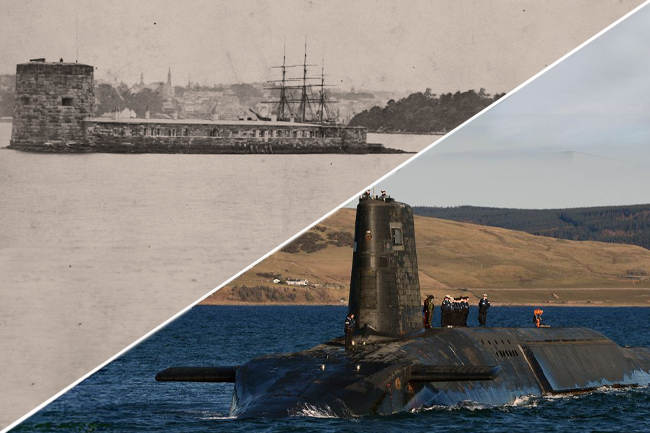
Newspapers debated, in full seriousness, whether Russia would attack Sydney or Melbourne, whether the objective would be occupation or merely the seizure of gold from colonial banks. Fort Denison was commissioned on Pinchgut Island in Sydney Harbour. Victoria passed legislation to establish a Volunteer Corps of up to 2,000 men. A war fought thousands of miles away over a peninsula in the Black Sea was catalysing Australia's first independent military capability.
The panic did not end with the peace. In 1863, the Russian corvette Bogatyr, flagship of the Pacific squadron under Rear Admiral Popov, sailed into Melbourne undetected. More than 8,000 Melburnians visited the ship during a goodwill tour.
After the corvette departed, the Sydney Morning Herald reported that the crew had been surveying the coastal fortifications of Port Jackson and Botany Bay. The revelation deepened the following year when a Polish officer who had deserted from the Bogatyr disclosed that Popov had received orders to attack British naval targets near Australian shores in the event of war.
Russian invasion scares recurred in 1870, when the corvette Boyarin appeared at Hobart; again in 1882, when three Russian warships entered Melbourne and in 1885, when Bare Island Fort stood guard over Botany Bay. For three decades, Crimea's aftershock kept reshaping Australian defence thinking.
That a war triggered by a dispute over the custody of holy sites in the Holy Land could produce this cascade of consequences at the furthest edge of the British Empire is the analytical point. Australia's strategic environment is not normally distributed. It is characterised by long periods of apparent stability punctuated by sharp, regime-changing shocks from quarters no plausible risk model would have flagged.
The original Crimean War also embedded its human residue in the colonial landscape. After hostilities ended, the British Government actively encouraged veterans to migrate, investigating New South Wales and Tasmania as suitable destinations. In Western Australia, Crimean veterans populated the pensioner guard force and the broader settler community.
Two Victoria Cross recipients of the 77th Regiment, Sergeant John Park and Private Alexander Wright, received their awards in Sydney.
Russian trophy guns arrived in Adelaide in 1859 and were fired to mark the Duke of Edinburgh's visit in 1867. Suburbs named after Crimean battles, Balaclava in Melbourne, Sebastopol near Ballarat, Alma and Inkerman across New South Wales and Victoria, wrote the war into the geography that Australians still walk through daily.
Fast forward 160 years and the pattern repeats with unsettling fidelity. Russia's annexation of Crimea in March 2014 might have remained a European affair in Australian strategic consciousness. The downing of Malaysia Airlines Flight 17 over eastern Ukraine on 17 July 2014, killing 298 people, including 38 Australian citizens and residents, ensured it did not.
The Abbott Government imposed sanctions, co-sponsored the UN Security Council resolution and pursued accountability through international courts. Abbott publicly vowed to “shirtfront” Russian President Vladimir Putin at the Brisbane G20 just months later, an Australian Rules football term for a front-on collision. The register was antipodean. The underlying dynamic, a distant Crimean event triggering a visceral response at the periphery, was not.
A decade on, the aftershock continues to propagate. In May 2025, the International Civil Aviation Organisation (ICAO) Council found Russia responsible under international law for the downing of MH17. Russia appealed; Foreign Minister Penny Wong called the response “deplorable”. The 2014 trigger, like the 1854 trigger before it, has not finished reverberating.
The objection writes itself: MH17 was contingent. A plane happened to be in the wrong airspace. That is not a structural transmission mechanism; it is bad luck. But this objection misunderstands what "fat tails" mean. The whole point of heavy-tailed distributions is that the specific trigger is unpredictable while the class of events is not.
Nobody in 1854 predicted that a dispute over church keys in the Holy Land would catalyse Australian volunteer militias. Nobody in 1863 predicted that a Polish deserter from a Russian corvette would reveal contingency plans to raid Melbourne. Nobody in 2014 predicted that a Buk missile in Donetsk would kill 38 Australians in a sunflower field.
The triggers were contingent. The vulnerability, a peripheral state deeply integrated into alliance networks but geographically remote from their theatres, was structural. Fat tails do not require predictable triggers. They require structural exposure to extreme events.
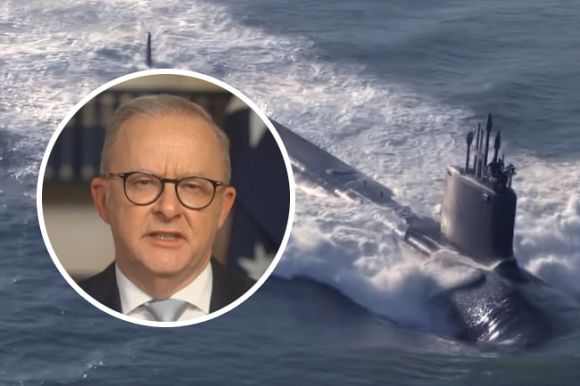
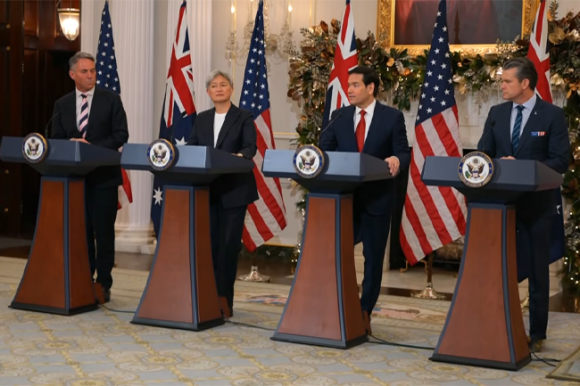
Russia's broader invasion of Ukraine in 2022 confirmed the pattern rather than creating it. AUKUS, announced in September 2021, predated the invasion, but the war validated its logic. Le Chatelier's principle holds that an external shock to equilibrium triggers a compensating response. In 1854, that response was a volunteer corps: modest, reversible, low commitment.
Nuclear-powered submarines, serviced at Plymouth's Devonport dockyard, are none of those things. The Plymouth connection closes a circle: one of the handful of Australian colonists to fight in the original Crimean War was Spicer Cookworthy, a subaltern in the First Regiment of Foot, bearing the surname of that city's most famous son, William Cookworthy, the Quaker who discovered china clay in Cornwall and founded the Plymouth porcelain works.
The colonies of the 1850s built forts and raised volunteers. Australia of the 2020s is acquiring nuclear submarines and reorienting its entire defence procurement architecture. The scale has changed, but the mechanism, the propagation of distant shocks through alliance networks to force option exercise at the periphery, has not.
Policymakers who assume mean reversion, or price Australian security using a normal distribution, will be caught out by the next Crimean shock. They always are.
Professor Vince Hooper is a proud Australian-British citizen and professor of finance and discipline head at SP Jain School of Global Management with campuses in London, Dubai, Mumbai, Singapore and Sydney.
 This work is licensed under a Creative Commons Attribution-NonCommercial-NoDerivs 3.0 Australia License
Support independent journalism Subscribe to IA.


Related Articles
- AUKUS Public Inquiry lays bare a pact built on false promises
- AUKUS Inquiry must welcome every side of the debate
- AUKUS: Australia's $368 billion boondoggle
- Investigating the foolish: The AUKUS Public Inquiry is announced
- AUKUS: Australia gets what America can spare