With anti-democratic movements stirring around the globe, Australia went to the polls in an unfazed frame of mind, writes Dr Lee Duffield.
THE WORLD might as well be impressed at the Australian elections of 5 May as a demonstration of democracy working well enough, always remembering the phrase Winston Churchill appropriated to himself: “...democracy is the worst form of government except for all those other forms that have been tried...”.
A citizen would have to be a champion whinger not to say they had reasonable treatment in this process of choosing a government — with ample service from non-partisan media outlets.
World’s best system for elections?
In Australia, every effort is made to ensure everybody eligible gets a vote and, in fact, must vote, so they won't complain afterwards about not sharing responsibility for the outcome. The well-enough funded Electoral Commission, independent under law, appears to have handled the massive administrative task efficiently — any complaints so far isolated, not systemic. It is proactive, providing information, setting out rules and making rulings on any disputes, on a theme of encouraging and helping citizens to vote.
It is a far cry from the gerrymandering and discouragement schemes in “Red” states in America (as shutting down voting centres in “Black” districts, or imposing multiple ID demands).
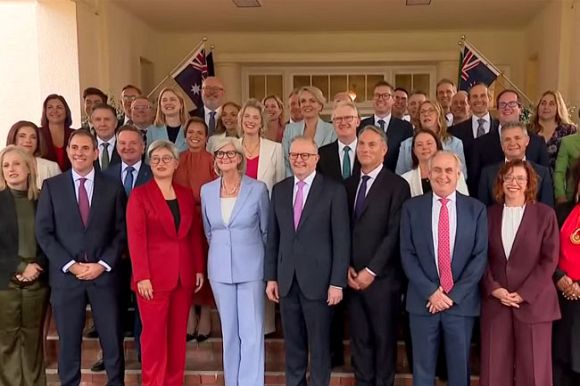
Importantly, the Australian political parties and independent candidates agreed to play by the rules and accept the outcome, which they did. One side issue was indicative and had shades of American-style rorting: where the Morrison Government cut money for remote voting booths going to isolated communities in the Northern Territory in 2022. With the services restored this time, the voting turnout jumped and so did numbers for the Labor Government.
The probity of the electoral system – in fact, probity in government generally – became an actual issue for the Election, with Labor Prime Minister, Anthony Albanese, promoting “Australian values” as the antidote to the Trump regime, with which his Opposition, Peter Dutton, had become identified.
How did the media perform?
Observers following mainstream news media, if at all competent to judge, could get informed on the issues being contested. These media were divided into the two camps — the first camp observing conventions like the Code of Ethics of the journalists’ association, the MEAA, or the Charter and Guidelines enforced by the ABC.
The ABC made a bid to perform as the go-to or default national provider for the event, as it does for national disasters, or with its comprehensive coverage for the regions. It is a strategy that promotes the idea of service to a cohesive Australian society and working institutions, and a survival strategy for the broadcaster assailed by commercial interests wanting it destroyed — as has been the case since its inception.
United mainstream media
Broadcasters were accordingly on their best behaviour for the electoral season. Even some of the most prominent have been known for errors, like letting out their private views, or not letting interviewees explain things: over-interrupting, pushing the reporter’s angle.
All that put aside in 2025. To offer some specific credit: two brought in from the “outrider” media – the Political Lead David Speers, formerly Sky News and Patricia Karvelas, ex News Corp – provided clear, useful commentary and fair handling of co-operative and unruly guests alike. ABC radio began using the National Affairs Editor, Melissa Clarke, as an interpreter to follow up key interviews, reviewing what they said, adding and providing level-headed and informative sense-making.

Democratic government, for all the imperfections eyed by Winston Churchill and others, has the best chance of working where there is a big range of free media and good information of the kind the ABC was providing.
The commercial free-to-air television stations kept up a dependable coverage, especially following party leaders on the campaign trail. Channel Nine, yearning to make it a bit tabloid, had great sport on the actual election night, with a facsimile dunking machine for members losing their seats.
News Corp, Sky and 2GB
The second media grouping, the three main right-wing chains – News Corp press, Sky News and the 2GB radio network – function as political actors in their own right, partisan boosters for the Liberal-National Coalition. Peter Dutton and the line-up of conservative spokespersons overwhelmingly put out their news through these channels, getting heaps of airtime, praise and nothing critical to answer.
But the adulation and open-handed “assistance” of virtually in-house media could even be seen as a well-meaning trap. Politicians softened up by hopelessly uncritical “interviews” could start to feel entitled to a life without accountability.
Dutton himself famously began whining about “hate” media, specifically the ABC and The Guardian, that were critiquing his campaign and when not successfully avoided, plying questions. (It evoked Donald Trump’s castigations of “fake news” in America, cementing another association in people’s minds that proved electorally toxic for Dutton.)

Postscript
A postscript on reporting of the shifting of positions in the parties after the May Election.
New Liberal Leader Sussan Ley, in the recent past, would sound like fairy floss and got into strife over buying a property while on a “work trip” to the Gold Coast, also enjoying some serious partying according to local media then. Accepted now across the board as credentialed to be Opposition Leader, she will head one of three parties with women leaders: Greens, Liberals and One Nation.
Ms Ley’s penchant for one-eyed partisan rhetoric will be actually outmatched by her Deputy, Ted O’Brien, whose intolerance and “talking machine” tendency to shout down other talkers did not convince voters to back a nuclear energy policy, of which he is the chief advocate. O’Brien, based in Maroochydore, from a family flour milling business on the Darling Downs, has the bush conservative outlook of big frogs in small puddles. Interesting to watch if he goes alright with the critical media.
The dumping of two ministers, Mark Dreyfus and Ed Husic, by their right-wing Labor factions, lit a warning beacon over Albanese — will hubris get him? It leaked out that he had told Dreyfus in early February he wanted him to stay on, but did not intervene when the numbers guys moved. It could be proof that the Prime Minister is tough, but it does not answer whether he is weak or strong.
A point for consideration is that the replacement ministers – Dr Daniel Mulino, 55, an economist, and Sam Rae MBA, 38, with a background in business and the Victorian Party machine – are bright customers in the model preferred by their faction: fitting a technocratic model with enough Labor background. (Do they get mistaken in the corridors for Jim Chalmers, or the ghost of Paul Keating?) Wherever they stand on reform in society, they should be competent, so useful in the hefty program the Government has laid out before it.
Amongst Dr Lee Duffield’s vast journalistic experience, he has served as ABC's European correspondent. He is also an esteemed academic and member of the editorial advisory board of Pacific Journalism Review and elected member of the University of Queensland Senate.
 This work is licensed under a Creative Commons Attribution-NonCommercial-NoDerivs 3.0 Australia License
Support independent journalism Subscribe to IA.


Related Articles
- Dutton dressed up as Angus
- Opportunity for major government system reform has arrived
- 'Friendly' media could not save the Opposition
- Doing our bit for the democracy sausage
- Historic election result sees Labor triumph over Liberal catastrophes