
If corporate leaders are serious about the prosperity of future generations, they need to do more than cherry-pick policies that serve their own commercial interests and present them as a national economic strategy, writes Professor Carl Rhodes.
CORPORATE AUSTRALIA HAS DIAGNOSED the nation’s economic malaise. Unsurprisingly, it believes government is largely to blame. Business, apparently, has little to answer for.
New research by law firm Mallesons finds business leaders losing confidence that government policy is supporting productivity and competitiveness.
They present themselves as committed to growth, investment and innovation, while warning that policy failure could leave the next generation worse off than their parents.
The full report will not be released until September, but its early findings, shared with the Australian Financial Review, tell a bleak story. Business is trying to build prosperity, government is getting in the way, and ordinary Australians are paying the price.
It is a convenient and reassuring morality tale. Government is blamed, while business quietly exempts itself from scrutiny.

Corporate Australia's warning
Mallesons’ annual Directions Survey draws on the views of directors and senior business leaders. The 2026 survey examined economic and regulatory pressures, government-business relations, and the impact of artificial intelligence on strategy and organisational design.
The results show a business community increasingly dissatisfied with government. Just 1.6 per cent of respondents believe the relationship between business and government is working “very well”, while more than 40 per cent say it is working poorly. More than half believe current policy settings will harm productivity growth.
The message is that government failure, excessive regulation and the lack of business-friendly reform threaten productivity and future living standards.
This account is only half right.
Productivity matters, and business leaders are right to worry about Australia's weak performance.
But their view rests on an assumption that corporate Australia treats as common sense. Lift productivity and prosperity will follow. It is the old promise of trickle-down economics. What benefits business is presented as benefiting everyone.
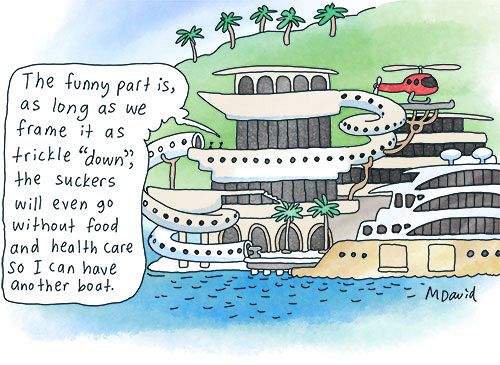
The same old trickle-down myth
Faith in business-led prosperity is hardly new. It was a central promise of the neoliberal project that has dominated economic policy since the 1980s.
For decades, we have been told that if governments cut red tape, reduce taxes, weaken constraints on business and create favourable conditions for investment, the resulting economic growth will eventually flow through to the rest of society.
History tells a different story. Economic growth and productivity gains have largely failed to translate into broadly shared benefits to working people.
As the OECD has noted, rising productivity does not automatically lead to inclusive prosperity, with the benefits often distributed unevenly across firms, workers and households.
Australians have lived through this failure. Real disposable incomes have declined significantly and housing affordability has become increasingly strained while market concentration and profit margins have risen across much of the economy.

Who really benefits?
What the business story refuses to confront is the fact that the real problem is not simply about how much wealth an economy creates, but who has the power to claim it.
If corporate leaders are serious about the prosperity of future generations, they need to do more than cherry-pick policies that serve their own commercial interests and present them as a national economic strategy.
Productivity creates wealth. Who receives it depends on wages, bargaining power, taxation, competition, housing and the institutions that govern economic life, many of which business actively seeks to influence in its own financial objectives.
Without institutions that distribute economic gains more fairly, greater productivity can become corporate profits, rising executive remuneration, soaring asset prices and further concentration of wealth.
Productivity may be necessary for rising living standards, but it is far from sufficient.
What business leaders leave out
If business leaders’ concern for future generations is genuine, then they need to start asking different questions, rather than limiting themselves to the kinds of policies that got us into this mess.
How will productivity gains be shared with workers rather than absorbed into profits? Are corporations investing enough in skills and training? Are executive rewards rising faster than employee incomes? Are firms promoting competition, or benefiting from market concentration?
These are not peripheral questions, but they are largely absent from a business agenda focused on lower regulatory burdens, investment incentives and the conditions corporations say they need to succeed.
Blaming government is easier than confronting the possibility that today’s pressures on wages, housing and living standards stem in no small part from an economic model from which business itself has benefited.
It is true that the next generation is at risk of being worse off than the last, but higher productivity alone will not save it. Australia also needs an economic system that distributes the benefits of growth fairly.
If business wants support, it needs to explain not only how wealth will be created, but how it will be shared.
Without that, its productivity agenda is not a plan for national prosperity. It is a demand for corporate advantage dressed up as concern for the future.
Carl Rhodes is Professor of Business and Society at the University of Technology, Sydney. He has written several books on the relationship between liberal democracy and contemporary capitalism. You can follow him on X/Twitter @ProfCarlRhodes.
 This work is licensed under a Creative Commons Attribution-NonCommercial-NoDerivs 3.0 Australia License
Support independent journalism Subscribe to IA.