Australia’s accelerating military integration with the United States is drawing the nation deeper into preparations for a potential war with China, writes Dr William Briggs.
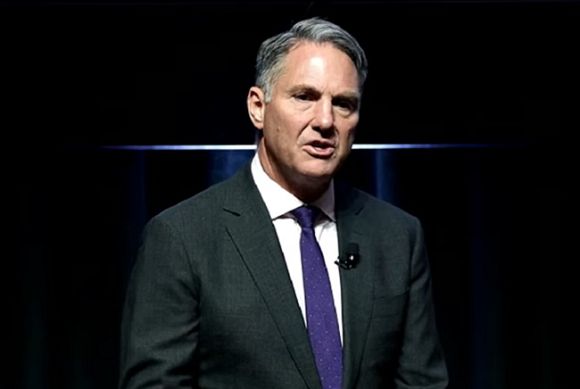
AUSTRALIA’S MINISTER for Defence, Richard Marles, is well pleased with his Washington visit and with his discussions with U.S. Secretary of War, Pete Hegseth.
Marles has stated that an ‘acceleration in force posture’ would be announced at the next meeting of Australian and U.S. defence ministers later this year.
What this means in reality was clearly spelled out in the official “readout” issued by the U.S. Department of War. This statement declared that the American military would ‘accelerate force posture initiatives at Australian bases’. It is currently in the process of expanding the number of troops and materiel permanently stationed in Australia.
We have become almost inured to the increasing level of integration of the two military forces, although what makes this announcement more disturbing is the manner in which both Hegseth and Marles enthused about an even greater coalescence of forces in what can only be seen as a massive military build-up.
Two questions hang in the air: Why and why now?

The answers are chillingly obvious. The U.S. has long been preparing the way for a potential war with China. Its “ducks” are very much in line. Our media, while reporting on the meeting, have hardly given any serious assessment of the danger implied.
There are connections between this clear build-up that seeks to confront China and the wars that are already underway in Ukraine and the Middle East.
NATO Secretary General Mark Rutte, speaking in relation to the war in Ukraine and the European and U.S. role in that war, recently stated that “we are not at war, but we are certainly not at peace, either”. Ambiguous, coy, or a veiled threat?
Many commentators say the world is at war and are calling it a world war. Former New Zealand Defence Minister Ron Mark has declared that “in my view, we’ve been in World War III for quite a long time now”.
No ambiguity here. Mark was using an interview to fan the flames of belligerency against the perceived “enemies” of peace, freedom and democracy: China, Russia, North Korea and Iran.
Others, while accepting that conflicts are underway across the globe and that the war in Ukraine and Iran are interconnected, don’t want to frighten the horses, arguing that it is a dangerous tactic to describe the situation as a word war.
Our media so often do us a disservice, or rather serve the State’s interests, which are not always the interests of the people. All too often, a fog of propaganda is presented as analysis. The wars that are underway are linked.
The USA – if it is to maintain military hegemony and, importantly, economic power in a world that sees U.S. power being challenged – behaves as all fading empires have behaved. This time around, the issues entwine with a global economic crisis, a need to expand market share, secure resources, keep rivals at bay and keep capitalism afloat.
In this light, the war in Ukraine can be seen as a war to secure, for the U.S. and Europe, the vast resources of Russia. This is not to suggest that Russia has not acted in a reactionary manner, but the fact of the matter is that the war has assumed a wider context than the early description of it as a “proxy” war.
The same motivations are at play in the U.S. war against Iran. Control of oil means control of the global economy. Iran was, after all, attacked. It has sought to defend itself.
The conflict in the Middle East has obvious implications for the looming conflict aimed at China. The USA and its allies are doing all in their power to weaken China. The potential oil crisis certainly suits the USA, as China is so obviously dependent on Middle East oil.
Wars inevitably have an economic background and motivation. The USA, as the world’s largest economy and military power, is seriously challenged by the rise of China and is prepared to drag the world into war to preserve its primacy.
This brings us back to the meeting between Hegseth and Marles and the obvious role that Australia is to play in the aggressive policies of America.
What the meeting described is a continuation of what has been developing.
U.S. naval personnel have already begun arriving in Western Australia for permanent deployment. The Albanese Government is spending $8 billion to expand the Stirling naval base, which will become one of America’s largest in the Indian Ocean.
The rotation of U.S. troops through the Northern Territory has grown to 2,500. Tindal Air Base is being upgraded for use by nuclear-capable U.S. aircraft. Fuel storage facilities are being expanded. The Labor Government is spending $14 billion on upgrading its northern bases.

The U.S. military is also making use of airbases in Queensland and in Western Australia, and storage facilities designed to support logistics and U.S. operations are being established in Victoria and across the entire continent.
It has been revealed that Pine Gap, which is pivotal to American war planning around the world, has undergone a significant expansion. Ten new satellite dishes and antennas have been added. The expansion links the U.S. and Australia even further, and makes Australia central to the war plans of the USA.
Marles spoke with unabashed enthusiasm of how the basing arrangements for the U.S. military had expanded continuously over the four years of the Labor Government’s rule. Reference has been made to this lethal work expanding further, but details remained, deliberately, obscure. Again, the media has not made much of this evasive behaviour.
The “readout” of the talks did, however, point to an acceleration of U.S.-led war games in this country. The existing “games” involving thousands of U.S. troops, the Talisman Sabre exercises involving over 35,000 troops from 19 countries, the exercises described as a rehearsal for war and what the Defence Department called a preparation for a ‘high-end warfighting environment’, are all bad enough. But no, there is always more, and this is what is captivating Marles and his U.S. counterpart.
Making Australia a fully integrated part of the U.S. war machine comes at a cost. Those costs can be counted in dollar terms. Hegseth, in the ‘readout’, ‘emphasised the need for capable allies to contribute to the collective defence and invest in their own sovereign security’. In a press conference, Marles let it be known that Labor had a “good story to tell... we now have defence spending at 2.8 per cent of GDP... by the NATO measure puts us ahead of most NATO countries”.
The actual cost, in the event of a U.S.-led and initiated war will be infinitely greater, but human lives are very much a secondary consideration in the cause of maintaining economic superiority.
The war against China might not yet be “real” in the sense that the armies of the U.S. and its allies are not engaged in open warfare, but the intentions and motivations are clear for all to see. A massive military build-up in the Indo-Pacific has been underway. This has directly targeted China. The United States has 750 military bases across 80 countries. It spends more on its military than the next ten biggest spenders combined.
The fears of those who believe that a third world war is effectively underway will not be assuaged by the behaviour of the USA, its NATO allies, its Israeli ally in the Middle East, or the actions of its loyal supports in the Indo-Pacific. The actions of Australia fit this tragic pattern.
To make matters even worse, we have the infamous words of Hegseth who pledged that America would not be hindered by “stupid rules of engagement”.
The mask has been stripped away. There is no “rules-based order”, no international law, only the rule of the powerful, the rule of capitalist power and its fight for survival; the rule of the jungle.
Dr William Briggs is a political economist. His special areas of interest lie in political theory and international political economy. He has been, variously, a teacher, journalist and political activist.
 This work is licensed under a Creative Commons Attribution-NonCommercial-NoDerivs 3.0 Australia License
Support independent journalism Subscribe to IA.