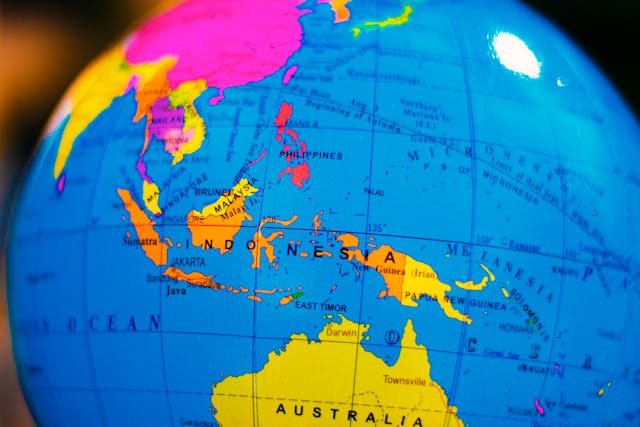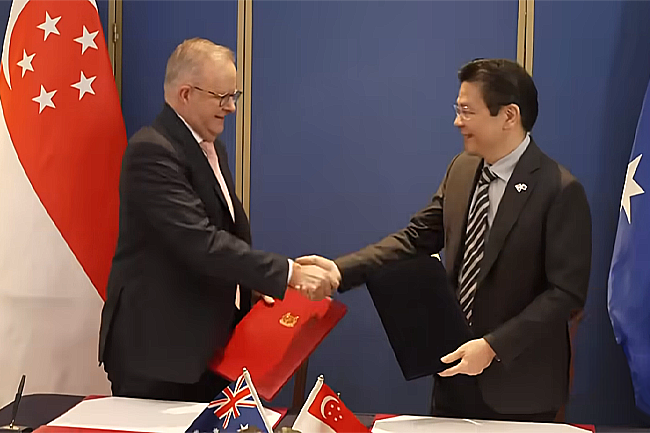
Richard Marles' warning that xenophobia weakens Australia's strategic relationships took on new significance after Pauline Hanson's call for a ‘monocultural’ Australia, writes Carl Gopalkrishnan.
DEFENCE MINISTER Richard Marles spent much of his address to the Defending Australia Summit on 2 June describing Australia’s expanding network of defence relationships across the Indo-Pacific.
Invoking former PM Paul Keating’s observation that Australia finds its security “in Asia, not from Asia”, the Defence Minister then offered a curious warning:
“The risk in articulating the narrative in this way is that it almost sounds inevitable. But of course, nothing could really be further from the truth.”
Marles went on to argue that “the countries of the Indo-Pacific keenly observe what we are doing here” and warned that those “who attempt to walk down the path of xenophobia” not only undermine Australia’s social cohesion but “fundamentally means that we are less safe”.
Some critics would later dismiss these remarks as identity politics. Yet coming at the end of a speech celebrating decades of cooperation and defence partnerships, they sounded less like a detour than a warning. Relationships, trust and reputation, Marles appeared to suggest, are capabilities, too.
Days later, Senator Pauline Hanson used the National Press Club to call for a “monocultural” Australia. In hindsight, the sequence reads rather differently. Perhaps Marles was not simply describing a new form of capability. Through the speech itself, he was almost war gaming it. He was reminding Defence insiders and the country more broadly that the relationships he had just spent 20 minutes celebrating should never be mistaken for something automatic.
And yet, Marles' words have hit a wall of silence that really needs to be pushed a little.
Having worked with multicultural communities on social cohesion, emergency response and recovery over the last decade, I have learned that long memories can be both a blessing and a curse. Communities shaped by war, migration and hardship become good at enduring. We lower the bar for anxiety and threat because memory has taught us to survive. We tell ourselves not to overreact until one day we discover that endurance and consent are not the same thing.
In much of the Indo-Pacific, long memories shaped by war, occupation and instability encourage people to think carefully about what is worth saying publicly and what is better managed quietly. Relationships continue, but silence should not be mistaken for consent.
Australia may suffer from the opposite problem. Decades of alliance memories and strategic reassurance can create an institutional complacency where Asia’s silence is often interpreted as consent.
That, implied Marles, goes against the trust and confidence Australia has built with countries across our region. Trust instead requires an ability to see the world through the eyes of others, and at times it “requires us to challenge decades-long, hardwired reflexes in our own institutions so that we can offer trust and receive trust in return, and what it requires is for us to offer respect”.

Marles' warning that nothing about Australia’s place in the region is inevitable deserves a second reading. What may appear reassuring to Australians can look very different to neighbours who have spent generations learning that relationships require constant care.
AUKUS should have reminded Australians of that distinction. Much of Asia did not see the agreement coming. There was criticism, analysis and private discussions rarely reported in Australia. Relationships continue, but that continuity should never be mistaken for consent to xenophobic White nationalism. In much of the region, people have long memories.
Three decades of Pauline Hanson and cyclical debates about Australian identity are viewed in much the same way. Australia’s current regional military and trade partnerships are no guarantee that our domestic debates are regarded with indifference, which raises a more interesting question. Are Australians once again confusing silence with consent?
Marles' warning about xenophobia was not directed at fringe extremists. Speaking at the Defending Australia Summit, he argued that Australia must “challenge decades-long, hardwired reflexes in our own institutions” before later warning against “people distinguishing between migrants and Australians”.
The irony was that a Defence Minister delivered this warning at the Defending Australia Summit, hosted by The Australian, to an audience of defence industry and media insiders. The people in that room were not outside Pauline Hanson’s monocultural Australia. They were inside it and they seemed to have entirely missed his point.
In defence language, capability simply means the ability to achieve things. Most Australians think of ships, missiles and personnel. Yet alliances, trust and relationships are capabilities, too. They take decades to build and moments to damage.

Perhaps after Senator Hanson’s National Press Club address, Marles’ own speech makes better sense. He wasn’t saying: “Be nice because multiculturalism is good.” He was saying: “Don’t damage capabilities.”
The irony is that many critics heard identity politics because they assumed capability only meant hardware. They heard the warning but missed what he was trying to protect.
Marles’ remarks about xenophobia deserve to be taken seriously. Multicultural capability, however, should also help Australia understand how AUKUS itself has landed across the region.
Jack Holland, Professor of Global Security Challenges at the University of Leeds, has pointed out that historical “Anglobal colour lines” within the AUKUS alliance are seen clearly in Asia, if rarely spoken about. Perhaps this also explains why Asia’s relative silence should not reassure Australians. In much of the Indo-Pacific, long memories make people carefully weigh up what is worth saying publicly and what is better managed privately.
Marles warned the summit that the countries of the Indo-Pacific keenly observe Australia and that nothing about our place in this region should be regarded as inevitable. Pauline Hanson’s speech did not invalidate that warning. It made it easier to understand. If he is right, the periodic rehabilitation of Pauline Hanson by sections of the media and political class is unlikely to be interpreted across the region as the constant care those relationships require.
Carl Gopalkrishnan is an Australian artist and policy practitioner with long-standing experience in multicultural policy, social cohesion and community engagement.
 This work is licensed under a Creative Commons Attribution-NonCommercial-NoDerivs 3.0 Australia License
Support independent journalism Subscribe to IA.