Defending Country and Defend Sacred Ground have different objectives, but they agree on the need for clarity in how the Australian War Memorial deals with frontier conflict in Australian history.
This forum has been organised with the agreement of the publishers of Independent Australia and Quadrant Online. The protagonists are each providing a 1,200-word article, a 600-word rejoinder, and a 100-word summing up.
Both publications provide for reader comment. Defending Country and Defending Sacred Ground thank Independent Australia and Quadrant Online.
Read the 1,200-word argument for including frontier conflict in the Australian War Memorial HERE (Defending Country) and the argument against inclusion HERE (Defend Sacred Ground).
The Defending Country rejoinder
Written by Dr David Stephens, member of the Defending Country Memorial Project campaigning for the Australian War Memorial to properly recognise and commemorate the Australian Frontier Wars.
Defending Country believes the Australian War Memorial Act 1980 should be amended to ensure that the Australian (Frontier) Wars are properly recognised and commemorated at the Memorial.
Our proposed amendments are shown below in context, with the new words in bold.
Section 3 of the Act: Interpretation
“Australian military history” means the history of:
(a) wars and warlike operations in which Australians have been on active service, including the events leading up to, and the aftermath of, such wars and warlike operations;
(b) wars and warlike operations within Australia and involving Indigenous Australians, including the events leading up to, and the aftermath of, such wars and warlike operations;
(c) the Defence Force.
Section 5 of the Act: Functions of Memorial
(1) The functions of the Memorial are:
(a) to maintain and develop the national memorial referred to in subsection 6(1) of the Australian War Memorial Act 1962 as a national memorial of Australians who have died:
(i) on or as a result of active service; or
(ii) as a result of any war or warlike operations in which Australians have been on active service; or
(iii) as a result of any war or warlike operations within Australia and involving Indigenous Australians.
Those amendments make clear that there is no difference between Australians sent overseas to fight and die defending Australia – their country – and, on the other hand, Indigenous Australians defending Country on Country. The common thread is “Defending Country”. (The changed definitions would also cover inter-tribal conflict.)
Comments on Defend Sacred Ground (DSG) paper
- DSG alleges “activists” have been pushing the Memorial Council to act unlawfully by redefining frontier conflict as “war” to bring it within the Memorial’s ambit. In fact, the definition in the Act is ‘wars and warlike operations’ and the Council’s approach is supported by a 2013 legal opinion. DSG provides no evidence that the Council has been influenced improperly or by stealth. The Council has acted on its own initiative. Any proper influence by Defending Country has been reported over the past three years on our website. DSG has not kept up.
- DSG forgets that settlers, governments and contemporary commentators used the term “war” and that the Indigenous side often employed classic guerrilla warfare. Not all wars look like Gallipoli or Kokoda.
- DSG’s claim that only 11 British soldiers were killed in the contest for Australia forgets that civilian settlers and Native Mounted Police carried much of the fight against First Nations people – who were fighting for survival – and suffered most of the casualties.
- DSG says the Memorial was ‘never intended to note the violence of “some Australians against other Australians”’. But the charters of cultural institutions are not set in stone; they change as new evidence emerges and the society confronts its history. Nothing Defending Country advocates detracts from the Memorial’s commemorative function. Indeed, acknowledging the Australian Wars makes the Memorial more meaningful, as it helps us come to terms with all of our history. That is not inflicting guilt, but nurturing honesty.
- The DSG claim that many regions of Australia saw little or no violence is disproved by the Australian Wars and Resistance website, which shows 40 areas of violence between colonists and First Nations people, in every State and Territory and leading to tens of thousands of deaths. (Precision is impossible: Aboriginal dead were uncounted and unburied.)
Defending Country’s approach is inclusive, finding the common element between service in uniform and First Nations fighters: they were all Defending Country. The DSG approach is exclusive, linking commemorative entitlement to uniformed service. What is DSG afraid of?
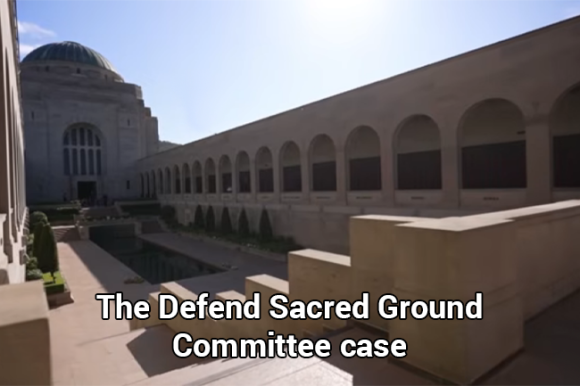
The Defending Sacred Ground rejoinder
Written by members of the Defend Sacred Ground Committee, Roger Karge and Peter O'Brien Lt Col (Rtd).
The essay submitted by Peter Stanley in this Forum is remarkable not for what it contains, but rather for what Stanley omits.
He begins with a journey around the Memorial to show all is well — experts such as himself, as Principal Historian, have everything in hand. The public and veterans need not fear the impending changes as the Council ‘embrace[s] a much wider ambit’ to include ‘conflict far beyond the initial purpose’.
But where is Stanley’s concern for the Memorial’s primary aim as a sacred shrine of remembrance for 103,140 Australians, whose lives were sacrificed in defending our country in war?
Sure, he mentions in passing that ‘honour and pride’ are ‘part of the Memorial’s purpose... but they surely do not define it’. Says who? Stanley and the activists?
Stanley’s omissions are glaring. At no point does he use the words “sacred”, “sacrifice”, “soul”, “ultimate”, “price”, “remembrance”, nor “legacy”. The higher emotions these words release are of little concern to Stanley, not even in respect to the Aboriginal warriors he wants within the Memorial.
How would Stanley presume to depict the “sacredness” of their “sacrifice”? Did Aboriginal people consider killing another human and being killed oneself, in the same way as we do today? Why didn’t they erect memorials for their own dead, killed during inter-tribal “wars”, the original “Australian Wars”? Is it ethically appropriate to sanctify ground in Canberra for Noongar warriors killed on their own Country, 200 years ago and some 4,000 km away?
Indeed, do the activists even have the authority to speak of such matters, to identify these warriors by name, without being accused of a severe breach of protocol or cultural appropriation?
But these omissions are of little concern to Stanley. Instead, his polemic focuses unabashedly on redefining “conflict” to mean “war” so as to bring frontier conflict within the remit of the Act. He relies on “research” from compliant historians that allows him to claim that ‘conflict had resulted in anything between 20,000 and 100,000 deaths. 99 per cent Indigenous’. He then adds the disclaimer, ‘Precision is impossible: Aboriginal dead were uncounted and unburied’.
This is an extraordinary statement from a scholar and proves our point that the very sanctity of the Memorial is being ignored. The “research” is so flimsy and lacking “precision” that the death toll could be 20,000, or it could be 100,000. Or maybe it was zero? Who knows, and do the activists even really care? With this uncaring statement, Stanley comes across as an ideologue for the cause, consumed by a crusade where the death of one man is, indeed, a terrible thing, but 100,000 deaths are just a statistic to be used for political gain.
But Australians can see what is going on here. It’s the Voice 2.0: profound, irreversible changes by stealth at a major institution with no public say in the matter.
Look who are the patrons of Stanley’s campaign, Defending Country. They include the usual suspects from the failed Voice Referendum: historian Clare Wright, organiser of 350 historians for the Yes campaign; Megan Davis, lead campaigner for the Voice YES case; Thomas Mayo, Yes23 campaigner and presenter at the SEARCH Foundation, the former Communist Party of Australia; Larissa Behrendt, who tells her listeners she only has “whitefellas” on her ABC radio program “when they are true allies” and Pro-Palestine advocate Anita Heiss.
Nevertheless, we agree with Stanley’s call that ‘the AWM Act needs to be clarified’.
Sign our petition and we will ensure the Minister amends the Act, one way or the other, to provide legal clarity and stop the Council’s unlawful proposals.
Read the 1,200-word arguments below:
The Defending Country initial 1,200-word case for including frontier conflict in the Australian War Memorial HERE:
Read the Defend Sacred Ground initial 1,200-word case against including frontier conflict in the Australian War Memorial HERE:
 This work is licensed under a Creative Commons Attribution-NonCommercial-NoDerivs 3.0 Australia License
Support independent journalism Subscribe to IA.