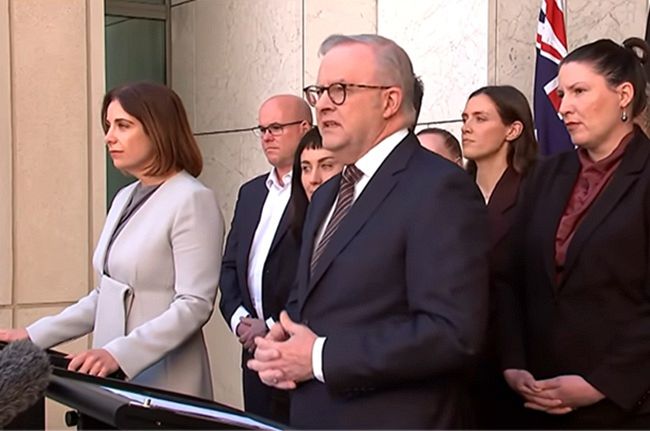
Governments should not decide which political opinions are acceptable. However, freedom of expression does not give corporations an unrestricted right to manipulate attention and amplify division for profit, writes Paul Budde.
AUSTRALIA'S PROPOSED DIGITAL DUTY OF CARE could become the next important step in making global technology platforms accept responsibility for the environments they create.
The exposure draft of the Online Safety Amendment (Digital Duty of Care) Bill 2026 would require online services to identify foreseeable risks and take reasonable steps to provide Australians with a safe online environment.
This shifts responsibility towards the companies designing the technology. That is where it belongs.
Manufacturers of cars, medicines and children’s toys must consider safety before their products reach the public. Digital platforms, despite influencing behaviour, mental health and access to information, have largely escaped comparable responsibilities.

An argument dating back to 2001
The principle of user control is not new to me. In a 2001 submission to the Productivity Commission, I argued that the emerging broadband economy should include permission-based marketing.
Users – not network operators, advertisers or algorithms – should determine how their personal information and participation could be used. Advertising should be based on an informed exchange rather than invisible extraction.
I repeated this argument in subsequent BuddeComm reports on broadband, mobile services, digital media and privacy, and more recently in opinion pieces about social media and platform power.
Unfortunately, permission-based systems lost out to a far more profitable model built around extracting personal data and maximising attention. The platforms’ algorithms now decide much of what users see, promoting the material most likely to keep them engaged.
This is not merely a privacy issue. Children and vulnerable people can be repeatedly directed towards eating-disorder material, self-harm, misogyny, dangerous behaviour and extremist ideas.
As I argued in Meta pays billions, but its addictive business model survives; parents and young people cannot carry this responsibility alone. Safer design must be built into the platforms.
Building on the under-16 initiative
Australia has already shown that a middle power can influence the international debate.
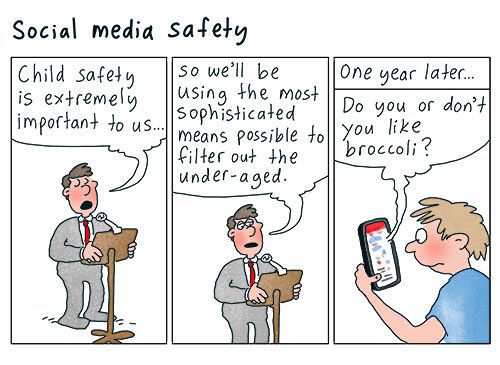
It was the first country to prohibit children under-16 from holding accounts on major social-media platforms. The initial results have been mixed. Platforms removed or restricted millions of accounts, but many teenagers continued using social media or circumvented the controls.
As I wrote in Australia’s social media ban offers lessons for the Netherlands, this does not mean the policy failed.
The ban changed expectations, supported parents and schools, and forced platforms to respond. It also encouraged other countries to act. France, Britain, Denmark, New Zealand and others are now considering or developing their own approaches, each learning from and refining the Australian experiment.
The Digital Duty of Care could have a similar influence.
The government’s My Feed, My Way proposal would allow Australians over-16 to choose between algorithmic recommendations and content from accounts they have selected themselves.
This is a welcome return to the permission-based principle. However, having read the exposure draft, I believe that right needs to be stated more clearly. The bill currently allows the Minister to prescribe future “user empowerment tools”, but does not itself guarantee a chronological or follower-only feed.
That guarantee should appear in the final legislation.

Middle powers acting together
Australia cannot reform the global digital economy alone. Progress will require middle powers and regional blocs to compare results and develop compatible safety principles.
Australia, Canada, New Zealand, Britain, European countries and like-minded Asian democracies may not adopt identical laws. Collectively, however, they represent markets that even the largest platforms cannot ignore.
The technology companies will resist because reducing algorithmic engagement, behavioural profiling and addictive design threatens their business models.
Pressure will also come from Washington. The Trump Administration has warned against overseas regulations and penalties affecting American technology companies. It is therefore encouraging that Prime Minister Anthony Albanese has said Australia will determine its policies according to the national interest.
This is not anti-Americanism. Foreign companies operating in Australia must comply with Australian safety and consumer laws. Digital corporations should be no exception.
The stakes extend beyond protecting children. As I discussed in Democratic promise to algorithmic power: How social media reshaped truth, systems rewarding outrage and division are damaging the shared informational foundations of democracy.
Governments should not decide which political opinions are acceptable. However, freedom of expression does not give corporations an unrestricted right to manipulate attention and amplify division for profit.
Australia’s under-16 initiative did not solve online harm, but it changed the international conversation. The Digital Duty of Care can build on that leadership by establishing a vital principle: companies that design our digital environment must accept responsibility for its foreseeable consequences.
Paul Budde is an IA columnist and managing director of independent telecommunications research and consultancy, Paul Budde Consulting. You can follow Paul on Twitter @PaulBudde.
 This work is licensed under a Creative Commons Attribution-NonCommercial-NoDerivs 3.0 Australia License
Support independent journalism Subscribe to IA.