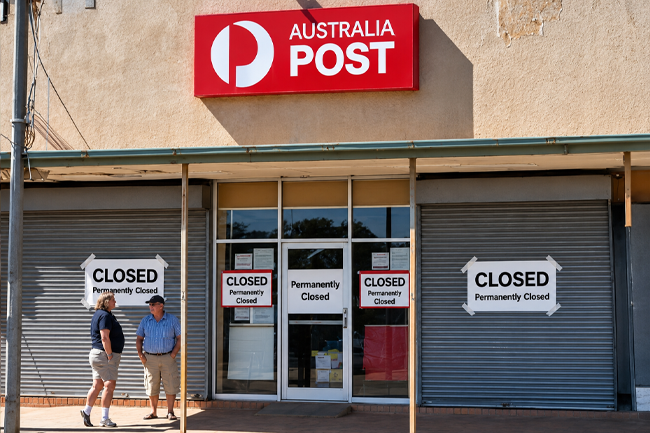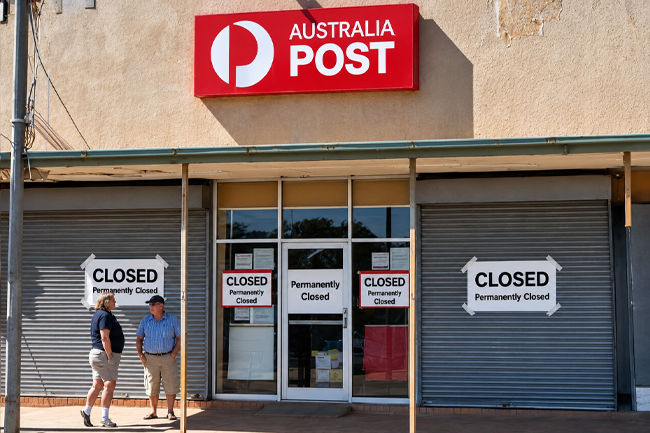
With Australia Post suddenly saying it won’t scale back its smaller outlets (LPOs) in major cities, attention has turned to its plans for regional Australia, which “can’t afford to lose them”. Andrew Gardiner reports.
IN A CLEAR CASE of damage control, Australia Post (AusPost) has walked away from leaked plans to buy back and close up to 36 small suburban outlets in Sydney and Melbourne.
The news, revealed late last month, came just three days after CEO Paul Graham announced his retirement from next June, having come under fire for not revealing the plan in Senate Estimates.
By backing away from its Major Cities Trial of LPO buy-backs, AusPost has backflipped on earlier assertions – made as recently as July – that it wanted to address what it called a ‘clear oversupply’ in the suburbs and to leave regional LPOs alone. ‘It’s like suffering whiplash. What’s their position going to be next week?’ one LPO operator asked.
The controversy has triggered two separate parliamentary inquiries into AusPost’s true agenda on LPO closures. The probes, held separately in the Senate and House of Representatives, will get to the bottom of AusPost’s broad plans to move towards parcel delivery and away from personal service, including the most important question: “Where will the hammer fall?”
Until they get an answer to that question, LPO operators have taken a “watch what they do, not what they say” approach to AusPost. They note the pressure smaller, struggling regional LPO operators are coming under to abandon their permanent licenses in favour of finite contracts full of fine print — a prelude, they fear, to LPOs giving way to scaled-back services at pharmacies, newsagents and parcel lockers.
AusPost is dangling financial incentives for struggling operators to surrender their permanent licenses, a move that LPO chair Scott Etherington compares to offering a glass of water – with strings attached – to a man dying of thirst. “When I walk up to [that man] and I say, ‘It’s completely up to you whether you choose to take this glass of water,’ most people would say that’s not really a voluntary choice,” he told a Senate committee in September.
But for every carrot, there’s a stick. At last count, AusPost has installed 1,510 parcel lockers across Australia, many of them on pavements in front of LPOs. These lockers bring $1.22 per processed item for operators, around half the $2.40 they get for a parcel stored on-premises, adding to financial pressure from a shrinking revenue base AusPost has done little to address.
Those who take the “carrot” are often left with diminishing yearly returns after AusPost withdrew more than 70 of the services LPOs could offer (including lucrative Western Union payments) over the past 18 months. What’s more, AusPost has the right to shut down LPOs by terminating these contracts, with just 90 days’ notice.
‘The contracts are loaded against the operator and make LPOs in small towns unfeasible,’ one operator said. ‘In some cases, they’re just waiting for licence holders to retire or walk away before shutting that LPO down.’
Locals in vulnerable, small or remote towns often rely exclusively on LPOs for basic services like banking, bill paying, ID checking or passports. Residents of Camooweal (Queensland) or Carnamah (WA) might have to travel more than 150 kilometres to complete such basic tasks should local LPOs close down and their services aren’t offered elsewhere.
‘It’s going to be a death knell for some of these places,’ one operator said.
Licence-holders and local MPs say there are major problems with replacing LPOs with community postal agencies at places like the local chemist or newsagent. It’s happened already in several country towns, and – with a few exceptions – those businesses haven’t been allowed to offer banking, passports and the like (with no apparent plans for them to do so).
AusPost’s annual report for 2024-25 openly admits it is ‘trialling a new access model for customers in consultation with the Pharmacy Guild of Australia’ and just as clearly states there were no plans to transfer services such as Bank@Post to chemists or other local businesses. If an LPO shuts down, there could be no alternatives in small towns whose local banks closed years ago.
Etherington, the Gulgong (NSW) LPO operator, said:
‘AusPost wants to be in parcel delivery, not service delivery, which is what small communities need.’
Mallee (Vic) MP Anne Webster pointed out:
“It's really important for people to be able to connect [and access these services] at the local post office... [but pharmacies] don't have banking and bill paying capability.”
The seeming lack of contingency planning around AusPost’s retreat from the bush should be a hot topic during public hearings at the aforementioned parliamentary inquiries into Australia’s postal services.
Submissions for the House of Representatives inquiry close on Monday 7 December.
AusPost, a Government Business Enterprise with a mandate for profit, has come to the conclusion that letters and stamps (not to mention banking, passports and ID checks) don’t help its bottom line.
‘They want to deliver parcels – which they see as the big money maker – and will handle envelopes if they must,’ one source said.
To that end, unmanned send/receive kiosks and, perhaps, a chemist or newsagent with scaled-back services now qualify as “24/7 Post Offices”, AusPost says, making it ‘easier for Australians to do the things they need to do’. People from small towns without banking or bill-paying facilities may beg to differ.
When it walked away from its plans for suburban LPOs, AusPost abandoned a concept which made some sense: reduce the glut of LPOs in suburbs ‘where there are more than 70 post offices within 7.5km, all competing with each other’.
‘The leak (of AusPost’s blueprint) forced them into some silly decisions; it’s policy on the run,’ one source explains.
So, instead of purchasing and closing LPOs in places like Ascot Vale in Melbourne’s inner north west (where locals have more than 100 options to do their banking and 30 places to get a passport), critics say AusPost is putting the squeeze on LPO operators in small towns which have an LPO and very little else. ‘That makes no sense whatsoever,’ one LPO operator said.
Some 87 LPOs were permanently closed from January 2024 to March this year. Their operators (who covered the cost of premises, equipment, AusPost décor, working capital and sometimes the licence itself) were often forced into retirement or onto the vocational scrap heap.
Meanwhile, the small towns many of them served face a viability crisis of their own if locals can’t access basic facilities like banking. OECD research shows that towns losing such services will likely go into a cycle of economic and population decline.
Australia, already the eighth most urbanised country on Earth, can scarcely afford a further drift of people away from the regions that the loss of such services brings.
Critics say Canberra has stood by and allowed AusPost to do its thing, cutting back on services LPOs have provided for 35 years as it transitions to parcel delivery, usually the province of private enterprise. With not one but two parliamentary inquiries now underway, that may soon change.
Andrew Gardiner is an Adelaide-based graduate in Media Studies, with a Masters in Social Policy.
 This work is licensed under a Creative Commons Attribution-NonCommercial-NoDerivs 3.0 Australia License
Support independent journalism Subscribe to IA.