
Meta will pay up to US$18 billion (AU$25.5 billion) to settle American legal claims that Facebook and Instagram harmed children and contributed to social media addiction.
In previous articles, I have argued that Australia’s social-media ban for children under 16, while imperfect, was an essential first step. It challenged the assumption that protecting children was primarily the responsibility of parents and that the platforms themselves did not need to change.
However, age restrictions alone will not solve the problem. Governments must ultimately force social media companies to change the addictive design of their platforms. The Meta settlement is the logical next development in this process, although it still falls short of fundamental reform.
Treating the damage, not the cause
The settlement will direct billions of dollars to American states for youth mental health services, education programs and other measures addressing unhealthy social media use.
These services are necessary, but compensation treats the consequences rather than the cause. If social media platforms continue exposing young people to products designed to maximise engagement, the damage will continue, and even more money will be required for counselling, treatment and public health programs.

We risk creating a system in which the platforms continue generating enormous profits from addictive products while governments use settlement money to repair some of the damage.
The underlying problem is the design of the platforms and their algorithms. They are engineered to keep people scrolling, watching and reacting because attention generates advertising revenue. Unless that commercial mechanism changes, the problem will continue.
A meaningful but incomplete start
The settlement nevertheless includes important reforms.
Subject to court approval, Meta will introduce a two-hour daily limit across Facebook and Instagram for American users aged 13 to 17. It will restrict overnight access, disable notifications during school hours, hide like counts, strengthen age verification and reduce exposure to harmful content. An independent auditor will monitor compliance.
Teenagers will also be offered a chronological, non-personalised feed, while parents using Meta’s supervision system can make this the default.
These are meaningful steps because Meta is accepting that platform design – not simply the behaviour of children and parents – is a legitimate area for government intervention.
However, personalised algorithmic feeds are not prohibited. Teenagers or their parents will generally have to select the safer option.
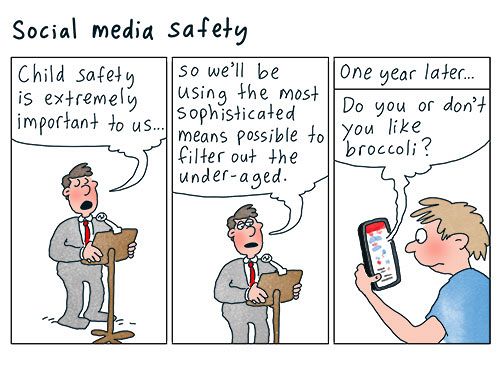
This is where the settlement falls short. Addicted people do not normally volunteer to restrict access to the product to which they are addicted. They often find ways around restrictions. It is unrealistic to expect teenagers to disable an algorithm specifically designed to retain their attention.
Lasting protection requires safer design to be built into platforms by default.
The issue is larger than child safety
As I have argued before, this extends beyond children’s mental health.
The same algorithms that encourage compulsive use also shape the information people receive. They reward emotional reaction and rapid engagement over reflection, accuracy and expertise.
Algorithmic feedback loops create competing versions of reality. Targeted messaging and disinformation allow visibility and virality to compete with institutional credibility, damaging the informational foundations of democracy.
Social media offered enormous democratic potential by enabling people to communicate and participate directly in public debate. But commercial incentives and political manipulation have created systems that also amplify division, misinformation and extremism.
The platforms make more money when people remain emotionally engaged. Whether that engagement strengthens or damages society is secondary to their business model.

Building international pressure
Australia’s under-16 ban has been criticised over its enforceability and the likelihood that teenagers will circumvent it. Some criticism is justified. No single national initiative can solve a problem involving enormously powerful global platforms.
Nevertheless, Australia helped set off a chain of international responses. Other countries are following or considering similar action, while governments are paying greater attention to addictive design and corporate responsibility.
The American settlement adds another important element. Legally, it applies only in the United States and creates no binding precedent elsewhere. Politically, however, Meta has accepted that governments can impose time limits, restrict engagement features, require independent auditing and demand billions to address social harm.
The European Union could now play a particularly important role. It has been the strongest major jurisdiction in challenging the uncontrolled power of digital platforms. Hopefully, it will go further by regulating the algorithms and commercial incentives causing the harm.
Neither Australia’s ban nor the American settlement is sufficient. But both add to the growing international pressure on social media companies.
The ultimate objective must remain clear: these platforms must be redesigned to serve people and society, rather than exploiting human vulnerability to maximise profits.
Paul Budde is an IA columnist and managing director of independent telecommunications research and consultancy, Paul Budde Consulting. You can follow Paul on Twitter @PaulBudde.
 This work is licensed under a Creative Commons Attribution-NonCommercial-NoDerivs 3.0 Australia License
Support independent journalism Subscribe to IA.


Related Articles
- 'Careless People' and Meta's unprincipled corporate dominance
- Meta and X abandon fact-checking: a further blow to democratic values
- Big band, big news: Metallica set to rock Oz in 2025
- New Music Through Old Ears 22: Elton Mules for Metallica