The Farrer by-election has exposed the cracks in Australia's two-party system and revived the case for electoral reform, writes Dr Klaas Woldring.
THE DRAMATIC RESULT of the recent Farrer By-election suggests that the two-party system in Australia is in deep trouble.
It is the consequence of the single-member district electoral system. That is why earlier similar developments in New Zealand are worthy of examination.
These developments started with questioning their electoral system during the 1980s, which was undertaken very professionally by a Royal Commission. It produced an exceptionally comprehensive Report on the electoral system: ‘Towards a better Democracy?’ in December 1986. This resulted in major changes being made during the 1990s in both parliamentary and local government electoral systems.
Nationally, a mixed-member proportional system was introduced in 1996 after a referendum held in 1993, referred to as the mixed-member proportional system.
New Zealanders voted to adopt the MMP system, a form of proportional representation combining the original single-member electorates with proportional representation. This compromise led to an increase in minor parties entering parliament, making multi-party governments the norm.
This unusual combination resulted in a proportional system that ended the former two-party system and created more diverse representation in the national parliament. It looks like a compromise that may have been agreed to in order to facilitate the passing of the referendum. The reality is that the system is essentially proportional.
In 2011, a further referendum was held, which confirmed that the people wanted to keep the new system rather than continue with a “first-past-the-post” system, based on single-member districts.
The result has been a type of proportional system in which each voter has two votes. One is for the overall political party, the other for the electoral district. The party vote is what ultimately decides the number of seats each party gains in parliament, with any shortfall between the number of electorates won and the party's overall percentage of the party vote made up by list party members elected.
It was the Labour Party that adopted this policy to seriously consider introducing proportional representation. While changes resultant from this were delayed, the undercurrent of support for electoral reform continued and was bolstered by the commissioning of the Royal Commission in 1985, which ultimately recommended the change to MMP.
We have now reached a situation in Australia that demonstrates the problems of the single-district electoral system as never before. The recent Farrar by-election presents a new situation that raises the issue of renewal of the electoral system. The questionable so-called two-party system, claimed to be associated with effective government, clearly no longer exists, nor is it likely that it can be restored.
Apart from the large number of Independents, we now also have at least three Opposition parties. Then we have an ALP Government that gained a primary vote of 34.6 per cent, which translated into 94 seats in Parliament or 64 per cent of the total 150 seats available. The ALP claims that it strives for fair and democratic representation. That is clearly not what this is.
What is the ALP going to do about it? It has never raised this issue in the Joint Standing Committee on Electoral Matters at the end of a federal general election. That may be in its own interest, but is it in the country’s interest?
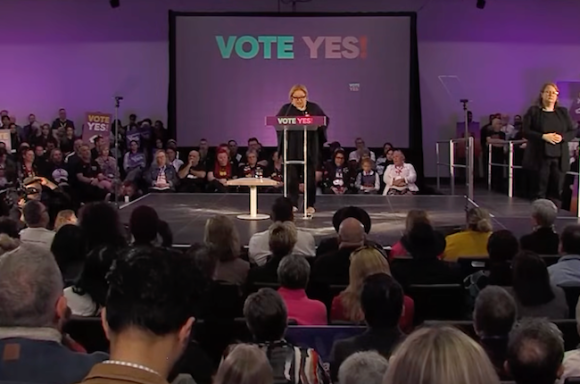
It may have been seen as more or less impossible for the One Nation party to win Farrer. Strong support existed for a quite competent woman, an independent candidate even, supported financially by the progressive political organisation GetUp!, but to no avail.
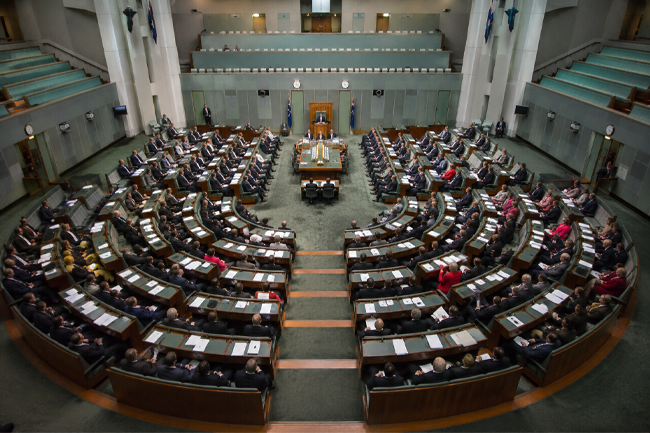
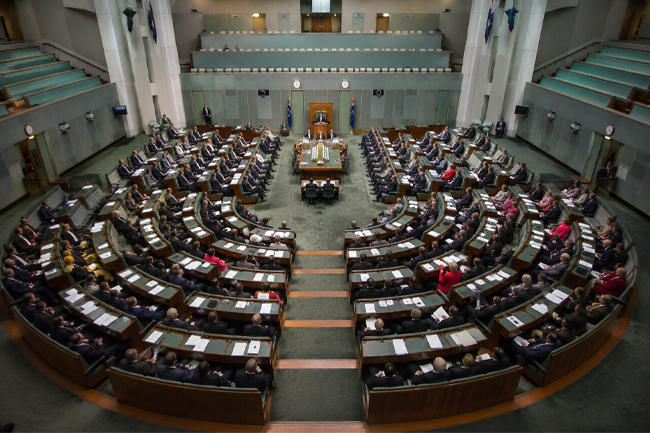
The two-party system continues in the Australian House of Representatives with the usual polarised, oppositionist commentary. The major parties are seated opposite to facilitate this mostly negative debate that Australia surely can do without.
Even in the UK and the U.S., campaigns are underway to end this essentially Westminster heritage. All campaigns are concentrated on the policies of the major parties. In elections, voters are required to choose between the two. The system makes it very difficult and costly to start a new party. This situation surely can be changed, as the people of New Zealand decided to do – and did – in the 1990s.
We are now in a situation where an extreme right party, such as One Nation, could be in government nationally based on one-third of the primary vote. That may seem unlikely now, but it is not impossible. Is it not high time that we see debates in the media on this issue? Thus far, I have seen nothing of the sort.
Only quite recently, I watched a three-week program on the electoral system in Australia on the ABC, which claimed that Australia had an excellent electoral system. In 2003/4 there was a serious federal inquiry into why the 1999 Republic Referendum had failed. The outcome was: Lack of education at all levels of the educational system, from high school to university, and by the media.
Has anything been done about that? No, to the contrary, really.
So, it is not so surprising that the Prime Minister decided last year that there would be no more referendums. Surely, this is not the solution. But even more importantly, which party will adopt a policy to change the electoral system? An inquiry, such as the one in New Zealand 40 years ago, is long overdue.
Dr Klaas Woldring is a former associate professor at Southern Cross University and former convenor of ABC Friends (Central Coast).
 This work is licensed under a Creative Commons Attribution-NonCommercial-NoDerivs 3.0 Australia License
Support independent journalism Subscribe to IA.